
How does a pool builder work out average project value and profit?

- How do I calculate my average pool contract value and gross profit per pool?
- Why do average project value and profit matter for marketing?
- Step 1: Which jobs should I include?
- Step 2: How do I work out average project value?
- Step 3: Which costs come off to get gross profit per pool?
- How do I get real job costs instead of guesses?
- Step 4: Should I average profit or margin?
- Step 5: How many pools cover my overhead?
- Should I work out separate numbers for remodels and each pool type?
- How do these numbers set a marketing budget?
- What mistakes throw the numbers off?
- What's different about project value and profit for pool builders
- A worked example: one season of pools
- Frequently asked questions
- Key takeaways
- More in this section
- Sources
The short version
- Average project value = total final contract value / pools completed.
- Gross profit per pool = final contract value - direct build costs.
- Use actual costs from completed jobs, not bid-time estimates.
- Split new builds, remodels and pool types; blended numbers mislead.
For pool builders who want two honest numbers from last season’s jobs before they set a marketing budget, judge a lead source or raise prices.
Get a free visibility audit · Book a growth call
How do I calculate my average pool contract value and gross profit per pool?
Add up the final contract value of every pool you completed over the last full season, including change orders, and divide by the number of pools: that’s your average project value. Then, for each pool, subtract the direct costs of building it (materials, crew labor, subcontractors, permits and equipment rental) to get gross profit per pool, and average those. Work the numbers out separately for new builds, remodels and each pool type, because one blended average hides the jobs that actually make you money.
These two numbers sit under every budget decision we make with a pool builder, because marketing is paid from gross profit, not revenue. We know the back office side first-hand: we were an equity partner in a pool construction company, where we streamlined back-office operations, built the lead-generation engine and ran sales and marketing, and that business did $2M+ revenue in year one. Every one of our packages includes monthly reports with a cost-per-lead breakdown, so you can set cost per lead against what a pool leaves you. See how it fits on our pool builder marketing page, or browse more pool builder marketing questions.
Why do average project value and profit matter for marketing?
Because every marketing question a pool builder asks comes back to them. How much can I pay for a lead? Is this channel worth it? How many pools do I need to sign this year? None of those has an answer until you know what an average pool brings in and what it leaves you after it’s built.
Most owners know their contract prices well. Fewer know their real profit per pool, because costs come in over weeks from a dozen suppliers and subs, and change orders shift the total. That gap is where marketing decisions go wrong: an owner who thinks each pool leaves more than it does will happily overpay for leads.
Once you have these numbers, the next steps are working out what a lead is worth and what a good cost per signed pool contract is.
Step 1: Which jobs should I include?
Use completed pools from your last full season, so every job has its final costs in. A pool that’s still being built will understate costs, and one that signed but hasn’t started tells you nothing about profit yet.
- Include: every pool you finished, including the ones that ran over, went badly or had a difficult homeowner. They’re part of your real average.
- Keep separate: remodels, resurfacing, equipment-only jobs and service work. Each is a different business with different numbers.
- Set aside, with a note: a true one-off, like a pool for a family member at cost. Leave it out, but write down why.
If you only did a handful of pools, use two seasons. A small sample with one huge custom build or one disaster job can make the average say something that isn’t true.
Step 2: How do I work out average project value?
Add up the final contract value of every pool in your list and divide by the number of pools. Final means after change orders, upgrades and any discounts, not the number on the first proposal.
Change orders matter more in pools than most trades. A homeowner who signs for a basic pool and adds a spa, a sun shelf, lighting and an automation system during the build can end up well above the original contract. If you average the signed prices instead of the final ones, your average project value will look lower than what you actually collected.
Leave out sales tax and anything you collect on behalf of someone else. Financing fees from a lender, if the homeowner pays them, aren’t your revenue either.
Step 3: Which costs come off to get gross profit per pool?
Gross profit is what’s left after the costs that come with building that specific pool. BDC’s definition of gross profit margin puts it as net sales minus direct expenses, or cost of goods sold, divided by net sales and multiplied by 100%. For a pool, direct costs usually include:
- Materials: steel, shotcrete or the fiberglass shell, plumbing, equipment, tile, coping, plaster or finish.
- Crew labor: hours on that job at what each person costs you, including payroll taxes and benefits.
- Subcontractors: excavation, electrical, gas, decking, fencing.
- Permits, engineering, inspections, dumping and haul-off.
- Equipment rental for that job, and sales commission if you pay one per pool.
Office rent, office staff, insurance, trucks you’d own anyway and marketing stay out. They’re overhead, and they come in at Step 5.
Curious what your marketing is actually booking?
Get a free visibility audit — no obligation, no sales pitch.
How do I get real job costs instead of guesses?
Track costs against each job as they happen, not at year end. Job costing tools in field software do this for you. Jobber’s job costing works out job profitability from timesheets, line item costs and expenses logged on the job, and shows a profit margin of profit divided by revenue. It also warns that the job profit can be inaccurate if the same cost is counted twice, for example once on a line item and again on a timesheet.
Housecall Pro’s job costing reports define gross profit as job revenue minus labor, material, commission and miscellaneous costs, and profit margin as gross profit divided by job revenue, across jobs you can filter and compare.
Whatever you use, the habit is the same: every supplier invoice and every crew hour gets tagged to a job. If you’re starting from spreadsheets, pull last season’s invoices by job address and rebuild it once. It’s a long afternoon, but it’s the most useful one you’ll spend on marketing all year.
Step 4: Should I average profit or margin?
Work out both, then use dollars for marketing decisions. Gross profit per pool in dollars is what pays for leads and overhead. Margin as a percent is useful for spotting problems: if one pool type or one crew consistently runs a lower margin, that’s worth knowing.
Average the dollars the simple way: total gross profit across all pools divided by the number of pools. Don’t average the percentages, because a small pool at a high margin and a big pool at a low one will give you a figure that doesn’t match the money in the bank.
Also look at the spread, not just the average. If most pools land close together, the average is a good planning number. If they’re all over the place, find out why before you build a budget on it.
Step 5: How many pools cover my overhead?
This is where profit per pool turns into a business decision. The SBA’s break-even point calculator divides fixed costs, which don’t change with sales or volume, by price minus variable costs per unit. For a pool builder, that’s annual overhead divided by gross profit per pool.
The answer is the number of pools you have to build before the business makes anything. Every pool after that is where real profit comes from, and it’s often the work that marketing has to bring in. That’s why knowing this number makes the marketing budget conversation easier: you can see exactly how many extra pools it has to produce to pay for itself.
To turn a revenue goal into a pool count and a lead target, see how many leads a pool builder needs to hit a revenue goal.
Should I work out separate numbers for remodels and each pool type?
Yes. A custom gunite build, a fiberglass install, a remodel and a resurfacing job each have their own price range, their own margin and often their own sales process. A blended average across all of them describes none of them.
Separate numbers answer questions a single average can’t. Maybe remodels leave less per job but sign faster and fill gaps in the schedule. Maybe fiberglass installs leave a steady margin with fewer surprises. Maybe custom builds leave the most per job but run over more often. Each of those points your marketing somewhere different.
How to budget for new pools versus remodels uses these split numbers to divide the marketing budget.
How do these numbers set a marketing budget?
Three ways:
- A ceiling on cost per contract. What you spend on marketing to win one pool has to sit well below gross profit per pool, with room left for overhead and profit. How much you can afford to spend to win one pool customer sets that ceiling step by step.
- What a lead is worth. Gross profit per pool times the share of leads that sign gives you the most a lead can cost before it loses money.
- A share of revenue as a sanity check. Total marketing spend against total revenue, compared year to year.
The share-of-revenue view is covered in what share of revenue a pool builder should put into marketing. Use it as a check, not the main method; the per-pool math tells you more about whether a channel is paying.
What mistakes throw the numbers off?
- Using signed prices instead of final contract values. Change orders go in.
- Using bid-time cost estimates. Use what the job actually cost.
- Leaving out your own labor. If you run a crew or the excavator yourself, put a fair cost on those hours, or your profit per pool is overstated.
- Putting overhead in the job costs, or leaving job costs in overhead. Pick one rule and stick to it.
- Including unfinished jobs, which look more profitable than they’ll end up.
- Never updating. Material prices, crew wages and your pricing change. Rerun the numbers at the end of each season and whenever you change prices.
Not sure which of these is costing you jobs?
A free visibility audit checks the Google profile, reviews, site and tracking, and shows what to fix first.
What's different about project value and profit for pool builders
Change orders move the total. Pool buyers add features during the build more than most customers. Final contract value is often well above the signed price.
Site surprises move the cost. Rock, poor soil, groundwater, access problems and permit delays can change what a pool costs to build. They belong in the average, because they’ll happen again.
Few jobs, big numbers. A pool builder completes far fewer jobs than a service company. One bad job shifts the average a lot, so use a full season, or two.
Mixed work. New builds, remodels, resurfacing and service can live in the same company with very different economics. Keep them apart in the numbers.
A worked example: one season of pools
This builder is made up to show the math, not a benchmark for your market.
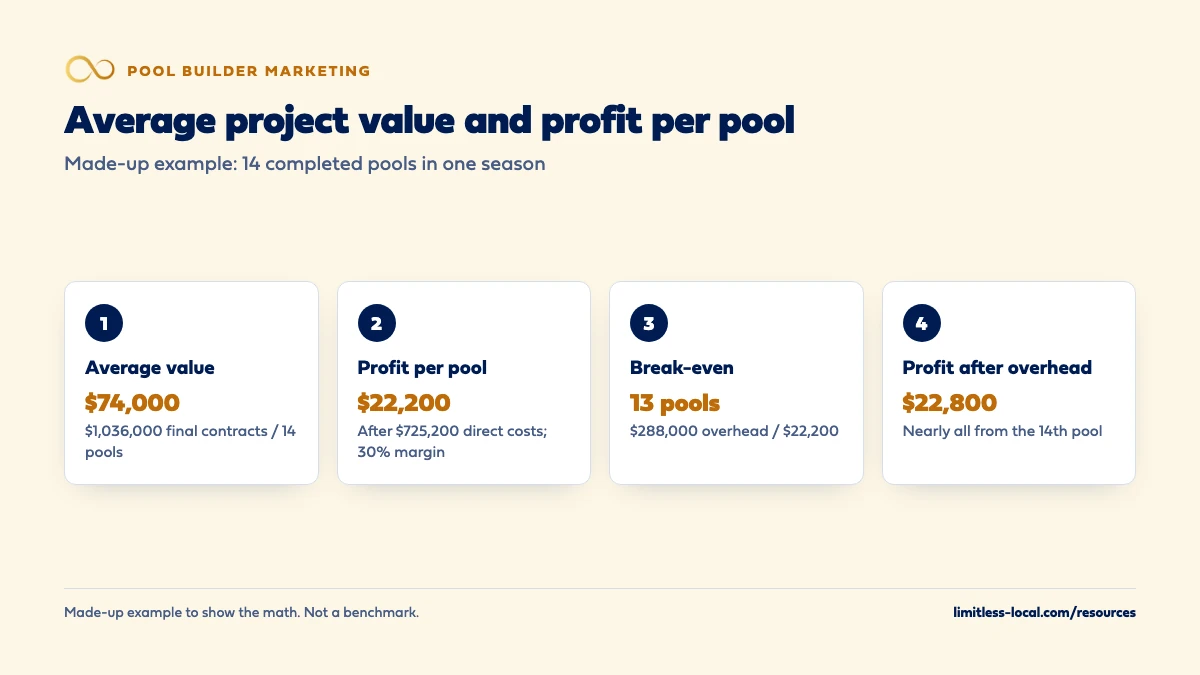
Last season the builder completed 14 new pools. Final contract values, including change orders, added up to $1,036,000.
- Average project value: $1,036,000 / 14 = $74,000.
- Direct costs (materials, crew labor, subs, permits, rentals) across the 14 pools: $725,200.
- Total gross profit: $1,036,000 – $725,200 = $310,800.
- Gross profit per pool: $310,800 / 14 = $22,200, a 30% margin.
Overhead (office, insurance, trucks, salaries outside the crews) runs $24,000 a month, or $288,000 a year. Divided by $22,200, it takes 13 pools to cover overhead, and the 13th only just does it. Nearly all of the $22,800 left after overhead comes from the 14th pool.
That changes the marketing conversation. If marketing helped bring in two or three of those 14 pools, it wasn’t a cost to cut; it was the difference between a break-even year and a profitable one.
Frequently asked questions
Should I include sales commission in the cost of each pool?
Yes, if you pay it per pool. It’s a cost that comes with that sale, so it belongs with the direct costs, not overhead.
Is gross profit the same as what I take home?
No. Gross profit per pool still has to cover overhead, marketing and your own pay. What’s left after all of that is net profit.
What if I don't track job costs yet?
Rebuild last season from supplier invoices, sub invoices and payroll by job address. Then start tagging costs to each job as they happen.
Should I count financing dealer fees?
If you pay a fee to the lender when a homeowner finances, count it as a cost of that pool. It comes off what that sale leaves you.
Do warranty callbacks count as a job cost?
If you can tie them to a pool, add them to that pool’s costs. If not, track them as a separate line so they don’t vanish from the math.
How often should I recalculate?
At the end of every season, and whenever you change your prices or a major supplier changes theirs.
Key takeaways
- Average project value is total final contract value divided by pools completed.
- Gross profit per pool is final contract value minus direct build costs, from actual job costs.
- Use completed pools from a full season, and keep remodels and pool types separate.
- Divide overhead by gross profit per pool to see how many pools it takes to break even.
- Set marketing budgets against gross profit, never against the contract price.
Want a second set of eyes on your setup?
We'll look at how you show up locally and where calls are leaking, then send you a plain-English breakdown.
More in this section
- How does a pool builder work out what a lead is worth?
- How much should a pool builder spend on marketing?
- How should a pool builder budget for new pools vs. remodels?
- What does a pool builder budget beyond ad spend?
- What lead volume should a pool builder expect in the first year?
Sources
- What is the gross profit margin — BDC
- Job Costing — Jobber Help Center
- Job Costing Reports — Housecall Pro Help Center
- Break-even point calculator — U.S. Small Business Administration