
What makes a pool builder look reputable to homeowners online?
- Which online trust signals make homeowners comfortable calling a pool builder?
- What do homeowners check before they trust a pool builder?
- Where do homeowners see these trust signals?
- How much do reviews decide whether I look reputable?
- How should my replies to reviews look?
- Why do finished pool photos matter so much?
- How should I show my license, insurance and warranty?
- What does a homeowner find when they search my company name?
- Do consistent business details really make a difference?
- How fast should I reply to look reputable?
- What makes a pool builder look less reputable online?
- Which trust signals should a pool builder fix first?
- What's different about looking reputable as a pool builder
- A worked example: a quick trust check and fix
- Frequently asked questions
- Key takeaways
- More in this section
- Sources
The short version
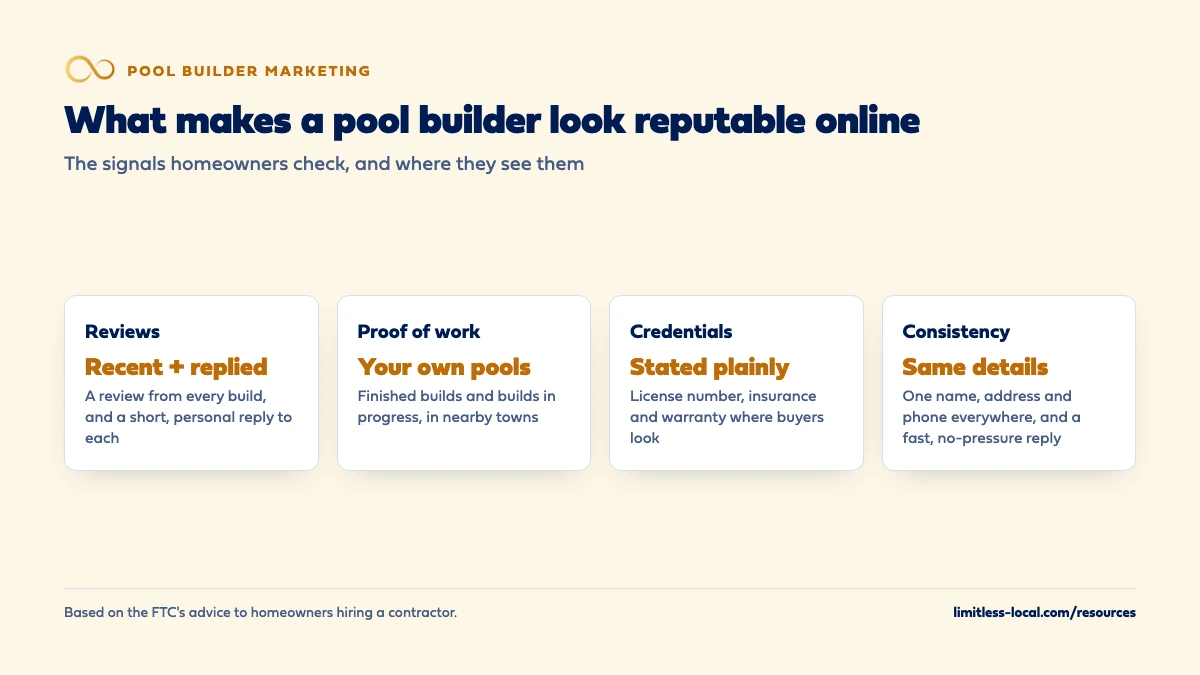
- Recent reviews with thoughtful replies from you.
- Photos and project pages of pools you actually built, in nearby towns.
- License, insurance and warranty stated plainly, where buyers can find them.
- Consistent business details and a fast, no-pressure reply to every inquiry.
For pool builders who want homeowners to see a trustworthy company when they look them up, and want to know which signals to fix first.
Get a free visibility audit · Book a growth call
Which online trust signals make homeowners comfortable calling a pool builder?
A pool builder looks reputable online when a homeowner can check what you say in a few minutes: a steady flow of recent Google reviews with your replies, a gallery of finished pools in nearby towns, your license, insurance and warranty stated plainly, the same name, address and phone everywhere, and a quick, professional reply when they reach out. Those match what consumer guides tell homeowners to check before hiring a contractor. Make each one easy to find on your Google Business Profile and website, and avoid anything that looks like a pressure sale.
Most of these signals live on your Google profile, your reviews and your listings, which is where our local SEO work starts: Google Business Profile management, review response and review generation, and your name, address and phone synced across 50+ directories. The pool builder marketing page shows how we work with pool companies, and the pool builder marketing questions library goes through the rest one question at a time.
What do homeowners check before they trust a pool builder?
The same things consumer guides tell them to check. The FTC’s advice on how to avoid a home improvement scam tells homeowners to:
- Consider only contractors who are licensed and insured, and confirm the license with the state or county.
- Get recommendations from people they know and trust.
- Search the company’s name online with words like “scam,” “review” or “complaint.”
- Read customer reviews with a critical eye.
- Get written estimates and a contract that includes the contractor’s name, address, phone number and license number.
The same guide lists the warning signs: pressure for an immediate decision, asking to be paid everything up front or in cash, asking the homeowner to get the building permits, and suggesting they borrow from a lender the contractor knows.
That gives you a checklist from the buyer’s side. Make the good signs easy to find, and make sure nothing about your online presence looks like the warning signs.
Where do homeowners see these trust signals?
Mostly in places you control or can influence:
- Your Google Business Profile, usually the first thing they see: rating, review count, recent reviews, your replies, photos and hours.
- Your website: the gallery, project pages, about page, credentials, process and contact details.
- A search for your company name, which shows your profile, your site, other listings and anything else written about you.
- Social media, where they look for recent builds and how active you are.
- Neighbors and friends, who may have watched you build next door.
A buyer rarely checks just one. They move between them, and each one either confirms the last or raises a question. Where homeowners research pool builders before they call maps the whole path.
How much do reviews decide whether I look reputable?
A lot, and it’s not just the star rating. How many you have, how recent they are and whether you reply all shape what a homeowner thinks. In BrightLocal’s Local Consumer Review Survey 2026, a panel of 1,002 US adults asked about local businesses in general, 74% said they seek reviews written in the last three months, and 37% named the owner having responded to a review as one of the things that matter most when they read one. That’s not a pool-specific number, but pool buyers read reviews like anyone else.
Don’t panic about one bad review, either. Google’s tips to get more reviews say honest, balanced reviews can help potential customers decide, and that a mix of positive and negative feedback often feels more trustworthy. A wall of perfect reviews all posted in the same week can look less believable than a steady record with a thoughtful reply to the odd complaint.
The fix is simple and ongoing: ask every customer at handover, every time, so there’s always something recent.
How should my replies to reviews look?
Your replies are read by every future buyer, so write them for that audience. Keep them short, polite and relevant, personalize them, and keep them conversational, not promotional. Instead of the same thank-you on every review, mention something from the build, like the sun shelf or the tight backyard access.
For negative reviews, take more care:
- Reply promptly, and stay calm.
- Acknowledge any mistake, and explain what was outside your control without blaming the customer.
- Never share private details about the customer or the job.
- Offer to take it offline by phone or email.
A calm, specific reply to a bad review can do more for your reputation than another five-star review. How a pool builder should respond to negative Google reviews covers common situations, like delays and change orders.
Why do finished pool photos matter so much?
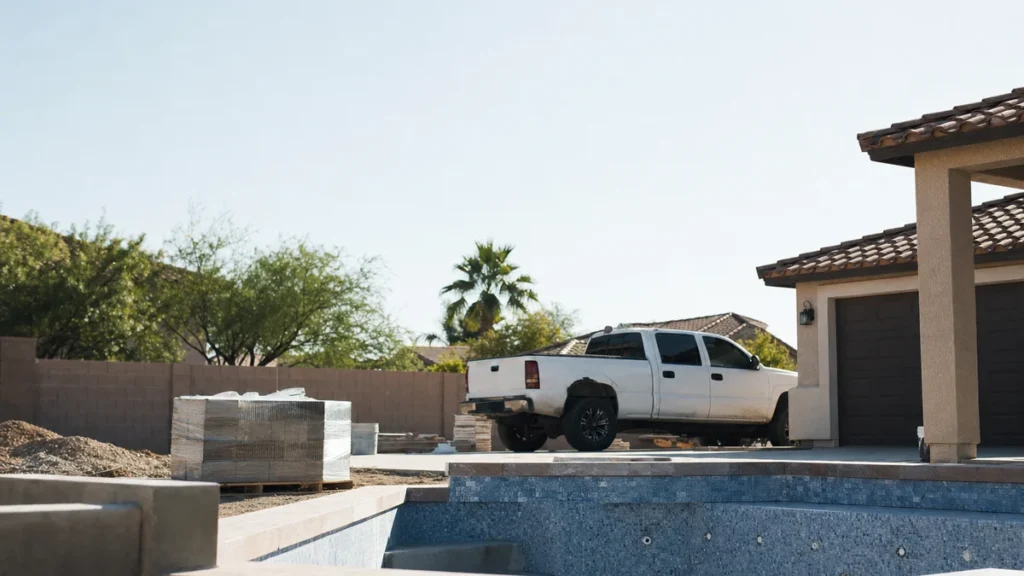
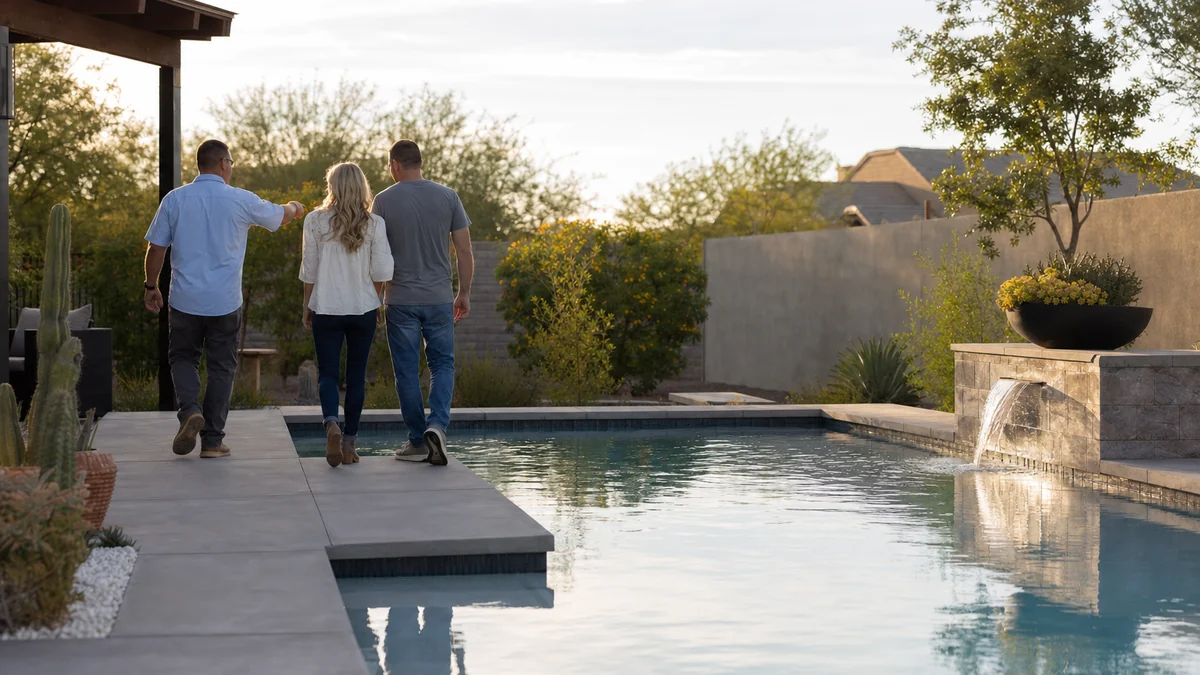
Because anyone can say they build beautiful pools. A homeowner wants to see ones you actually built, ideally in a yard and neighborhood like theirs. Real photos of your work are the proof behind every other claim on your site.
Show:
- Finished pools, from several angles and at different times of day.
- Builds in progress, showing excavation, steel, plumbing and tile, which says you run a real, organized job site.
- Your crew and trucks, so buyers know who’ll be in their yard.
- The town or area for each build, without the homeowner’s address.
Stock photos do the opposite. Buyers often recognize them, and they raise the question of why you didn’t use your own. Setting up a pool builder’s project gallery page covers how to lay it out.
Curious what your marketing is actually booking?
Get a free visibility audit — no obligation, no sales pitch.
How should I show my license, insurance and warranty?
Plainly, and where buyers look. Since homeowners are told to confirm a contractor’s license and ask for proof of insurance, make it easy for them:
- License number in the website footer and on your about page, where your state licenses pool work, so a buyer can look it up.
- Insurance stated on your site, with a certificate ready to send when asked.
- Warranty described in plain words: what’s covered, for how long and how a claim works.
- Memberships and certifications that are current, with links buyers can check.
Being upfront here does two things: it answers the questions buyers were told to ask, and it sets you apart from builders who make buyers dig for it. Which credentials a pool builder should show on its website goes item by item.
What does a homeowner find when they search my company name?
Find out before they do. Search your company name on its own, then with words like “reviews” and “complaints,” just as homeowners are told to. Look at what shows up on the first page:
- Is your Google profile there, complete and up to date?
- Do your other listings show the right name, phone and website?
- Is there an old listing, an old company name or a duplicate profile that confuses things?
- Are there complaints that never got a reply?
Claim and fix the listings you can, and reply to old complaints where the platform lets you. You can’t control everything that appears, but you can make sure the first page is mostly yours and accurate.
Do consistent business details really make a difference?
Yes, to buyers and to Google. If your website shows one phone number, your Google profile another and an old directory listing a third, a homeowner starts to wonder whether these are the same company, or whether you’re still in business. Google’s page on improving your local ranking says businesses with complete and accurate information are more likely to show up in local search results.
Pick one official version of your name, address and phone, and use it everywhere: your website, Google profile, other listings, trucks and paperwork. Keeping a pool builder’s name, address and phone consistent walks through fixing them one by one.
How fast should I reply to look reputable?
Fast enough that the homeowner isn’t left wondering. For a pool buyer, the first reply is the first sign of how you’ll run their build. A same-day call back, a clear next step and a confirmed consultation time say “organized.” Three days of silence says the opposite, however good your reviews are.
How you reply matters as much as how fast. Avoid the tactics consumer guides warn homeowners about: pressure to decide on the spot, “this price is only good today” offers, or asking for large deposits before there’s a contract. A calm, informative first conversation is one of the strongest trust signals you can give.
What makes a pool builder look less reputable online?
A few things undo the rest quickly:
- Fake or bought reviews. The FTC’s rule on consumer reviews and testimonials went into effect on October 21, 2024, and its Q&A says a business that puts fake or false testimonials on its own website could be liable.
- Arguing with reviewers or sharing a customer’s details in a reply.
- Stock photos in place of your own work.
- No license number, no address or service area and no way to tell where you’re based.
- Outdated information: wrong hours, a disconnected number, a last post from years ago.
- A sales-heavy site with countdown offers and no real information about how you build.
None of these take long to fix, and fixing them removes the doubts that stop a buyer from calling.
Which trust signals should a pool builder fix first?
Start where most homeowners look first, and where the fixes are quickest:
- Your Google Business Profile: correct details, real photos, and replies to every unanswered review.
- A review from every new build, starting now, so your newest review is always recent.
- Your website basics: license number, insurance, warranty and service area on the page, and stock photos replaced with your own.
- Your name, address and phone, matched across your main listings.
- Project pages for your best builds, added steadily.
Most of this is a few weeks of work, then a habit. Videos and content that build trust for a pool builder covers the next layer once these basics are in place.
Want to see where your company stands?
A free visibility audit shows where you show up on Google, Maps and AI answers, and what it's costing you in calls.
What's different about looking reputable as a pool builder
The stakes are high for the buyer. A pool is one of the biggest purchases a homeowner makes on their house, and they’ll live with the builder in their yard for weeks. That makes them check more carefully than they would for a repair call.
The fear is an unfinished pool. Many buyers worry about a builder who takes a deposit and disappears, or a pool left half-built. Signs that you’re established and organized answer that worry before it’s spoken.
Your work is visible to neighbors. Every build is a public demonstration of how you run a job site. Clean sites and finished photos online reinforce each other.
The decision takes months. A buyer may check your profile several times before signing. Recent reviews and fresh project photos keep you looking current every time they come back.
A worked example: a quick trust check and fix
This example is made up to show the method, not a benchmark for pool builders. Say a builder searches their own name and finds 41 Google reviews, a 4.7 rating, the newest review from seven months ago and replies on only a handful. Their website gallery mixes their own pools with stock photos, the license number isn’t on the site, and an old directory listing shows a phone number they stopped using.
Over the next three months they:
- Reply to every unanswered review, starting with the negative ones.
- Ask every customer at handover for a review, and collect 11 new ones.
- Replace the stock photos with their own builds and add short project pages for their best recent pools.
- Put the license number, insurance and warranty summary in the footer and on the about page.
- Fix the old listing’s phone number.
None of that changes the quality of their pools. It changes what a homeowner sees in their first few minutes of checking, which is often what decides whether they call. A free visibility audit shows how your profile, reviews and listings look from the outside.
Frequently asked questions
Does a high star rating matter more than the number of reviews?
Both matter, along with how recent the reviews are. A strong rating built on a handful of old reviews tells a buyer less than a slightly lower rating with a steady stream of recent ones.
Should I show reviews from other sites on my website?
Yes, as long as they’re real and you show them accurately. Link to where buyers can read the originals.
Can I ask happy customers to post a review on a specific day?
You can ask any time, but ask every customer, not only the ones you expect to be happy. A natural flow of reviews looks more believable than a burst.
Do awards and 'best of' badges make me look more reputable?
Only if they’re real, current and something a buyer can check. A paid badge with no clear source can do more harm than good.
Should my phone number and address be on every page of my site?
Your phone number, yes. Your address or service area belongs in the footer of every page so buyers know where you work.
How do I look reputable if I'm a new pool company?
Show what you can: your license, insurance and warranty, photos of every build from day one, reviews from each customer, and a clear process. How a new pool company gets its first customers covers the early stage.
Key takeaways
- Homeowners are told to check license, insurance, recommendations, reviews and complaints before hiring a contractor, so make each one easy to find.
- Recent reviews with short, personal replies matter more than a perfect score.
- Real photos of your own builds, in nearby towns, are the proof behind every other claim.
- Use one version of your name, address and phone everywhere, and reply to inquiries quickly without pressure.
- Fake reviews, stock photos, missing license details and pushy sales tactics undo the rest.
Not sure what's working right now?
Start with a free visibility audit: rankings, Google profile, reviews and tracking, checked against your service area.
More in this section
- What do homeowners search when they are ready to hire a pool builder?
- Where do homeowners research pool builders before they call?
- What videos and content build trust for a pool builder?
- Which credentials should a pool builder show on its website?
- Which online listings should a pool builder have besides Google?
Sources
- How To Avoid a Home Improvement Scam — Federal Trade Commission Consumer Advice
- Tips to get more reviews — Google Business Profile Help
- Tips to improve your local ranking on Google — Google Business Profile Help
- The Consumer Reviews and Testimonials Rule: Questions and Answers — Federal Trade Commission
- Local Consumer Review Survey 2026 — BrightLocal