
How does marketing affect what a pool company is worth to a buyer?

- What do buyers look for in a pool construction company's marketing before they make an offer?
- What is a buyer actually paying for in a pool company?
- Does spending on marketing lower what my company is worth?
- Why do buyers worry about leads that depend on the owner?
- Which marketing assets go with the business when it sells?
- Who should own the accounts before I sell?
- How does a tracked pipeline help a buyer trust my numbers?
- Does relying on one lead source lower the value?
- Do reviews and brand reputation count?
- What records should I start keeping now?
- Who should put a number on my pool company?
- What's different about selling a pool company
- A worked example: two pool companies with the same profit
- Frequently asked questions
- Key takeaways
- More in this section
- Sources
The short version
- Buyers pay for earnings they believe will continue after you leave.
- Lead flow that runs through you personally is a risk; a system that runs without you is an asset.
- Own the Google profile, website, domain, ad accounts and phone numbers in the company's name.
- Tracked sources and cost per signed contract make your numbers easier to believe.
- Cutting marketing before a sale to lift one year's profit thins the pipeline a buyer is paying for.
For pool company owners thinking about selling in the next few years, and wondering which parts of their marketing a buyer will pay for.
Get a free visibility audit · Book a growth call
What do buyers look for in a pool construction company's marketing before they make an offer?
Marketing affects what a pool company is worth mainly through how believable its future earnings look to a buyer: lead sources that don’t depend on the owner, accounts and listings the company owns outright, and a tracked record of where signed contracts came from all make the earnings easier to trust. Leads that run through the owner’s personal network, accounts held in an agency’s name and one dominant lead source make a buyer more cautious. What that’s worth in dollars depends on the whole business, the market and the buyer.
A pool company’s marketing is part of what a buyer is buying, so it pays to build it like an asset rather than a monthly expense. We’ve sat on the owner’s side of this: we were an equity partner in a pool construction company, where we streamlined back-office operations, built the lead-generation engine and ran sales and marketing, and that business did $2M+ revenue in year one. Every one of our packages includes call, form and source tracking with monthly cost-per-lead reports, the kind of record a buyer asks for. See how it fits on the pool builder marketing page, or browse more pool builder marketing questions.
What is a buyer actually paying for in a pool company?
Mostly, earnings they expect to keep getting after you hand over the keys. BDC, Canada’s business development bank, says in its guide on valuing a business you’d like to acquire that the most common way to set a fair price is a multiple of EBITDA, a measure of operating earnings, and that professional valuators typically confirm it with an asset-based approach and a look at what comparable businesses sold for. It also says many factors can influence which multiple is used, including goodwill and the company’s location.
Marketing sits right inside that. It produces the signed contracts behind the earnings, and it shapes how confident a buyer is that those contracts will keep coming. Two pool companies with the same profit last year can look very different to a buyer if one can show exactly where its work comes from and the other can’t.
The SBA’s guidance on selling your business makes the same point from another angle: when valuing a small business, include intangible assets like brand presence, intellectual property, customer information and projection of future revenue.
Does spending on marketing lower what my company is worth?
Not when it’s working. Marketing is an expense, so it reduces this year’s earnings, but buyers care just as much about whether earnings are growing and will hold up. ServiceTitan’s contractor guide to preparing your company for sale says the valuation a buyer pays is a multiple of your EBITDA, based on historical growth and expected future growth.
That’s why cutting marketing in the year before a sale to make the profit line look better tends to backfire. The savings show up in one year’s numbers, and then the pipeline thins: fewer consultations, fewer signed builds in the backlog, a softer start to the next season. A careful buyer looks at all of that.
What does drag on value is marketing that costs money and can’t show what it produced. Spend you can tie to signed contracts reads as an engine. Spend nobody can explain reads as a cost the buyer will want to cut or check.
Why do buyers worry about leads that depend on the owner?
Because the owner is the one part of the business that’s leaving. In many pool companies, the best leads come through the owner: past customers who call his cell, builders and landscapers who know him, the neighbor who met him at a ballgame. The owner often runs the design consultations and closes the sales too.
Buyers are really buying the team, and if the team is mostly the owner, they’re less keen.
Marketing can shift that. A Google profile, website and reviews in the company’s name, ads that bring in consultations without anyone’s personal network, a CRM that holds every past customer, and a salesperson or designer who runs consultations all move the lead flow from you to the company. None of it happens in a month, which is why owners who plan to sell start years ahead.
Which marketing assets go with the business when it sells?
The ones the company actually owns and can hand over:
- Google Business Profile, with its reviews, photos and history.
- Domain and website, including the photo galleries and pages that bring in search traffic.
- Ad accounts on Google and Meta, with their history and data.
- Phone numbers, including tracking numbers.
- Customer and lead records: past builds, open proposals, warranty and service history.
- Photos and video of past builds, with clear rights to use them.
A sale can include customer lists, job and invoice history, equipment lists and membership lists, so be clear on exactly what you’re selling. If an asset sits in an employee’s personal account, an old agency’s name or a family member’s email, it may not transfer cleanly, and a buyer will notice.
Curious what your marketing is actually booking?
Get a free visibility audit — no obligation, no sales pitch.
Who should own the accounts before I sell?
The company, every time. On the ad side, Google’s help on ownership of client accounts says a manager account, such as an agency’s, can be made owner of a client account with full administrative access, but that this doesn’t take data ownership or administrative rights away from the client account; the client account still owns its data. On the profile side, Google’s help on Business Profile owners and managers says a profile can have multiple owners but only one primary owner, with full control over the profile.
Before a sale, make sure the company is the primary owner of the Google profile, holds the domain and the website files, owns the ad accounts, controls the tracking numbers and keeps its own copy of every lead. Agencies and freelancers should be users or managers, not owners.
Who owns a pool builder’s ad accounts and website goes through each account and how to take back one you don’t control.
How does a tracked pipeline help a buyer trust my numbers?
It turns “we get most of our work from Google and referrals” into something a buyer can check. With tracking in place, you can show for each of the last few seasons:
- How many leads each source produced.
- How many became design consultations and how many signed.
- The value of the contracts each source brought in.
- What each source cost, and the cost per signed contract.
- The backlog of signed builds still to start.
That’s the evidence behind the projection of future revenue a buyer is paying for. It also helps you, long before a sale, by showing which channels deserve more money. Tracking which marketing produces signed pool contracts covers the setup, and what a good cost per signed pool contract is covers how to read the result.
Does relying on one lead source lower the value?
It adds risk a buyer will price in. If most signed contracts come from one place, whether that’s the owner’s referrals, one big home show, one builder partner or one ad account, the earnings depend on that source staying healthy. A change in a platform’s rules, a partner retiring or a bad season for referrals can take a large share of the work with it.
A spread of sources, each tracked, tells a buyer the business can lose one and keep going. That doesn’t mean every channel at once. Referrals plus a strong Google profile and reviews, search ads, and one or two partner relationships is already a much sturdier picture than referrals alone.
Whether a pool builder should diversify beyond referrals covers how to add sources one at a time.

Do reviews and brand reputation count?
They count as part of a company’s intangible value, alongside brand presence and customer information, and buyers notice them quickly because they’re public. A profile with years of detailed reviews from real builds, a website full of finished pools and a name homeowners recognize in your towns are all things a new owner would otherwise have to build from scratch.
Two things can weaken them. A brand built entirely around the owner’s personal name can be harder to hand over, since homeowners were buying the person. And a reputation that only exists offline, through word of mouth with little online to show for it, is hard for a buyer to see or measure.
Keep one Google profile in the company’s name rather than starting new ones, so the review history stays with the business you’re selling.
What records should I start keeping now?
Start with what a lender and a buyer will ask for. When a bank values a business, it typically wants financial statements for the past several years, interim results and projections, the prior year’s tax return, a list of discretionary and non-recurring or one-time expenses, significant upcoming changes, major planned investments and information on the management team.
On the marketing side, add:
- Monthly marketing spend by channel.
- Leads, consultations and signed contracts by source.
- Contract values and the backlog of signed builds.
- A list of every account, who owns it and who has access.
- Agency and software contracts, with their terms.
Keep personal expenses out of the business books, too. Buyers dig deep into the financials, and personal costs run through the company muddy the earnings they’re trying to judge.
Who should put a number on my pool company?
A professional, not a rule of thumb. Hire a professional valuator, ideally one both sides agree on; for smaller businesses, an accountant experienced with business valuation may be able to give an adequate sense of a company’s worth. Advice from your lawyer, a business evaluation expert, your accountant and your banker rounds it out.
The right valuation depends on your earnings, growth, backlog, market, the mix of new builds, remodels and service, and who the buyer is. Marketing is one factor among those, and a good valuator will look at it alongside everything else.
Where marketing helps most is before the valuation: clean ownership, tracked sources and a lead flow that doesn’t depend on you give the valuator and the buyer something solid to work from.
Want to see where your company stands?
A free visibility audit shows where you show up on Google, Maps and AI answers, and what it's costing you in calls.
What's different about selling a pool company
Long sales cycles. A pool sold this spring may have started as a lead last fall, so a buyer looks at the pipeline and backlog, not just last year’s revenue.
Seasonal swings. Revenue bunches into building months, so buyers want several seasons of records to see the pattern.
The owner often sells and designs. In many pool companies, the owner runs the consultations, which makes a non-owner sales process a big part of transferable value.
Mixed lines of business. New builds, remodels and service have different earnings and lead sources. Keep their marketing and numbers separate so a buyer can see each one.
A worked example: two pool companies with the same profit
These two companies are made up to show what a buyer looks at, not a valuation of either.
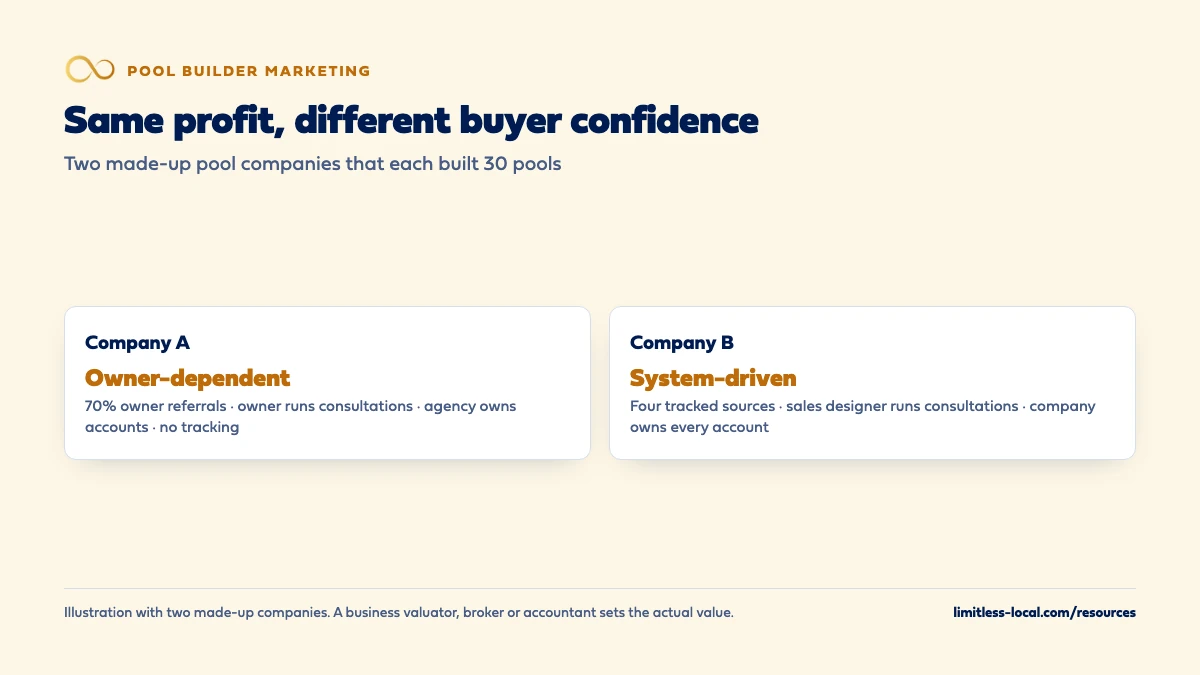
Both built 30 pools last year and made the same profit.
Company A: about 70% of signed contracts came from the owner’s referrals and builder friends. The owner runs every consultation. The website and Google Ads account were set up in the old agency’s name, and nobody can say which ads produced which jobs.
Company B: referrals brought in about 40% of contracts, the Google profile and reviews about 25%, search ads about 20%, and a landscape partner about 15%, all tracked in the CRM. A sales designer runs most consultations. The company owns every account.
A buyer looking at A has to wonder how much of the 30 pools walks out the door with the owner. A buyer looking at B can see the system that produced them. Same profit, very different confidence, and that confidence is what shapes the offer.
Frequently asked questions
Should I spend more on marketing right before selling?
Only if it’s tracked and you can show what it produced. A sudden spend with no record of results won’t impress a buyer, while steady, tracked growth over a few seasons will.
Is my pool company's website worth anything on its own?
It’s part of the business, not usually priced separately. A site that ranks and brings in tracked leads adds to the case for future earnings.
Will a buyer keep my marketing agency?
That’s up to the buyer. What matters for the sale is that the company owns the accounts, so the buyer can choose.
Does a service line make a pool company more attractive?
Recurring service revenue can look steadier to a buyer than build revenue. A valuator will weigh it against its own costs and churn.
How many years of marketing records will a buyer want?
Several seasons is better than one, because pool revenue is seasonal and a buyer wants to see the pattern.
Can I sell my pool company if all the leads come from me?
Yes, but buyers may be more cautious. Moving lead flow and sales into the company before you sell is one way to change that.
Key takeaways
- Buyers pay for earnings they believe will continue, so marketing matters through how trustworthy it makes those earnings look.
- Lead flow that depends on the owner is a risk; a system the company owns is an asset.
- Make the company the owner of the Google profile, domain, website, ad accounts and phone numbers.
- Track sources, signed contracts and cost per contract for several seasons before a sale.
- Keep marketing running and tracked into a sale; cutting it to lift one year’s profit thins the pipeline.
Not sure what's working right now?
Start with a free visibility audit: rankings, Google profile, reviews and tracking, checked against your service area.
More in this section
- Is a pool service business profitable, and where does marketing fit?
- What share of revenue should a pool builder put into marketing?
- How much should a pool builder spend on marketing?
- How much does a pool marketing agency cost?
- What are the biggest marketing mistakes pool companies make?
Sources
- How to value a business you'd like to acquire — BDC
- Manage your business: Close or sell your business — U.S. Small Business Administration
- Selling Your Company: Chapter 15. Preparing Your Company For Sale — ServiceTitan
- Manager Accounts (MCC): About ownership of client accounts — Google Ads Help
- Manage your Business Profile owners & managers — Google Business Profile Help