
Do direct mail or referrals beat SEO for a roofing company?
- Referrals, direct mail or SEO: which should a roofing company lean on in 2027?
- Which brings in cheaper signed roofs: referrals, direct mail or SEO?
- Why can't a roofing company just live on referrals?
- Do homeowners still find roofers through word of mouth?
- What does direct mail cost a roofer, and when does it work?
- What does SEO cost a roofer, and how long until it pays?
- How do referrals and SEO help each other?
- Where do social media and lead marketplaces fit?
- Which should I put money into first?
- How much of my time does each one take?
- How do I compare referrals, direct mail and SEO fairly?
- What's different about this choice for roofing companies
- A worked example: three sources, one month
- Frequently asked questions
- Key takeaways
- More in this section
- Sources
The short version
- Referrals close best and cost the least, but you can't scale them on demand.
- SEO takes months to build, then keeps working for homeowners who don't know anyone who used you.
- Direct mail is a targeted, short-term tool, strongest around jobs you just finished.
- Compare all three by cost per signed roof, with every lead tagged by source.
For roofing owners weighing word of mouth and postcards against building their spot on Google, and wondering where the next dollar and the next free evening should go.
Get a free visibility audit · Book a growth call
Referrals, direct mail or SEO: which should a roofing company lean on in 2027?
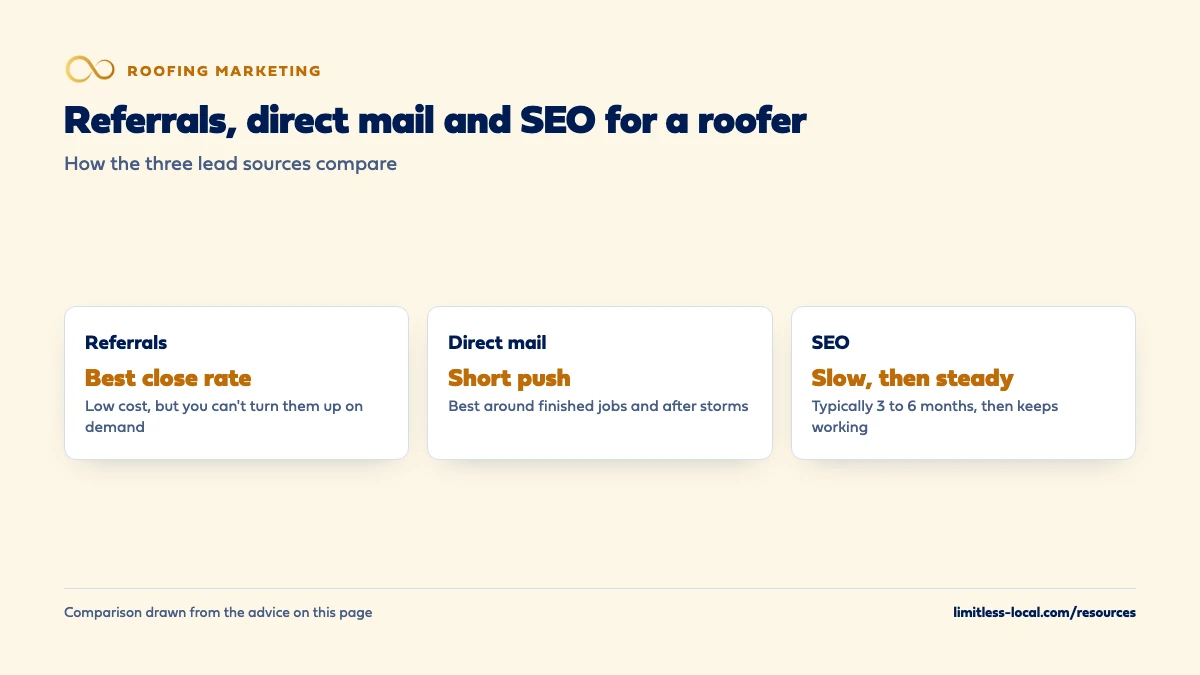
Referrals usually beat SEO for a roofing company on close rate and cost per signed roof, but you can’t turn them up when the schedule goes quiet. SEO is slower, typically 3 to 6 months before organic growth means anything, and after that it keeps reaching homeowners who’ve never heard of you. Direct mail rarely beats either one on its own; it works best as a short push around roofs you just finished or after a storm. Most roofers do best keeping referrals as the base, building SEO as the steady source, and using mail to fill gaps, judged by what each signed roof cost.
This is the cost-per-signed-roof thinking we use when we build a roofing company’s plan: keep what’s already working, like referrals, and add the channels that reach homeowners who don’t know you yet. Local SEO and your Google Business Profile are part of every package on our roofing marketing page. For the wider view of every lead source, read the guide to getting roofing leads, or browse more roofing marketing questions.
Which brings in cheaper signed roofs: referrals, direct mail or SEO?
Referrals, almost every time. A referred homeowner already trusts you before you walk the roof, they’re usually comparing fewer roofers, and you didn’t pay for a click or a postcard to meet them. Your cost is mostly time: doing great work, asking, and following up.
SEO comes next once it’s built. You pay for the work every month, but there’s no charge per call, so as the calls grow, the cost of each signed roof drops. The catch is the start: in the first months you’re paying for work that hasn’t produced much yet.
Direct mail is usually the most expensive per signed roof, because most postcards land on houses that don’t need a roof this year. In Roofing Contractor magazine’s 2006 homeowner survey of roof-replacement buyers, direct mail made up 6% of the leads but only 2% of the jobs, and relatives and friends were the most effective sources of all. That survey is old and mail has changed since, but it’s still one of the few published looks at which roofing lead sources actually turn into jobs.
Why can't a roofing company just live on referrals?
Because you don’t control them. Referrals come when a past customer happens to talk to a neighbor who happens to need a roof. That’s great news when it happens and no help in a slow February.
Roofing makes this harder than most trades. A homeowner replaces a roof once every couple of decades, so your happiest customers won’t need you again for years. Your referral flow depends on how many roofs you’ve done, how long ago and how well you stayed in touch. A company in its first few years simply doesn’t have enough past customers to keep crews busy on word of mouth.
Referrals also cap your growth at your current circle. If you want to add a crew, move into a new town or do more metal roofs, the people you’ve already worked for can’t send you enough of that work. Why referred homeowners sign so often, and what that means for your online leads, is covered in whether referral roofing leads close better than digital leads.
Do homeowners still find roofers through word of mouth?
Yes, and search is close behind. In the magazine’s 2026 survey of homeowners, 74% said they’d follow a recommendation from a neighbor, friend or family member, 62% said they’d call a roofer they’d used before, and half said they use search engines. Home services websites and social media each came in around a quarter. Respondents could pick more than one, which is the real point: most homeowners do both. They hear your name from a neighbor, then look you up.
That lookup is where SEO and referrals meet. A referred homeowner who searches your name and finds a thin profile with six reviews may call the other roofer their cousin mentioned. About 62% of those homeowners rate online reviews as very or extremely important. A referral opens the door; your Google profile and reviews decide whether they walk through it.
What does direct mail cost a roofer, and when does it work?
The cheapest way to mail every house on a route is the Postal Service’s Every Door Direct Mail. Postage for an EDDM Retail flat is listed at $0.26 a piece, you need at least 200 pieces, and you can send up to 5,000 a day per ZIP Code. You choose routes on a map and can filter by things like household income. Printing and design come on top of postage.
Mail works best when there’s a reason that house should care right now:
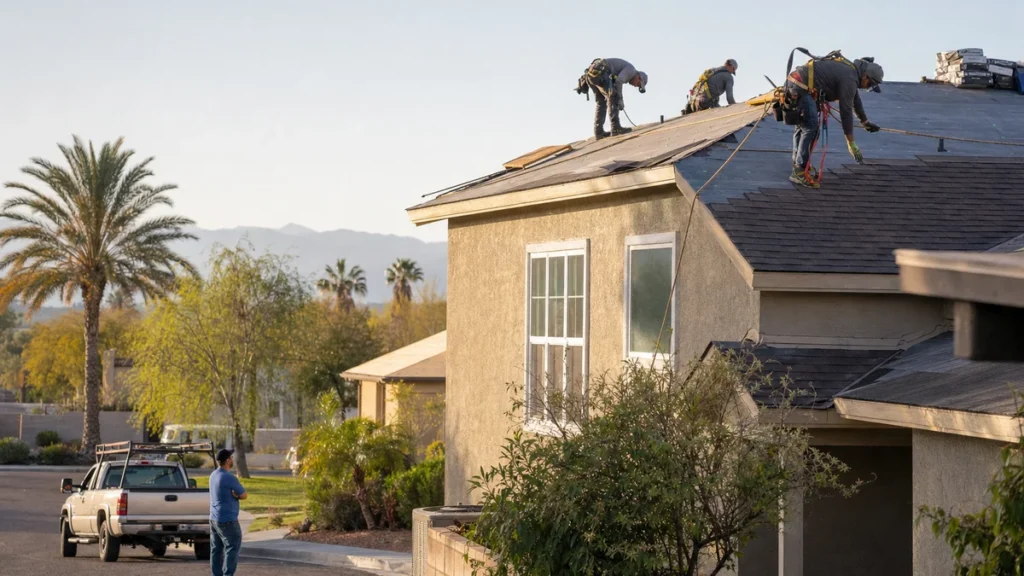
- Around a job you just finished. The neighbors watched your crew for two days. A card with a photo of that roof, the street name and a phone number lands while they still remember the trucks.
- After a storm in a specific area. Offer an inspection and a written estimate, nothing more. Keep the card about the inspection.
- Neighborhoods where roofs are aging out. Subdivisions built around the same time tend to need roofs around the same time.
Where mail falls down is as a blanket, every-month campaign across a whole city. You pay for every door, and almost none of those doors need a roof this season.
Curious what your marketing is actually booking?
Get a free visibility audit — no obligation, no sales pitch.
What does SEO cost a roofer, and how long until it pays?
SEO costs either money (an outside company or a hire) or your own hours, every month, and it pays back slowly at first. Ads can bring leads within days of launch; SEO typically takes 3 to 6 months to show meaningful organic growth. Google’s SEO Starter Guide notes that some changes take effect in a few hours while others can take several months, so judge the work over seasons, not weeks.
What you’re building is the part a referral can’t reach: the homeowner who just found a leak, doesn’t know a roofer and types “roof repair near me”. Once your website and your Google profile rank for the towns you serve, those calls keep coming whether you mailed anything that month or not. A roofing client of ours got 3x map pack visibility in its target towns, and better presence and consistent info across the web increased inbound calls.
If you’re planning cash around that ramp, how long SEO takes to bring a roofer its first leads walks through what usually happens month by month.
How do referrals and SEO help each other?
More than most owners expect. Every happy referral customer is also a chance for a Google review, and reviews feed your Maps ranking. Google’s local ranking help says local results are mainly based on relevance, distance and popularity, and that more reviews and positive ratings can help your local ranking.
So the work overlaps. Ask every customer for a review when the job is done, and the same habit that keeps referrals coming also builds the profile that wins strangers. Getting more Google reviews after a roof replacement covers the timing and the ask.
It runs the other way too. A homeowner who found you on Google and loved the job becomes a referral source for their street. That’s why the choice usually isn’t one or the other.
Where do social media and lead marketplaces fit?
Both sit between referrals and SEO. About 70% of roofing contractors told the magazine they advertise on social media, while around a quarter of homeowners said they use social media to find a roofer. Social works best for staying visible to people who already know your name: neighbors of past jobs, people who visited your site, past customers who might refer you.
Lead marketplaces get you in front of homeowners quickly, but you pay for each lead. On Thumbtack, for example, lead prices vary with the type and size of the job, how many pros are available and your market. You’re renting attention, not building something you keep, and the homeowner may be talking to other roofers too. Whether a roofer should buy leads covers the questions to ask before you sign up.
Which should I put money into first?
It depends on where your company is today:
- New roofing company, few past customers. You don’t have a referral base yet. Set up your free Google Business Profile, get reviews from every job, and start SEO now so it’s working by your second season. Use paid ads for calls in the meantime.
- Established, mostly referral-driven. Your base is strong but you can’t grow it on demand. Build SEO for the towns and jobs you want more of, and use your past customers to collect reviews that make it work faster.
- Moving into a new town. Nobody there knows you, so referrals won’t help yet. Mail around your first few jobs in that town, and build location pages and a profile presence for it.
- Booked out for months. Don’t buy more leads. Keep SEO and reviews running quietly and save mail for slow months.
- After a storm. Short bursts of mail and ads in the hit area, then back to normal. Don’t build your year around storms.
How much of my time does each one take?
This matters as much as money when you’re still on the roofs yourself.
- Referrals: a few minutes per job. Ask at the right moment, send a thank-you, stay in touch with a yearly check-in. Small effort, but it has to be a habit or it doesn’t happen.
- Direct mail: a few hours per drop. Picking routes, getting a card designed and printed, bundling it and dropping it at the Post Office for EDDM Retail. Then tracking which calls came from it.
- SEO: the most hours if you do it yourself (pages, profile posts, photos, reviews, links) and very little if someone else runs it.
If your evenings are already spoken for, that usually decides it. How much work each roofing marketing channel takes from you breaks it down further.
How do I compare referrals, direct mail and SEO fairly?
Tag every lead with where it came from the moment it comes in, then follow it to a signed roof. Without that, referrals get credit for homeowners who actually found you on Google, and mail gets blamed or praised on gut feel.
- Ask every caller how they heard of you, and record it in your CRM or field software.
- Put a separate phone number or a short web address on each mailer so those calls are easy to spot.
- Divide what each source cost (postage and printing, SEO fees, your time if you price it) by the roofs it signed.
- Judge SEO over months, not weeks, and judge a mail drop by the inspections it booked over the following weeks.
Tracking which roofing leads turn into signed jobs shows how to set up the stages so the comparison holds up.
Not sure which of these is costing you jobs?
A free visibility audit checks the Google profile, reviews, site and tracking, and shows what to fix first.
What's different about this choice for roofing companies
Long gaps between purchases. A roof isn’t a yearly service call. Your past customers are referral sources, not repeat buyers, which is why staying in touch matters more for roofers than for most trades.
Big tickets, careful buyers. Homeowners gather quotes for a roof: 66% of the homeowners surveyed said they’d get three. A referral often shortens that comparison; a postcard almost never does.
Storms change everything for a few weeks. Demand in a hit area jumps, and every roofer mails and knocks at once. Your reviews and your Maps listing are what make you look different from the crews who drove in last week.
Neighborhoods buy in clusters. Houses built together age together. A finished roof is advertising for the whole street, which is the one place direct mail earns its keep.
A worked example: three sources, one month
These numbers are made up to show the math, not a benchmark for your market. Say that in one month a roofer gets:
- Referrals: 5 leads and 2 signed roofs. No media cost, just the owner’s time and a thank-you card.
- Direct mail: 3,000 EDDM postcards around recent jobs. Postage at $0.26 a piece is $780, plus $450 for printing, so $1,230 in total. The cards bring 9 calls and 1 signed roof: $1,230 per signed roof.
- SEO, eighth month: $2,000 a month for the work, 14 leads and 4 signed roofs: $500 per signed roof. In its first few months the same $2,000 bought very few leads, so the true cost of those early roofs was much higher.
Referrals win on cost, SEO wins on volume once it’s built, and the mailer is the priciest per roof but still worth it if a replacement brings in far more than $1,230 in gross profit. None of these lines tells you to drop the others. They tell you where the next dollar goes: keep referrals, keep building SEO, and mail only where the math still works.
Frequently asked questions
Is direct mail still worth it for roofers in 2027?
It can be, as a targeted tool. Mail around roofs you just finished or in a storm-hit area, track the calls with a separate number, and stop if it doesn’t sign roofs at a cost you’re happy with.
How long should I run a direct mail test before judging it?
Long enough for the calls it brings to turn into inspections and estimates, usually several weeks after the drop. One drop is a small sample, so compare a few drops to similar neighborhoods before you decide.
How many postcards do I need for an EDDM mailing?
EDDM Retail needs at least 200 pieces, and you can send up to 5,000 a day per ZIP Code.
Can SEO replace referrals completely?
It shouldn’t. SEO brings homeowners who don’t know anyone who used you; referrals bring the ones who do. You want both.
Do referred homeowners still look me up online?
Most do. A thin Google profile or a handful of old reviews can lose a referral you’d otherwise have signed.
What should a roofer's postcard say?
One clear offer, like a free inspection with a written estimate, the town or street, a photo of a real roof you finished nearby, and one phone number you can track.
Key takeaways
- Referrals close best and cost least, but you can’t scale them when you need more work.
- SEO typically takes 3 to 6 months to build, then keeps reaching homeowners who don’t know you.
- Direct mail works as a targeted push around finished jobs or after a storm, not as a citywide habit.
- Referrals and SEO feed each other through reviews and your Google profile.
- Tag every lead by source and compare channels by cost per signed roof.
Want a second set of eyes on your setup?
We'll look at how you show up locally and where calls are leaking, then send you a plain-English breakdown.
More in this section
- Is door knocking or online marketing better for a roofing company?
- Which roofing companies get the best results from SEO versus ads?
- Can a roofing company do its own SEO?
- Will SEO work for a roofer without a big marketing budget?
- What does SEO actually mean for a roofing company?
Sources
- The Homeowner's Roofing Journey in 2026 — Roofing Contractor
- Roofing Contractor's Consumer Survey — Roofing Contractor
- Every Door Direct Mail (EDDM) – Targeted Mail Marketing — USPS
- SEO Starter Guide: The Basics — Google Search Central
- Tips to improve your local ranking on Google — Google Business Profile Help
- Get Listed on Google – Google Business Profile — Google
- How much do I pay for leads and opportunities? — Thumbtack Help