
How does a roofing company get recommended by ChatGPT?
- How do roofers show up when homeowners ask ChatGPT or Google's AI for a roofer?
- What happens when a homeowner asks ChatGPT to recommend a roofer?
- Can I pay or sign up to be recommended by ChatGPT?
- Step 1: Can AI search tools read my roofing website?
- Step 2: Are my roofing pages in Google's and Bing's indexes?
- Step 3: Do my business details match everywhere?
- Step 4: What should my roofing pages say so AI tools can use them?
- Step 5: Should my site spell out license, insurance and warranty?
- Do Google reviews affect whether ChatGPT recommends a roofer?
- How do I check whether ChatGPT mentions my roofing company?
- What should a roofer avoid when chasing AI recommendations?
- What's different about AI recommendations for roofing companies
- A worked example: a one-hour AI visibility check
- Frequently asked questions
- Key takeaways
- More in this section
- Sources
The short version
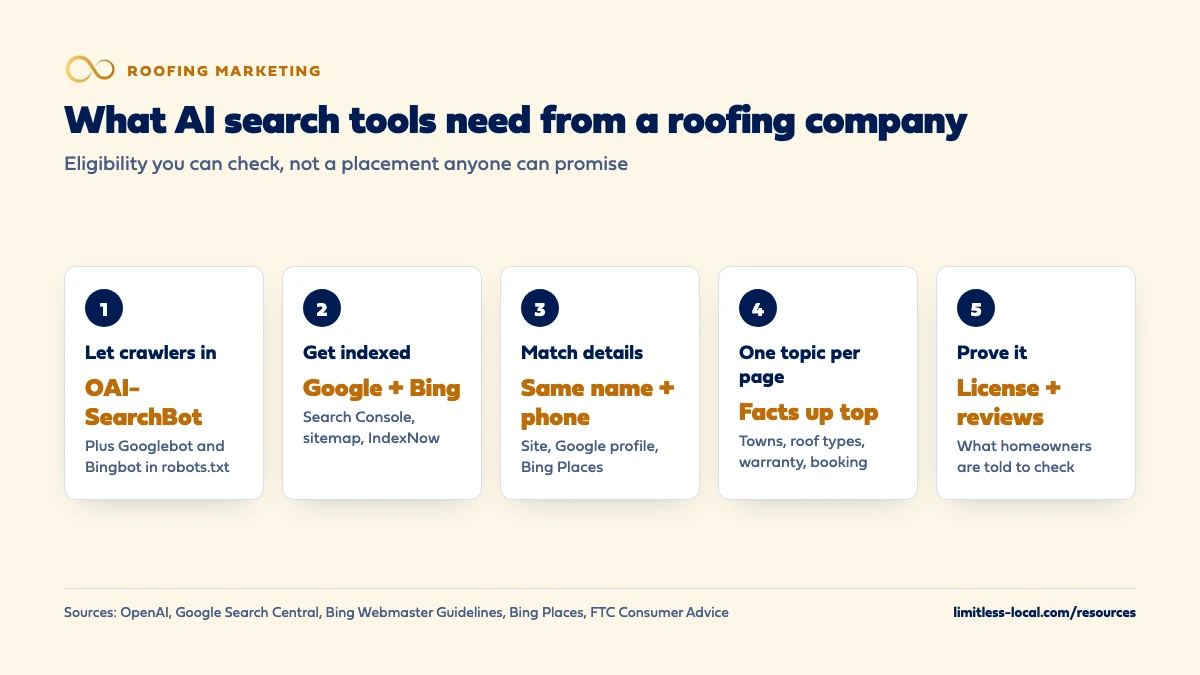
- Make sure your site lets OAI-SearchBot, Googlebot and Bingbot in; blocking OAI-SearchBot keeps you out of ChatGPT search answers.
- Keep your business name, address, phone and towns identical on your site, Google Business Profile and Bing Places.
- Give repair, replacement, storm damage and inspections their own pages, with the key facts near the top.
- State your license, insurance, warranty and local address plainly; nobody can promise an AI mention.
For roofing owners who’ve asked ChatGPT for a roofer in their own town, didn’t see their company, and want to know what actually moves that.
Get a free visibility audit · Book a growth call
How do roofers show up when homeowners ask ChatGPT or Google's AI for a roofer?
There’s no sign-up and no published formula: ChatGPT search, Google’s AI Overviews and Microsoft Copilot build their answers from web pages and business listings their search systems can reach, and none of them promises a spot. A roofing company improves its chances by letting those crawlers into its website, keeping its name, address, phone and service area identical everywhere it’s listed, and putting plain, checkable facts on separate pages: the roof work it does, the towns it covers, its license, insurance and warranty, and real local reviews. Those are the same things homeowners are told to check before hiring a roofer after a storm, so the work pays off even when no AI tool is involved.
Nobody can honestly promise you a spot in ChatGPT’s answers, and we won’t either. What we can do is the groundwork every AI tool reads from: your Google profile, your listings, and clear pages on your site. That’s part of our local SEO work for roofing companies. If you’re weighing whether SEO is worth it at all, is SEO worth it for roofers covers the bigger question, and the roofing marketing questions library goes one question at a time.
What happens when a homeowner asks ChatGPT to recommend a roofer?
OpenAI publishes part of the answer. ChatGPT can search the web when a question needs current information, and it sometimes works with outside search providers, rewriting the question into one or more targeted searches. It may use an approximate location from the person’s IP address for local results, and it may share location with third-party providers for things like nearby business listings. OpenAI also says ChatGPT ranks search results using multiple factors meant to surface relevant, reliable information, and that placement is not guaranteed (OpenAI Help Center).
In our judgement, roofing questions come in two kinds. Some are hiring questions: “who does hail damage inspections in [town]?” or “roof leak repair near me.” Others are research questions from homeowners pricing a replacement: metal or shingles, repair or replace, how insurance claims work. The hiring questions lean on business listings and local pages. The research questions lean on pages that explain things clearly. A roofer can show up in both, but for different reasons.
Can I pay or sign up to be recommended by ChatGPT?
No. None of the platforms offers that, and none publishes a ranking formula. Google says there are no additional technical requirements for its AI Overviews and AI Mode beyond being indexed and eligible to show in Search with a snippet, and that specific optimization isn’t required (Google Search Central). Bing’s guidelines name the practice, generative engine optimization, and say it doesn’t guarantee grounding or citations in AI answers, just as SEO doesn’t promise rankings (Bing Webmaster Guidelines).
So be wary of anyone who says they can lock in a ChatGPT placement. What the platforms do document is what makes a site eligible, and that’s what the steps below cover.
Step 1: Can AI search tools read my roofing website?
Check this first, because it’s the one thing that can rule you out completely. OpenAI says its search crawler, OAI-SearchBot, is what surfaces websites in ChatGPT’s search answers, and that sites opted out of it won’t be shown in those answers, though they can still appear as plain navigational links. It recommends allowing OAI-SearchBot in your robots.txt file and allowing requests from its published IP ranges, and notes that changes can take about 24 hours to take effect. Its training crawler, GPTBot, is a separate setting: you can block GPTBot and still allow OAI-SearchBot (OpenAI). Google lists allowing crawling in robots.txt, and by any hosting or CDN setup, among its best practices for AI features.
- Open
yoursite.com/robots.txtin a browser and look for lines that block OAI-SearchBot, Googlebot or Bingbot, or a rule that blocks every bot. - Ask whoever runs your hosting whether a firewall or bot-blocking setting is on. In our judgement, it’s worth checking because security plugins can block crawlers without the owner knowing.
Step 2: Are my roofing pages in Google's and Bing's indexes?
Being readable isn’t the same as being indexed. For Google, a page has to be indexed and eligible to show with a snippet to appear as a supporting link in AI Overviews or AI Mode, and Google suggests verifying your site in Search Console to catch technical problems quickly (Google Search Central).
Bing matters more than most roofers think, because its guidelines cover Bing search, Copilot and the results Bing supplies to other AI tools. Bing asks for an accurate sitemap and recommends IndexNow to tell it right away when you add, change or remove a page, which it says reduces outdated or incorrect references in Copilot answers (Bing Webmaster Guidelines). If you put up a storm damage page the week a hailstorm hits, that’s exactly the kind of change worth sending.
Curious what your marketing is actually booking?
Get a free visibility audit — no obligation, no sales pitch.
Step 3: Do my business details match everywhere?
Every one of these systems is trying to work out which business is which. Google’s AI features guidance tells site owners to check that their Business Profile information is up to date. Bing says it uses many data sources for local listings and that Bing Places is one of the primary ones, and it recommends marking an old listing as closed after a move instead of editing it into the new one (Bing Places for Business). Bing’s guidelines also ask for clear, consistent names for organizations and locations, and say that improves citation accuracy.
In our judgement, this is where roofers’ details tend to get messy: a DBA on the trucks and a different legal name on the website, a storm-season office that closed, tracking numbers from old campaigns left on directory listings. Pick one name, one main number and one address, and make every listing match. It’s the kind of cleanup behind one of our own past results: a roofing client got 3x map pack visibility in its target towns; better presence and consistent info across the web increased inbound calls. That’s one client’s result, not a forecast for yours, and it was about Maps, not AI answers. If your Maps listing itself is the problem, why a roofing company isn’t on Google Maps covers that diagnosis.
Step 4: What should my roofing pages say so AI tools can use them?
Bing is the most specific of the platforms about content. Its guidelines say a page is more likely to be picked for an AI answer when it sticks to one topic, puts essential information near the top instead of after a long introduction, states facts outright and keeps important information visible on the page itself (Bing Webmaster Guidelines). Google adds that important content should be in text, not only in images.
For a roofer, in our judgement, that means one page each for roof repair, roof replacement, storm and hail damage, inspections and commercial work, if you do it. Near the top of each, in plain sentences: the towns you cover, the roof types and materials you work on, whether you do insurance-claim inspections, how fast you get out for an active leak, your warranty, and how to book. A gallery of roof photos with no words says nothing an AI tool can repeat.
Those pages also have to work for the homeowner who clicks through. What a roofing website needs for more estimate requests covers that side.
Step 5: Should my site spell out license, insurance and warranty?
Yes, because that’s what homeowners are told to check, especially after a storm. The FTC’s advice for hiring after weather emergencies tells people to confirm a contractor’s license with the state or county, ask for proof of insurance, read online reviews and search the contractor’s name with words like “scam” or “complaint,” get more than one written estimate, and treat a contractor who won’t provide license, insurance or a written contract as a red flag (FTC Consumer Advice).
In our judgement, an AI tool asked how to choose a roofer after a storm is likely to give similar advice, and the homeowner will then go looking for those facts. Make them easy to find: your license number where your state requires one, proof of insurance on request, your local address, how long you’ve worked in the area, and what your warranty covers. Leave out anything you can’t back up.
Do Google reviews affect whether ChatGPT recommends a roofer?
None of the AI documentation cited here says so directly, so be wary of confident claims either way. What Google does say is that reviews affect regular local results: popularity is one of the main factors, it’s partly based on how many reviews you have, and more reviews and positive ratings can help your local ranking (Google Business Profile Help). And the FTC tells homeowners to read reviews before hiring.
Our judgement is that reviews are worth the effort regardless of AI. A steady flow of recent reviews that mention the job and the town is useful to Maps, to homeowners and to any tool reading business listings. Getting more reviews after a roof replacement covers the ask, and what to do about an unfair review covers the other side.
How do I check whether ChatGPT mentions my roofing company?
Ask the way a homeowner would, and keep notes:
- Ask ChatGPT, Google (with AI Mode), Copilot and any other assistant a few real questions: “Who does hail damage roof inspections in [town]?”, “Best roof replacement company near [town]”, “Emergency roof leak repair [town]”.
- Put the town in the question. OpenAI suggests including a city, neighborhood or postal code when local results show the wrong area, and says ChatGPT may otherwise use an approximate location from the IP address (OpenAI Help Center), so a search from your office may not match what a homeowner across town sees.
- Open the sources each answer cites. That shows which pages and listings the tool is reading, and whether your details there are right.
- Repeat with the same questions once a month, and after any big storm.
Treat it as a spot check, not a score: answers change with wording and location. For harder numbers, Google says visits from AI Overviews and AI Mode are counted in the Web search type of the Search Console Performance report, alongside the rest of your search traffic.
What should a roofer avoid when chasing AI recommendations?
Bing’s guidelines list the tactics that cost visibility in Bing and Copilot (Bing Webmaster Guidelines):
- Keyword stuffing and artificially engineered language written to trigger AI citations instead of helping a reader.
- Prompt injection, meaning content designed to manipulate the AI models, which Bing says may lead to reduced visibility or removal.
- Link schemes, including bought links and private networks.
- Cloaking, showing crawlers different content than visitors see.
One roofing-specific trap, in our judgement: pages for every town a storm touched, including towns you don’t really serve. They read like the out-of-town storm chasers homeowners are warned about, and if an AI tool repeats them, you get calls you can’t take. If a tactic only makes sense because a machine is reading the page, it’s a risk to your whole site.
If you’re paying someone for this work, how to know if your roofing marketing agency is getting results covers what to ask for.
Not sure which of these is costing you jobs?
A free visibility audit checks the Google profile, reviews, site and tracking, and shows what to fix first.
What's different about AI recommendations for roofing companies
Storms move the questions. After hail or high winds, homeowners ask a burst of questions in a few days: who inspects roofs nearby, whether damage is covered, how to spot a scam. In our judgement, a storm damage page that’s already live, indexed and accurate is worth more than one rushed up afterward.
Insurance questions need care. Homeowners ask AI tools about claims. Explain your inspection process and how you work with adjusters, but don’t publish anything that promises what a claim will pay or how to get one approved. A wrong answer repeated by an AI tool, with your name on it, is worse than no answer.
Local proof matters more. Because homeowners are warned about out-of-town crews, the facts that prove you’re local (a real address, the towns you work in, jobs in those towns, reviews from those neighborhoods) carry extra weight on a roofing site.
A worked example: a one-hour AI visibility check
This is an illustration, not a real client. Picture a residential roofer with four crews who asks ChatGPT for “hail damage roof inspection in” its home town and never sees its name. A one-hour check turns up three problems:
- The site blocks OAI-SearchBot. A security plugin added a rule that blocks unfamiliar bots. Fix: allow OAI-SearchBot and the other search crawlers, then give it about a day.
- Bing has last year’s storm number. The Bing Places listing was never claimed and still shows a tracking number from an old campaign. Fix: claim and verify it, and match it to the Google profile.
- One page tries to cover everything. Repairs, replacements and storm work share one services page that says “serving the greater metro.” Fix: separate pages that name the towns, the roof types, the inspection process and the warranty near the top.
None of these fixes can force a mention. Each one removes a reason to be left out. For context on what this kind of work costs, our Essentials package is $3,500 a month and includes business listing cleanup, Google Business Profile management and a content sprint of up to 10 pages, and we sync name, address and phone across 50+ directories. Ad spend, if you run ads, is paid to Google separately. Whether that’s worth it for your company is what a free visibility audit is for.
Frequently asked questions
If I block GPTBot, will my roofing company disappear from ChatGPT?
Not from search answers. OpenAI says GPTBot is for training its models and OAI-SearchBot is for search, and each is set separately, so you can block GPTBot and still allow OAI-SearchBot (OpenAI).
Does my Google Business Profile matter for AI answers?
Google’s guidance on AI features tells site owners to check that their Business Profile information is up to date, so keep it accurate: name, address, phone, hours, categories and service area.
Should I pay for a "GEO" service for my roofing company?
Only if it’s ordinary SEO work you can check: crawl access, indexing, listings and clear pages. Bing says GEO doesn’t guarantee citations, so a guaranteed AI placement is a red flag.
Why does ChatGPT recommend a different roofer when I ask from home?
ChatGPT may use an approximate location from your IP address, and answers change with wording. Put the town in the question and compare the same questions over time.
How long before changes show up in AI answers?
OpenAI says a robots.txt change can take about 24 hours to reach its search systems. Content and listing changes depend on recrawling and indexing, which nobody can promise a date for.
Can ChatGPT write my roofing website pages for me?
It can help with a draft, but the facts that matter (your towns, license, warranty and real jobs) have to come from you. Bing warns against content created to manipulate ranking systems or trigger AI citations instead of helping readers.
Key takeaways
- No one can sign you up for, or promise, a ChatGPT recommendation.
- Blocking OAI-SearchBot keeps you out of ChatGPT search answers; check robots.txt and your hosting first.
- Keep your name, address, phone and towns identical on your site, Google Business Profile and Bing Places.
- Give each roofing service its own page with the facts near the top, in plain text.
- Make license, insurance, warranty and local proof easy to find, because that’s what homeowners check.
Want a second set of eyes on your setup?
We'll look at how you show up locally and where calls are leaking, then send you a plain-English breakdown.
More in this section
- Can ChatGPT write the content on my roofing website?
- How does a roofing company get links from local websites?
- How can my roofing company stand out from other roofers online?
- Can a roofer offer a discount in exchange for Google reviews?
- How should a roofing company market commercial roofing?
Sources
- Searching the web with ChatGPT — OpenAI Help Center
- Overview of OpenAI Crawlers — OpenAI
- AI features and your website — Google Search Central
- Webmaster Guidelines — Bing Webmaster Tools
- Bing Places for Business: Manage your listing — Microsoft Bing
- Tips to improve your local ranking on Google — Google Business Profile Help
- How To Avoid Scams After Weather Emergencies and Natural Disasters — FTC Consumer Advice