
How do I attract better electrical clients and jobs?
- How does an electrical company find better clients and better-paying jobs?
- What makes a client or job "better" for an electrical company?
- How do I find out which jobs pay me best right now?
- How do I make my Google profile point at the jobs I want?
- Should my website lead with the work I want more of?
- How do I set Local Services Ads to bring in better jobs?
- How do I keep Google Ads from bringing in the wrong customers?
- How do I screen out poor-fit calls without scaring off good ones?
- What offers attract the customers I actually want?
- Should I go after builders, property managers or commercial accounts?
- How do I get more of my best customers coming back and referring?
- How do I know my job mix is actually getting better?
- What's different about attracting better jobs as an electrician
- A worked example: comparing two job types by profit per crew hour
- Frequently asked questions
- Key takeaways
- More in this section
- Sources
The short version
- Define a better job by profit per crew hour, not ticket size.
- Lead with your best work on your Google profile, website and ads.
- Set ad job types, keywords and areas to the work you want.
- Screen calls before the visit, and track your job mix monthly.
For electrical contractors who are busy but not making enough, and want more of the jobs and customers that actually pay, without just chasing more calls.
Get a free visibility audit · Book a growth call
How does an electrical company find better clients and better-paying jobs?
Decide which jobs and customers are worth the most to you, by profit per crew hour rather than ticket size, then point everything you put in front of the public at that work. List those services first on your Google profile and website, set your Local Services Ads job types and Google Ads keywords to them, screen out poor-fit calls before a truck rolls, and use offers that appeal to people planning a project, not people hunting a bargain. Track your job mix every month so you can see it shifting.
Pointing your Google profile, website and ads at the jobs you want is the everyday work in our Limitless Engine packages: Google profile management, service pages, Google Ads management and call tracking, with Local Services Ads management from the Growth tier up. Our electrical contractor marketing page explains how we work with electrical shops, and the rest of the electrical marketing questions library goes question by question.
What makes a client or job "better" for an electrical company?
Bigger tickets are the obvious answer, and they’re not always the right one. A better job is one that leaves more profit for every hour your crew spends on it, including drive time, the estimate visit and the callback. A $3,000 job that drags across three trips and two inspections can pay worse per hour than a clean afternoon swap.
A better client usually has a few more things going for them:
- They’re in the towns you want. Short drives mean more billable hours in the day.
- They need work you’re set up for. Your crew, your tools, your license, your supplier.
- They decide on value, not just price. They want it done right and want to know who’s showing up.
- They come back or send others. Homeowners with older houses, property managers and builders bring repeat work.
- They pay on time. A big commercial job that pays in ninety days can strain a small shop.
Write your own version of this list before you touch any marketing.
How do I find out which jobs pay me best right now?
Your invoices already know. Pull the last twelve months and group them by job type: service calls, panel upgrades, EV chargers, generators, rewires, lighting, remodel work, commercial service. For each group, note the average invoice, the materials and labor it took, and the crew hours including drive time.
Your field software can do most of the counting. Jobber’s Products and Services report shows how often each service was used on quotes, jobs and invoices, and the dollar value quoted, scheduled and invoiced for each item. Its lead source report adds the other half: how many leads each marketing channel brought in and the value of the first invoice tied to them.
Then rank job types by profit per crew hour. Most owners find one or two types well above the rest, and at least one they’ve been treating as bread and butter that barely covers the truck. The full method, including how to count the value of a repeat customer, is in working out profit per job and customer value.
How do I make my Google profile point at the jobs I want?
Your Google Business Profile is often the first thing a homeowner sees, so it should look like a business that does the work you want. Google’s page on managing your services says that when local customers search for something you offer, that service may be highlighted on your profile, and on the Maps app customers can see your full list under Services.
- Add your best services by name, with a description for each. Use Google’s suggested options where they fit and add custom services where they don’t.
- Group them into categories, so panel upgrades and EV chargers don’t get buried under a long list of small repairs.
- Post photos of the work you want more of. A clean panel swap or a finished generator install says more than a photo of the van.
- Ask customers on those jobs for reviews. A review that mentions the EV charger you installed tells the next EV owner you’ve done it before.
Remove services you no longer want to do. A profile that lists everything tells people you’ll take anything.
Should my website lead with the work I want more of?
Yes. If your homepage opens with a generic “residential and commercial electrical services” line and a stock photo, every visitor gets the same pitch. Put your best two or three job types near the top, each linked to its own page with real photos, what the job involves, roughly how long it takes and what makes your shop the safe pick.
Each of those pages should answer the questions a planner asks: Do you pull the permit? How long will the power be off? Do you handle the utility? Can you do it with the charger install? Those answers pull in homeowners who compare shops on quality.
How you arrange the page matters as much as what’s on it. The order that turns visitors into calls is covered in the website layout that turns visitors into booked electrician calls.
How do I set Local Services Ads to bring in better jobs?
With Local Services Ads you pick job types and service areas rather than keywords, so those settings decide who calls. Google’s page on editing your industries, service areas and job types walks through switching job types on and off and including or excluding counties, cities and ZIP codes.
Two settings shape your job mix more than any other:
- Job types. Leave on only the work you want. Google’s page on automated lead credits says it no longer gives credits for leads about a job type you don’t service or an area you don’t serve, so a loose setting means you pay for those calls.
- Broad search. You’re automatically opted in to general category searches like “electrician near me.” You can turn that off if you only want leads from people searching for a specific service. Google says this may cut your lead count, and general searches often bring good emergency work, so check those leads in your lead inbox first.
Draw the service area around the towns where your best customers live, not the widest circle your trucks could reach.
Curious what your marketing is actually booking?
Get a free visibility audit — no obligation, no sales pitch.
How do I keep Google Ads from bringing in the wrong customers?
Search ads give you more control than Local Services Ads, which means more ways to get it wrong. Three settings do most of the steering:
- Keywords built around your best jobs. “Panel upgrade” and “EV charger installation” plus your town names bring a different caller than “cheap electrician.” Give your best job types their own ad groups and their own budget so small jobs don’t eat it all.
- Negative keywords. Google’s page on negative keywords explains that they keep your ads off searches you don’t want. For an electrician that usually means words like cheap, free, DIY, how to, jobs, apprentice, salary and school, plus any services you’ve dropped. Negative keywords don’t catch close variants, so add singular and plural forms yourself.
- Location settings. Target the areas you want and exclude the ones you don’t. Google may also show your ads in nearby related areas, so check where your clicks actually come from.
Send each ad to the page for that job, not your homepage.
How do I screen out poor-fit calls without scaring off good ones?
Ask a few questions on every call and every form: what’s the job, where’s the property, when do they need it, what prompted it, and do they own the home. The answers tell your office whether to book a visit, send a price range or pass.
State your service call fee or trip charge on the phone, early. People who only want the cheapest possible price will drop off, and the people who stay have already accepted that good work costs money. For small jobs, a photo or a short video from the customer can replace a free visit altogether.
Screening should feel like good service, not a gate. The step-by-step version, from qualifying questions to which jobs get a paid estimate, is in how to stop price shoppers from wasting your estimates.
What offers attract the customers I actually want?
Offers decide who calls. A deep discount on a small service call brings in people shopping on price, and they’re the least likely to come back for a bigger job. Offers that add value to a planned project bring in people who are already planning to spend.
- A credit toward a bigger job. A safety inspection or load check that’s credited back if they go ahead with the panel upgrade.
- Bundles that make sense. A load check with every EV charger quote, or a surge protector priced in with a panel replacement.
- Faster scheduling for planned work, like a set install window for generator jobs booked before storm season.
- A maintenance or safety plan for homeowners with older houses, which keeps your best customers coming back.
Put the offer on the page for that job and in the matching ad, not on the homepage for everyone. More offer ideas, and how to word them, are in offers that get homeowners to call an electrician.

Should I go after builders, property managers or commercial accounts?
If your best-paying work turns out to be repeat work from a handful of accounts, going after more of those accounts may beat any homeowner marketing. Property managers, landlords, small commercial buildings, general contractors and remodelers can each send steady jobs from a single relationship.
They find electricians differently, though: through a short list and a phone call more than a Google search. A capabilities page, a few past projects and a direct ask to people you already know usually beat ads.
Weigh the longer payment terms and tighter margins first. How to reach these customers is covered in how an electrical contractor markets to commercial customers.
How do I get more of my best customers coming back and referring?
Your best customers already trust you, and they know others like them. Tag them in your field software and stay in touch: a reminder before storm season, a heads-up when you add a service they’d want.
Ask for referrals at the moment they’re happiest, usually right after the work is done and working. Make it specific: “If any of your neighbors are thinking about an EV charger, we’d be glad to help them too.” A specific ask brings in the same kind of job.
Our guide to getting more panel upgrade and EV charger jobs covers the marketing side of those two high-value services in detail.
How do I know my job mix is actually getting better?
Pick three numbers and check them every month:
- Share of revenue from your target job types. If panel upgrades and EV chargers were a fifth of revenue last year, you want that share rising.
- Average invoice by job type, so you can see whether bigger tickets come from more big jobs or from bigger versions of the same job.
- Cost per booked job by channel and job type. Total spend on a channel divided by the jobs it booked, split by job type where you can.
Give it a few months before you judge. Paid ads change who calls within weeks, while changes to your Google profile, website pages and reviews build more slowly. If the share of good work isn’t moving after a full season, look first at whether the phone is being answered and whether estimates are being followed up. Better leads still need someone to book them.
Want to see where your company stands?
A free visibility audit shows where you show up on Google, Maps and AI answers, and what it's costing you in calls.
What's different about attracting better jobs as an electrician
Emergency calls and planned jobs are different customers. Someone with no power wants whoever answers first. Someone planning a panel upgrade, an EV charger or a whole-home generator compares a few shops, reads reviews and asks about permits. You need both, but your marketing for the planned work should look nothing like your emergency pitch.
Safety and permits are your proof. Electrical work carries real risk, and homeowners know it. Showing your license number, explaining who pulls the permit and walking through the inspection all set you apart from handymen and help justify your price. Licensing and permit rules vary by state, so check yours.
New equipment brings new customers. EV chargers, battery backup, solar tie-ins and smart-home work often come from homeowners who are already spending on the car, the panels or the remodel. They tend to value quality over the lowest price, which makes them a natural target.
A worked example: comparing two job types by profit per crew hour
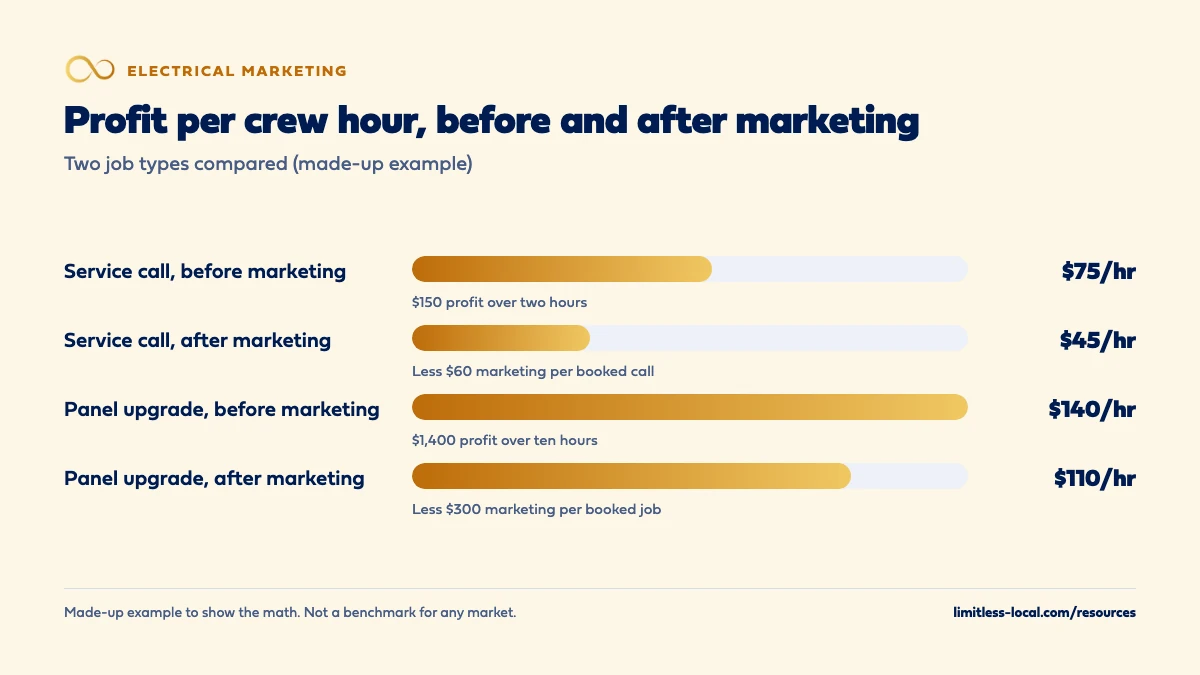
These numbers are made up to show the math, not a benchmark for your market. Say an electrician compares small service calls with panel upgrades from last year’s invoices.
- Service call: average invoice $250, gross profit $150 after parts and labor, about two crew hours with drive time. That’s $75 per crew hour. Marketing cost per booked service call: $60. After marketing, it leaves $90 for two hours, or $45 per crew hour.
- Panel upgrade: average invoice $2,800, gross profit $1,400, about ten crew hours including the estimate visit and inspection. That’s $140 per crew hour. Marketing cost per booked panel upgrade: $300. After marketing, it leaves $1,100 for ten hours, or $110 per crew hour.
Even though a booked panel upgrade costs five times as much in marketing, each crew hour on one earns more than double. That’s the case for moving ad budget, profile space and offers toward panel upgrades. It doesn’t mean dropping service calls: they keep the phone ringing, bring repeat customers and turn up the panels worth replacing.
Frequently asked questions
Will focusing on bigger jobs mean fewer calls?
Often, yes, at least at first. Narrower job types, negative keywords and tighter service areas cut some volume. The point is fewer wasted visits and more profit per crew hour, so judge it on booked revenue, not call count.
Should I stop taking small service calls?
Usually not. Small calls keep techs busy between bigger jobs, bring in new customers and turn up panels and wiring worth upgrading. Just don’t let them eat the budget meant for your best work.
Can raising my prices attract better clients?
It can filter out some bargain hunters, but price alone doesn’t attract anyone. Pair a higher price with visible proof: reviews that mention the job, photos, a clear warranty and fast, professional replies.
How long does it take to change my job mix?
Ad and Local Services Ads settings change who calls within weeks. Google profile, website and review changes build over months. Expect a full season before the mix shifts in a way you can measure.
Do I need different marketing for residential and commercial clients?
Yes. Homeowners mostly find you through Google, Maps and reviews. Commercial customers, builders and property managers lean on relationships, referrals and a short list of trusted shops.
Key takeaways
- Rank job types by profit per crew hour, after marketing, not by ticket size.
- List your best services first on your Google profile and website, with real photos and their own pages.
- Set Local Services Ads job types, Google Ads keywords and negative keywords to the work you want.
- Screen calls with a few questions and an upfront service call fee.
- Use offers that add value to planned projects, and track your job mix every month.
Not sure what's working right now?
Start with a free visibility audit: rankings, Google profile, reviews and tracking, checked against your service area.
More in this section
- How can an electrical contractor get more leads?
- How should a new electrical contractor get its first customers?
- How should an electrical contractor market to commercial customers?
- How do I run an electrical business that gets steady calls?
- How do I get more referrals from past electrical customers?
Sources
- Products and Services Report — Jobber Help Center
- Lead Source Report — Jobber Help Center
- Manage your services on your Business Profile — Google Business Profile Help
- Edit your industries, service areas, and job types — Google Local Services Help
- About Automated Local Services Ads lead credits — Google Local Services Help
- About negative keywords — Google Ads Help
- About targeting geographic locations — Google Ads Help