
What close rate should a pool builder expect from Google Ads leads?

- What close rate is realistic for pool construction leads from Google Ads?
- Why do Google Ads leads close lower than referrals?
- Is there a benchmark close rate for pool builders' Google Ads leads?
- What close rate do I need for Google Ads to pay?
- Should I measure close rate from leads or from consultations?
- How do search terms change who calls from my ads?
- How much does response time change my close rate on ad leads?
- How do I qualify Google Ads leads without scaring them off?
- How long should I wait before judging close rate on ad leads?
- How do I track close rate by lead source?
- What should I do if my Google Ads leads close too low?
- What's different about ad-lead close rates for pool builders
- A worked example: is this close rate high enough?
- Frequently asked questions
- Key takeaways
- More in this section
- Sources
The short version
- Ad leads usually close lower than referrals; that's normal, not a failure.
- No reliable published benchmark exists, so set your own break-even rate.
- Split it into lead-to-consultation and consultation-to-contract.
- Judge it over a full season, by search term and campaign, not by the week.
For pool builders running Google Ads who want to know whether their ad leads are closing at a healthy rate, and what to do if they aren’t.
Get a free visibility audit · Book a growth call
What close rate is realistic for pool construction leads from Google Ads?
Expect Google Ads leads to close at a lower rate than referrals, because many of those homeowners are early in their research and comparing several builders, and there’s no reliable published close rate for pool builders’ ad leads to hold yourself to. The rate you should expect is the one your own numbers can afford: at your average gross profit per pool and your cost per lead, enough ad leads have to sign to keep the cost of each contract well under what a pool leaves you. Measure it in two steps, leads to design consultations and consultations to contracts, over a full season, because ad leads can take months to sign.
Close rate by source is the number our reporting is built to show: every package includes call tracking with recording, form and chat lead tracking, source tagging and a monthly cost-per-lead breakdown. Google Ads management is part of our local ads work; the Essentials package is $3,500 a month and manages up to $2,500 a month in ad spend, which you pay to Google directly. See how it fits a pool builder’s plan on our pool builder marketing page, or browse more pool builder marketing questions.
Why do Google Ads leads close lower than referrals?
Because the homeowner arrives in a different place. A referral comes from a neighbor who swims in your pool every weekend; they already trust you and often aren’t talking to anyone else. A homeowner who clicks an ad for “pool builders near me” may be on their first evening of research, has likely clicked two or three other builders, and doesn’t know you yet.
That doesn’t make ad leads bad. They’re the leads you can turn up when the phone is quiet, in towns where nobody knows you yet. It means you should expect a lower share of them to sign, and plan your budget around that instead of comparing them with referrals and deciding ads don’t work.
For the general picture across every lead source, see what close rate is good for pool construction leads.
Is there a benchmark close rate for pool builders' Google Ads leads?
Not one worth planning around. Any figure you’ll find online mixes different markets, price points and definitions of a lead. One builder counts every call, including wrong numbers and pool-service requests; another counts only homeowners who booked a consultation. Their close rates can’t be compared.
A custom gunite builder selling six-figure projects and a fiberglass installer selling a standard package will also close ad leads at very different rates, and both can be healthy. So the useful question isn’t “what does everyone else get?” It’s “what rate do I need, and what am I actually getting?”
What close rate do I need for Google Ads to pay?
Work backward from your own numbers:
- Gross profit per pool. Your average contract minus materials, crew labor, subs and permits.
- Cost per lead from your ads, over a full season.
- Cost per contract = cost per lead divided by your close rate.
Your break-even close rate is the rate at which cost per contract equals gross profit per pool. You want to be well above it, because that profit also has to cover overhead, sales time and your own pay. If your ad leads cost a certain amount and only a small share sign, check the result against what a pool leaves you before deciding the rate is too low.
The worked example below runs the numbers end to end. A high-ticket build can afford a lower close rate than a smaller job, which is why the same rate can be fine for one builder and a problem for another.
Should I measure close rate from leads or from consultations?
Both, separately. They tell you different things and have different fixes:
- Leads to booked design consultations shows lead quality and follow-up: are the right homeowners calling, and are you reaching them fast enough to book them?
- Consultations to signed contracts shows your sales process: design, price, financing, trust.
If ad leads book consultations at a low rate but close well once they’re in front of you, the problem is upstream, in targeting or speed. If they book fine but rarely sign, look at who’s showing up to the consultation and how the proposal is going.
The first step is covered in what lead-to-appointment rate a pool builder should expect.
Curious what your marketing is actually booking?
Get a free visibility audit — no obligation, no sales pitch.
How do search terms change who calls from my ads?
A lot. The words a homeowner typed say how close they are to buying. “Inground pool builder” plus a town name is a different person from “how much does a pool cost” or “above ground pool” or “pool cleaning service”. If your ads show for all of them, your close rate is an average of very different people.
Google Ads’ search terms report shows the actual searches that triggered your ads and how those searches performed. Read it monthly. Add the ones you’ll never sell to (above ground, pool supplies, pool service if you don’t offer it, jobs and careers) as negative keywords, and move budget toward the terms that book consultations.
Cutting junk calls from paid ads has a starter list for pool builders.
How much does response time change my close rate on ad leads?
More than most owners expect, and more for ad leads than referrals. A referred homeowner will wait a day for your call. An ad lead who filled out three builders’ forms will talk to whoever calls first, and book with whoever makes it easy.
So close rate on ad leads is partly a measure of your office. If calls ring out during jobsite visits, or forms sit until the evening, you’re paying for leads that a faster competitor books. Answer live during business hours, call form leads back within minutes, and have a way to book the consultation on that first call.
How fast a pool builder should respond to a new lead goes through the setup.
How do I qualify Google Ads leads without scaring them off?
Ask a few plain questions on the first call or in the form: where the home is, roughly when they want to swim, what kind of pool they have in mind, and whether they’ve thought about budget or financing. That’s not interrogation; it’s what any good builder asks, and it helps the homeowner feel taken seriously.
The answers do two jobs. They tell you whether to book a design consultation now or nurture the lead for next season, and they show you which ads bring homeowners who are ready. A lead planning to build in two years isn’t a lost lead; it’s a lead with a different timeline, and counting it as lost will drag your close rate down unfairly.
More on this in how pool builders qualify leads before the design consultation.
How long should I wait before judging close rate on ad leads?
At least a full season. A pool lead can take months to sign. If you judge a campaign by contracts signed this month, you’ll undercount it every time.
Google Ads has the same issue built in. Its definition of a conversion cycle is the time it takes for a click to result in a conversion, and if you import conversions, that includes the time it takes for them to be reported. Its page on conversion windows says the default window is 30 days and that a longer window suits businesses whose buying cycle doesn’t fit it. Conversions that happen after the window ends aren’t recorded.
For a pool builder, that means setting a longer window on any signed-contract conversion you send back to Google, and doing your own count by lead date, not contract date: of the leads that came in during March, how many have signed by September?
How do I track close rate by lead source?
Tag the source on every lead the day it comes in, then mark each one won, lost or still open. Most field software can report on this. Housecall Pro’s conversion rate reporting, for example, available to Pipeline users, shows lead conversion by lead source and calculates conversion rate as won leads out of all leads, including open ones.
That last detail matters for pools. Open leads still deciding sit in the total and pull the rate down until they’re resolved, so read the numbers for leads from a few months ago, not last week.
To close the loop with Google, offline conversion imports let you report back when a lead converts offline, at your office or over the phone, so Google can see which clicks turned into signed pools. Google now recommends starting with enhanced conversions for leads, which it describes as an upgraded, easier version. What conversion tracking means for a pool builder explains the setup.
What should I do if my Google Ads leads close too low?
Find the step where they fall out before changing the budget:
- Few consultations booked: check search terms, location targeting and speed to call back.
- Consultations booked, few signed: look at who’s showing up. Price shoppers and homeowners outside your area point back to targeting; good-fit homeowners who don’t sign point to the proposal and follow-up.
- Leads still open: give them time, and keep in touch through the season.
- Rate low but cost per contract fine: leave it. A low close rate on cheap leads can still be a good deal.
Change one thing at a time and give it a season, or you won’t know which change helped.
Not sure which of these is costing you jobs?
A free visibility audit checks the Google profile, reviews, site and tracking, and shows what to fix first.
What's different about ad-lead close rates for pool builders
Long decisions. Homeowners design, get financing, check permits and wait for the season. Close rate on this month’s ad leads won’t be known for months.
Few contracts, big swings. One more or one fewer signed pool moves your close rate a lot. Look at a full season, and two if you can.
Mixed demand in the same searches. Pool searches include builds, remodels, service, supplies and above-ground pools. Keeping your ads on the work you sell matters more than in many trades.
Seasonal shoppers. Off-season ad leads often plan for next year. Count them as open and follow up, not as lost.
A worked example: is this close rate high enough?
This builder is made up to show the math, not a benchmark for your market.
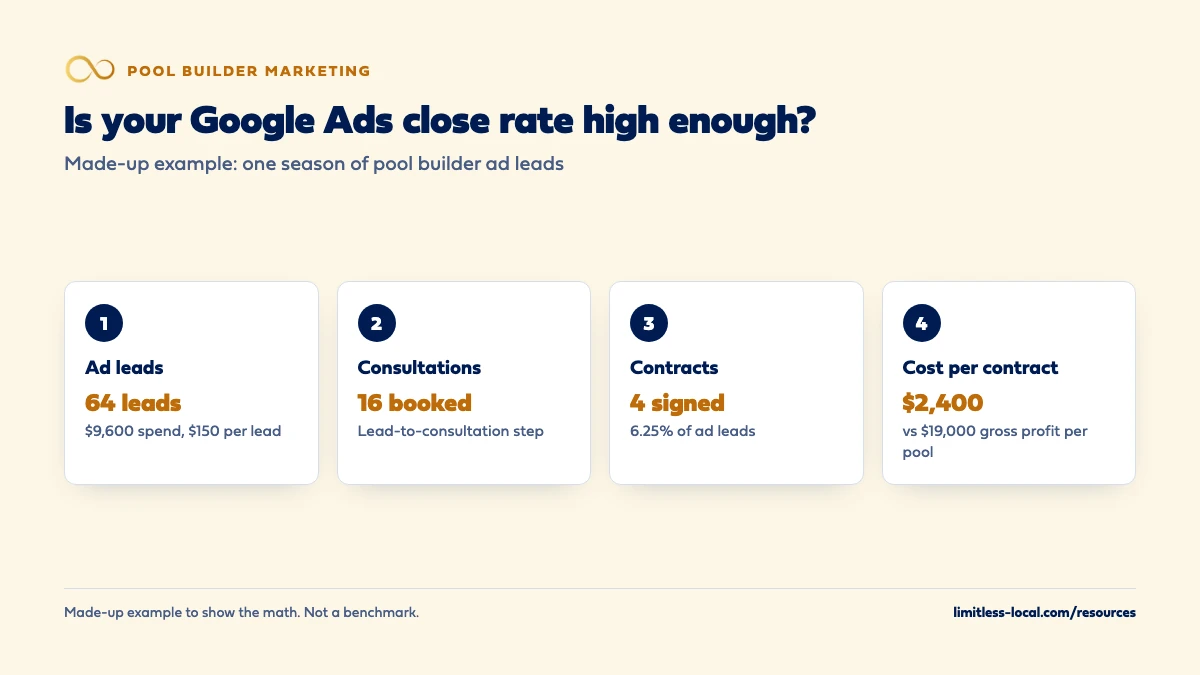
Over one season, Google Ads cost $9,600 and brought 64 real leads, so $150 per lead. Of those, 16 booked a design consultation and 4 signed. That’s a lead-to-contract close rate of 6.25%, and a consultation-to-contract rate of 25%.
Referrals that season: 12 leads, 7 consultations, 4 contracts, a close rate of about 33%. On close rate alone, ads look far worse.
Now the money. Cost per contract from ads is $9,600 divided by 4, or $2,400. The builder’s average pool leaves $19,000 in gross profit. At $150 a lead, the break-even close rate is $150 divided by $19,000, under 1%. A 6.25% close rate is comfortably above it, so the ads are paying, even though they close at about a fifth of the referral rate.
The next step is improving it: the search terms report shows a share of the leads came from “above ground pool” searches, which go on the negative list.
Frequently asked questions
Is a 5% close rate on Google Ads leads bad for a pool builder?
Not necessarily. It depends on your cost per lead and what a pool leaves you. Work out cost per contract first; a low rate on affordable leads can still pay well.
Should I count calls from homeowners outside my service area as leads?
Count them so you can see the problem, but report them separately. If many come in, tighten your ad location settings rather than letting them drag down the close rate.
Do Google Ads form leads close worse than calls?
It varies by builder, so tag each lead as a call or a form and compare. Whatever the gap, calling form leads back quickly narrows it.
Can Google Ads optimize for signed contracts instead of leads?
Yes, if you send signed contracts back to Google Ads as offline conversions. With a long sales cycle, set a conversion window long enough to catch them.
Should my sales rep's close rate on ad leads match referrals?
No. Compare reps on the same kind of lead. A rep who gets mostly ad leads will show a lower rate than one who gets mostly referrals.
How many leads do I need before my close rate means anything?
Enough that one contract more or less doesn’t swing it wildly. For most pool builders that means a full season of ad leads at least.
Key takeaways
- Google Ads leads usually close lower than referrals; judge them on cost per contract, not close rate alone.
- There’s no reliable published benchmark, so work out your own break-even close rate.
- Measure leads to consultations and consultations to contracts separately.
- Search terms, response time and qualification move the rate more than budget does.
- Count by lead date over a full season, and send signed contracts back to Google Ads.
Want a second set of eyes on your setup?
We'll look at how you show up locally and where calls are leaking, then send you a plain-English breakdown.
More in this section
- What close rate is good for pool construction leads?
- How long do Google Ads take to bring a pool builder calls?
- How much do competing pool builders spend on Google Ads?
- Are Google Ads worth it for pool builders?
- What monthly ad spend gets a pool builder steady leads?
Sources
- About the search terms report — Google Ads Help
- Conversion cycle: Definition — Google Ads Help
- About conversion windows — Google Ads Help
- About offline conversion imports — Google Ads Help
- Conversion Rate Reporting — Housecall Pro Help Center