
What should a sewage cleanup page say to get emergency calls?
- What does a sewage backup cleanup page need to turn visitors into emergency calls?
- Does sewage cleanup need its own page?
- What should the top of a sewage cleanup page say?
- What should the page tell a homeowner to do before we arrive?
- What can a sewage page say about health risks?
- How should the page explain our cleanup process?
- Should the page say who fixes the sewer line?
- What proof belongs on a sewage cleanup page?
- How should a sewage page handle insurance?
- What should the call to action be?
- What words should a sewage cleanup page use?
- What should a sewage cleanup page leave out?
- What's different about a sewage page compared with a clean-water page
- A worked example: what moving the phone number can change
- Frequently asked questions
- Key takeaways
- More in this section
- Sources
The short version
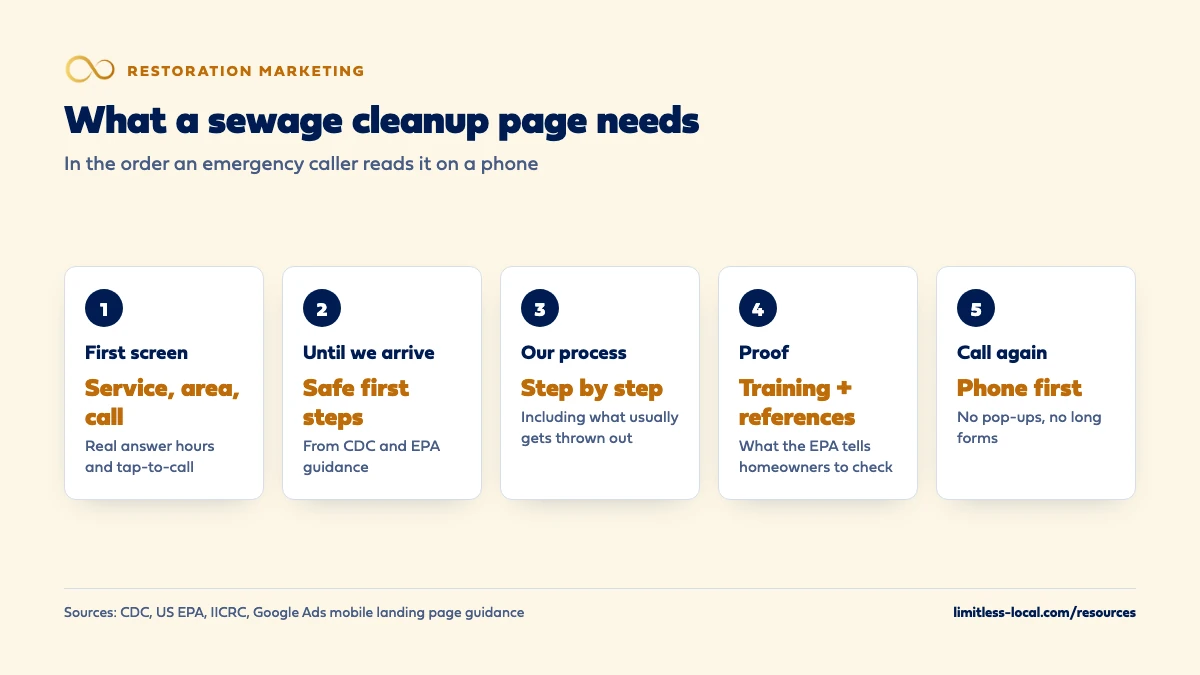
- Top of the page: sewage backup cleanup, your service area, real answer hours, and a tap-to-call number.
- Safe first steps for the homeowner, taken from CDC and EPA guidance, not your own warnings.
- Your process in plain words, including what usually gets thrown out and why.
- Proof the EPA tells homeowners to look for: qualifications, training, experience and references.
For restoration owners building or fixing the sewage cleanup page on their website, so the people who land on it call.
Get a free visibility audit · Book a growth call
What does a sewage backup cleanup page need to turn visitors into emergency calls?
A sewage cleanup page should tell a homeowner within one phone screen that you handle sewage backups, where you go, when someone answers, and how to call, then explain what to do and avoid until your crew arrives and how your cleanup works. Back it up with real proof, such as your certifications, training, crew photos and reviews, and keep any health statement to what a government source such as the EPA or CDC says. Leave out promises you can’t support, like guaranteed insurance coverage or a home declared safe.
Pages like this are what our website work for restoration companies is built around: a page per job type, with the phone number where an emergency caller expects it. The restoration marketing guide covers how the website fits with ads, SEO and referrals, and the restoration marketing questions library takes the rest one question at a time.
Does sewage cleanup need its own page?
In our judgement, yes, if it’s work you want. A homeowner with a sewage backup isn’t reading a general water damage page and hoping you also do sewage. They want a page that says you handle exactly this, in their town, now. A separate page also lets you say things that don’t belong on a clean-water page: what to avoid touching, what usually can’t be saved, and how you protect your crew and the household.
It works the same way for other loss types. What a restoration website should say about mold and fire damage covers those pages, and the water damage page is the one most sewage jobs sit next to.
What should the top of a sewage cleanup page say?
Someone standing in a basement with sewage on the floor reads the first screen and decides. In our judgement, that screen needs five things:
- What you do, in their words: sewage backup cleanup, sewer backup, toilet overflow.
- Where you go: your city and the towns your crews really reach.
- When someone answers: the hours a person picks up, not a promise you can’t staff.
- A tap-to-call number, large and repeated, plus a text option if you answer texts quickly.
- What happens when they call: who they’ll talk to and roughly what comes next.
Google’s own advice on mobile landing pages backs the layout: a mobile page should be free of clutter, easy to read and quick to load, prospects will wait only seconds for a page to load, and full-size pop-ups over the page disrupt the visit. Source: Optimizing your mobile landing page.
What should the page tell a homeowner to do before we arrive?
A short, sourced “until we get there” list builds trust and keeps people safe. Use government guidance rather than your own warnings, and link to it:
- The CDC says to wash hands after contact with floodwater, to wear rubber boots, rubber gloves and goggles if you must enter floodwater, and to wash clothes contaminated with flood or sewage water in hot water and detergent before reusing them.
- The EPA says not to use an HVAC system to dry the house if any part of it was affected by the flood, and to have a professional clean it.
- The EPA also says people with breathing problems or weakened immune systems, children and pregnant people should not take part in flood cleanup.
In our judgement, keep this list short and practical, and end it with the reason to call you rather than a reason to panic. Sources: Safety Guidelines: Floodwater and Flood Cleanup to Protect Indoor Air and Your Health.
What can a sewage page say about health risks?
Only what a credible source says, attributed and linked. A state homeowner guide on sewer backups, from the Colorado Department of Public Health and Environment, says untreated sewage contains disease-causing organisms such as bacteria, viruses and parasites. The CDC says floodwater may contain sewage, and that eating or drinking anything contaminated by it can cause diarrheal disease. The EPA says flood water can bring microorganisms, including from sewage, inside buildings, and that exposure during cleanup can cause allergic or irritant effects, or in some cases infectious diseases.
That’s enough to explain why sewage isn’t a mop-and-bucket job. Going further is a legal risk as well as a trust one: the FTC says advertising must be truthful and non-deceptive, that advertisers need evidence for their claims before an ad runs, and that it pays closest attention to ads making health or safety claims. It also says statements from satisfied customers usually aren’t enough to support a health or safety claim. This is general guidance, not legal advice. In our judgement, a calm, sourced paragraph converts better than scare copy anyway. Sources: Homeowner guidance on cleaning up after residential sanitary sewer backups, Safety Guidelines: Floodwater, Flood Cleanup to Protect Indoor Air and Your Health and Advertising FAQs: A Guide for Small Business.
How should the page explain our cleanup process?
Step by step, in the order the homeowner will see it, and with the parts that surprise people stated up front. In our judgement a sewage page should walk through inspection, removing the standing water, taking out what can’t be saved, cleaning and disinfecting, drying, and checking the work before repairs, using your own process names and photos.
The state sewer backup guide gives you honest expectations to borrow:
- Mattresses, pillows, foam items, upholstered furniture, books and most paper products should generally be thrown out, because they soak up contamination and are hard to disinfect.
- Wall-to-wall carpet that gets wet usually has to be replaced, and foam padding likely will.
- Microorganisms can get deep into soaked drywall, insulation and wood.
- Drying an enclosed area such as a basement or crawl space can take several weeks.
If you follow the IICRC S500 standard, say so; the IICRC describes it as setting out the procedures and precautions for professional water damage restoration. Sources: Homeowner guidance on cleaning up after residential sanitary sewer backups and ANSI/IICRC S500.
Curious what your marketing is actually booking?
Get a free visibility audit — no obligation, no sales pitch.
Should the page say who fixes the sewer line?
Yes, because it’s the homeowner’s next question. The IICRC says its S500 water damage standard assumes that finding and correcting the source of the water is the property owner’s responsibility, not the restorer’s, though the owner may hire the restorer or other specialists to do it. In our judgement, a backed-up sewer line usually needs a plumber before cleanup can finish.
In our judgement, say plainly how you handle it: whether you have a plumber you work with, whether the homeowner should call theirs first, and what you’ll do in the meantime. If you don’t have that relationship yet, building a referral network with plumbers is worth reading. Source: ANSI/IICRC S500.
What proof belongs on a sewage cleanup page?
The EPA gives homeowners a checklist for hiring a flood cleanup professional: ask about qualifications, training and experience, and check references. It says a qualified professional may have certification, training or experience in water damage restoration, mold removal or drying out buildings, and names organizations such as the IICRC. It also says the EPA has no certification program or contractor list of its own.
So put those answers on the page, and only the true ones:
- Certifications you or your technicians actually hold.
- Training your crews have completed.
- Photos of your own crews in protective gear with your equipment, with no customers’ faces or identifiable homes.
- Reviews that mention sewage or backup jobs.
What makes homeowners trust a restoration company they find online goes further on proof. Source: Flood Cleanup to Protect Indoor Air and Your Health.
How should a sewage page handle insurance?
Briefly and carefully. In our judgement, it’s fine to say that you document the job with photos and readings and can work with the homeowner’s insurance company, and that coverage for sewer backups depends on their policy. It isn’t fine to say a backup “is covered”, that you’ll “get your claim approved”, or anything that reads like insurance or legal advice.
Point the homeowner to their insurer or agent for coverage questions, and keep your role to what you actually do. Whether a restoration website should explain the claims process covers how much to say across the site.
What should the call to action be?
A phone call first. In our judgement, a sewage emergency is a call, not a contact form, so the button should dial, sit near the top, and repeat after each section. Google’s mobile landing page advice notes that forms are inconvenient on mobile and can cause visitors to leave, and that full-size pop-ups and chat boxes over the page disrupt the visit.
Add a text option only if someone answers texts quickly, and say what happens after hours honestly. A page that promises a person at any hour and sends calls to voicemail loses the job and the review. How fast a restoration company needs to answer emergency calls covers the coverage side. Source: Optimizing your mobile landing page.
What words should a sewage cleanup page use?
The ones homeowners type. Google’s SEO starter guide suggests thinking about the different words people might search for, since people who know a topic well use different words from people who are new to it. A homeowner searches “sewage backup in basement” or “toilet overflowed everywhere”, not an industry category number.
In our judgement, use the plain phrases in your headings and first paragraphs, and if you use trade terms such as “Category 3” or “black water”, explain them in a sentence. Give the page a clear title naming the service and your city, and link to it from your water damage page and main menu. The ranking side is covered in how to rank for water damage restoration in your city. Source: SEO Starter Guide.
What should a sewage cleanup page leave out?
In our judgement, these lose trust or create risk:
- Promises you can’t keep: “100% safe when we leave”, “we kill all bacteria”, or a guaranteed arrival time you can’t staff around the clock.
- Insurance promises: anything saying the job is covered or the claim will be paid.
- Health claims beyond your sources: the FTC says advertisers need evidence for their claims and pays closest attention to health and safety claims.
- Shock photos: close-ups of waste or customers’ homes. Show equipment and crews instead.
- Certifications you don’t hold, or logos you’re not entitled to use.
- Long company history above the phone number.
Source: Advertising FAQs: A Guide for Small Business.
Want to see where your company stands?
A free visibility audit shows where you show up on Google, Maps and AI answers, and what it's costing you in calls.
What's different about a sewage page compared with a clean-water page
More of the contents go. The state guidance says porous items that soaked up sewage generally can’t be saved. In our judgement, saying so on the page heads off the hardest conversation on site.
Safety comes before speed. A clean-water page can lead with how fast you dry. A sewage page, in our judgement, should lead with how fast you answer and then what the household should avoid until you arrive.
A plumber is often part of the job. The cause usually needs fixing by someone else, so the page should explain how that fits with your work.
Commercial callers read it too. Property managers and facility managers deal with backups in multi-unit buildings. In our judgement, a short paragraph on how you handle occupied buildings and after-hours access helps them pick you.
A worked example: what moving the phone number can change
These numbers are made up to show the math, not a benchmark or a forecast. Say your sewage cleanup page gets 150 visits a month, and your call tracking shows 6% of visitors call, or 9 calls. The phone number sits at the bottom of the mobile page, under a block of company history.
You rebuild the top screen: sewage backup cleanup, your towns, real answer hours and a tap-to-call button, with the safety list and process below. If the same 150 visits then called at 10%, that would be 15 calls. Nothing about your ranking changed; the page simply asked for the call where the visitor was looking. Your call log and job records then tell you how many became booked jobs, which is the number that matters.
On our side, a themed website is $3,750 ($3,000 with any of our marketing packages), up to 25 pages, which is room for a page per loss type plus the towns you serve. A free visibility audit is a simple way to see how your current pages read on a phone.
Frequently asked questions
Should the sewage page show prices?
In our judgement, rarely as a fixed number, because sewage jobs vary with the area affected and what has to be removed. Explain how you price and when the homeowner will get an estimate instead.
Can I tell homeowners not to clean sewage themselves?
You can point to what the EPA says: flood cleanup can be difficult and dangerous, it may be best to get help from experienced and qualified professionals, and some people shouldn’t take part at all.
Should I mention the EPA or CDC by name?
Yes, when you’re repeating what they say, with a link to the page. It shows the homeowner where the advice comes from and keeps you from making health claims of your own.
Does the EPA certify sewage cleanup companies?
No. The EPA says it doesn’t have a certification program or keep a list of flood cleanup contractors, and that some states and organizations may require certification or training.
Should the sewage page link to my water damage page?
Yes, in our judgement, both ways. Many sewage jobs also involve water damage, and linking related pages helps visitors and search engines see how your services fit together.
Is a separate commercial sewage page worth it?
Only if you do enough commercial work to say something specific about it, such as occupied buildings, after-hours access and working with property managers. Otherwise a section on the main page is enough.
Key takeaways
- Give sewage cleanup its own page, and make the first phone screen say what you do, where, when someone answers, and how to call.
- Borrow safe first steps and health statements from the CDC, EPA and state guidance, attributed and linked.
- Explain your process honestly, including what usually gets thrown out and who fixes the sewer line.
- Show the proof the EPA tells homeowners to look for, and only proof that’s true.
- Leave out insurance promises, health claims beyond your sources, and shock photos.
Not sure what's working right now?
Start with a free visibility audit: rankings, Google profile, reviews and tracking, checked against your service area.
More in this section
- How fast does a restoration company need to answer emergency calls?
- What should a restoration website say about mold and fire damage?
- Who should answer restoration calls after hours?
- Which Google Ads keywords should a water damage company target?
- How should a restoration company handle marketing during storm season?
Sources
- Flood Cleanup to Protect Indoor Air and Your Health — US EPA
- Safety Guidelines: Floodwater — CDC
- Homeowner guidance on cleaning up after residential sanitary sewer backups — Colorado Department of Public Health and Environment (hosted by Vermont DEC)
- ANSI/IICRC S500 Standard for Professional Water Damage Restoration — IICRC
- Advertising FAQs: A Guide for Small Business — Federal Trade Commission
- Optimizing your mobile landing page for sales — Google Ads
- SEO Starter Guide — Google Search Central