
Why do restoration ad costs spike during storms and freezes?
- Why do water damage clicks and leads cost more right after a storm or a hard freeze?
- Why do restoration ad costs jump when the weather turns?
- How does the Google Ads auction decide what I pay per click?
- Why does more competition raise every click, not just the top spot?
- Why do Local Services Ads leads cost more after a storm?
- How does automated bidding react to a surge?
- Why does my daily spend look higher than my budget during a storm?
- Why do hard freezes cause their own spike?
- Is a higher cost per click always bad during a surge?
- How do I see who is driving my costs up?
- How should I set bids and budgets before the next storm or freeze?
- When should I stop paying the surge price?
- What's different about ad cost spikes in restoration
- A worked example: when a pricier click still books cheaper
- Frequently asked questions
- Key takeaways
- More in this section
- Sources
The short version
- More companies bid on the same searches at once, and the auction prices that competition in.
- LSA lead prices are set by competing bids too, so they rise when everyone bids.
- Automated bidding and daily budgets can spend more on busy days unless you cap them.
- Judge a surge by cost per booked job, not cost per click.
For restoration owners who watch cost per click and cost per lead jump the week the weather turns, and want to know why before deciding what to do about it.
Get a free visibility audit · Book a growth call
Why do water damage clicks and leads cost more right after a storm or a hard freeze?
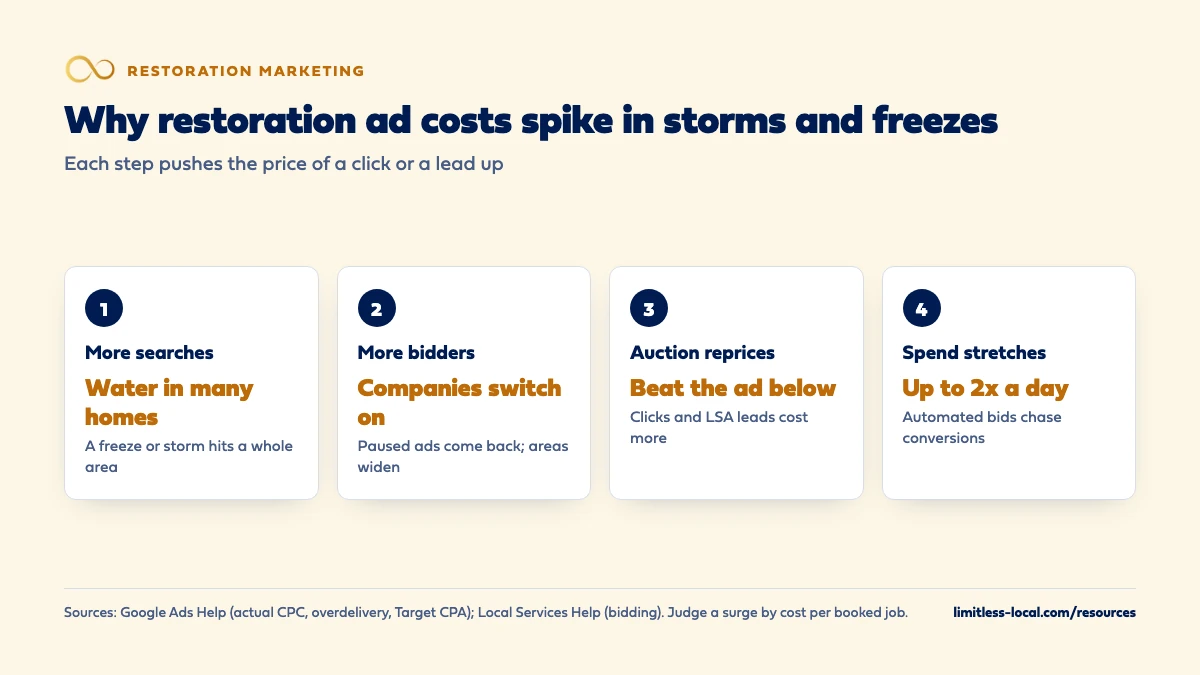
Restoration ad costs spike during storms and freezes because more restoration companies bid on the same searches at the same moment, and Google’s ad auction charges each advertiser what it takes to beat the ad ranked just below it, so more competition pushes prices up. Local Services Ads work the same way: Google says that when similar local businesses bid on the same lead, those bids determine how much the lead is worth. Automated bidding and budgets that can spend up to twice the daily amount on a busy day add to it, so set your bid limits, targets and capacity-based budget caps before the weather turns, not during the surge.
Storm and freeze weeks are when restoration ad budgets are easiest to waste, which is why we set bidding and budget rules up front when we run Google Ads and Local Services Ads. Our restoration marketing work ties every call back to booked jobs, so a spike in cost per click gets judged by what it actually booked. The water damage leads guide covers typical lead costs, and the restoration marketing questions library takes the rest one at a time.
Why do restoration ad costs jump when the weather turns?
Several things happen at once, and each one pushes cost up:
- More people search. A hard freeze or a big storm puts water in many homes in the same area within a few days.
- More companies bid. In our judgement, restoration companies that pause or trim ads in quiet weeks often turn them back on when the weather hits, and out-of-area companies may widen their targeting.
- The auction prices that competition in. Google charges what it takes to beat the ad below yours, so more and stronger competitors raise what you pay.
- Automation and budgets react. Automated bidding chases the extra conversions, and daily budgets can overspend on busy days.
None of that is a glitch. It’s how the system is designed to work, which is why the useful response is planning, not panic.
How does the Google Ads auction decide what I pay per click?
By the competition at that moment. Google’s definition of actual cost-per-click says you pay only what’s minimally required to clear the Ad Rank thresholds and beat the Ad Rank of the competitor immediately below you; if there’s no competitor below you, you pay only the reserve price. Ad Rank combines your bid, the quality of your ad and landing page, the thresholds, the competitiveness of the auction, the context of the search and the expected impact of your assets.
The same page notes that the competitiveness of the auction affects actual cost per click: as the gap in Ad Rank between two advertisers grows, the higher-ranked ad is more likely to win but may pay a higher cost per click for that certainty. Put simply: in a quiet week you may be competing with two other companies; the morning after a freeze, you may be competing with eight, and every one of them sets the floor you have to beat.
Why does more competition raise every click, not just the top spot?
Because each position has its own price floor set by the ad beneath it. Google’s own simplified example shows each advertiser paying just enough to beat the next Ad Rank down, or the minimum threshold if no one is below. When more restoration companies clear the thresholds for “water damage restoration” in your town, there’s a stronger ad below almost every position, so almost every position costs more.
Google adds that Ad Rank thresholds, and so actual cost per click, are typically higher for ads shown above the search results than below them. In our judgement, that’s why the top-of-page clicks restoration owners want most in an emergency rise fastest during a surge.
Why do Local Services Ads leads cost more after a storm?
The same principle, applied per lead. Google’s page on how bidding works for Local Services Ads says a bid is the most you’d pay for a lead, and that when similar local businesses bid on the same lead, those bids determine how much the lead is worth. It also lists three bid modes: Maximize leads (Google sets the bid), Target cost per lead, and Max per lead, where you manually set the most you’d pay.
So when more restoration companies raise bids or budgets for the same storm, lead prices can climb. If you’re on Maximize leads, Google is choosing the bid for you. In our judgement, a Max per lead or Target cost per lead setting decided before the weather turns is the simplest way to keep a surge from setting your price. Google Ads, LSAs or both covers how the two channels differ.
How does automated bidding react to a surge?
It goes after the extra conversions, and Google says plainly that cost can move. Its Target CPA page says some conversions may cost more than your target and some less, because your actual cost per conversion depends on factors outside Google’s control, including increased competition in ad auctions, and your actual conversion rate can be lower or higher than predicted.
Google also says Smart Bidding already manages seasonal events, and offers seasonality adjustments for when you expect major changes to conversion rates in a short event. It describes them as ideal for events of one to seven days, and says they may not work as well for periods longer than 14 days. In our judgement, most restoration accounts should leave them alone unless they have reliable conversion tracking and a clear forecast, because a wrong adjustment tells the system to bid harder at exactly the wrong time.
Curious what your marketing is actually booking?
Get a free visibility audit — no obligation, no sales pitch.
Why does my daily spend look higher than my budget during a storm?
Because Google allows it. Google’s page on overdelivery and your average daily budget says that on a given day, a campaign might spend up to twice its average daily budget to take advantage of fluctuations in traffic, and that over a month you won’t be charged more than 30.4 times the average daily budget. A storm day is exactly the kind of traffic fluctuation that page describes.
So a $120 daily budget can spend up to $240 on the first day of a freeze. That’s within the rules, but it can surprise an owner watching the account from a phone. Marketing during storm season covers how budget changes take effect when you raise or lower them mid-month.
Why do hard freezes cause their own spike?
Because burst pipes cluster. The National Weather Service says pipes on exterior walls and in places exposed to cold, such as basements, attics and under kitchen cabinets, freeze most often, and that water expands as it freezes, causing pipes to burst. A hard freeze hits a whole area at once, so in our judgement the calls, and the searches, tend to arrive within the same few days, often as temperatures climb back up and frozen pipes thaw.
Unlike a hurricane, a freeze can catch restoration companies with ads paused or budgets set for a quiet month. That makes the first day expensive for anyone whose settings react late, and cheaper for anyone who decided in advance what they’d spend.
Is a higher cost per click always bad during a surge?
No. In our judgement, the clicks during a freeze or storm often come from people with water on the floor right now, so a larger share of them may call and book. If that’s true in your account, a higher cost per click can still mean the same or a lower cost per booked job. The worked example below shows the math.
The only way to know is to track calls to booked jobs by source and week, and compare storm weeks with normal ones. A good cost per booked job covers what to measure against.
How do I see who is driving my costs up?
Use auction insights. Google’s auction insights report for Search campaigns shows how often another advertiser’s ad appeared when yours did (overlap rate) and how often your ad ranked higher than theirs or showed when theirs didn’t (outranking share), among other measures.
Run it for the storm week and a normal week and compare. In our judgement, if new names appear with high overlap during the surge, you’re seeing companies that switched on or expanded for the storm. That’s useful for planning: it tells you whether next time you should bid earlier, cap harder, or lean on your Google profile and referrals instead.
How should I set bids and budgets before the next storm or freeze?
Decide the limits in a quiet week, in our judgement in this order:
- Start from capacity. How many new water jobs can your crews start in a day? That sets the most leads worth paying for.
- Set a cost ceiling. A Target CPA, a Max per lead bid for LSAs, or both, based on what a booked job is worth to you.
- Set a surge budget. Decide the daily budget you’ll raise to, remembering a day can spend up to twice that.
- Tighten keywords. Keep money on the emergency terms that book jobs; Google Ads keywords for water damage covers which ones.
- Write the stop rule. When the schedule is full or arrival times slip, budgets come down.
When should I stop paying the surge price?
When you can’t take the jobs. In our judgement, the most expensive leads in a storm are the ones your crews can’t reach in time, because you pay for them and the homeowner books someone else. Once your schedule is full, lowering budgets or pausing campaigns is the cheapest decision you’ll make all week.
Avoiding leads your crews can’t handle goes deeper on matching ad spend to capacity, and the storm-season page linked above covers the timing of raising and lowering budgets.
Want to see where your company stands?
A free visibility audit shows where you show up on Google, Maps and AI answers, and what it's costing you in calls.
What's different about ad cost spikes in restoration
Demand arrives all at once. Most trades see seasonal swings over weeks. Restoration demand can jump overnight when a freeze or storm hits a whole area, and the ad auction reprices just as fast.
Everyone is chasing the same few searches. Emergency water searches are short and urgent, so many companies bid on nearly the same terms. That concentrates competition more than in trades with long lists of different job types.
The cost of a missed job is high. A homeowner with water on the floor won’t wait, so the companies that can answer and arrive fast can justify paying more per click, while companies that can’t are paying for leads that go elsewhere.
A worked example: when a pricier click still books cheaper
These numbers are made up to show the math, not a benchmark. In a normal week, say your clicks cost $20 and 10% of them turn into booked jobs. That’s 10 clicks per job, or $200 per booked job.
The morning after a hard freeze, clicks cost $30. If 15% of those clicks book, because more of the searchers have water on the floor right now, a booked job takes about 6.7 clicks: $30 times 6.7 is about $200 again. If only 10% book, it’s 10 clicks at $30, or $300 per booked job. Same spike in cost per click, very different result, and the only way to know which one you’re in is call tracking tied to booked jobs.
Every one of our packages includes call tracking with recording and source tagging, plus a monthly report with a cost-per-lead breakdown, so a storm week can be judged on jobs, not clicks. Ad spend is paid to Google separately. Our Essentials package is $3,500 a month and includes Google Ads management for up to $2,500 a month in ad spend; Local Services Ads management starts with our Growth package.
Frequently asked questions
Can I bid on the storm's name to get cheaper clicks?
We wouldn’t. Google’s Sensitive Events policy covers natural disasters and lists using keywords related to a sensitive event to drive additional traffic among the things it doesn’t allow, so keep the money on your normal emergency terms.
Should I pause ads when costs spike?
Only if you can’t take the jobs or your cost per booked job has climbed past what a job is worth. A higher cost per click alone isn’t a reason to stop, because storm searchers may book at a higher rate.
Do my Google reviews affect how much I pay during a storm?
For Local Services Ads, Google says quality service, including responsiveness and reviews, still matters alongside your bid in where you rank. For search ads, the quality of your ad and landing page is part of Ad Rank, which affects what you pay.
Why did my competitor show above me even though I raised my bid?
Ad Rank isn’t bid alone. Google combines your bid with ad and landing page quality, the context of the search and other factors, so a competitor with a better ad or page can outrank a higher bid.
How fast do costs come back down after a storm?
There’s no fixed timeline; it depends on when competitors pull back and when searches fall. Watch your own cost per click and auction insights week by week rather than waiting for the news cycle to end.
Should I raise my LSA budget before a forecast freeze?
Only as far as your crews can handle, and with a bid limit or target already set. Raising the budget without a ceiling on Maximize leads lets Google choose what you pay during the busiest days.
Key takeaways
- In Google’s auction, you pay what it takes to beat the ad below yours, so more competitors raise prices.
- For Local Services Ads, Google says competing bids from similar businesses determine what a lead is worth.
- A campaign can spend up to twice its average daily budget on a busy day.
- Google’s Target CPA page says increased competition can push cost per conversion above your target.
- A pricier click can still mean the same cost per booked job if more storm searchers book; track it.
- Set capacity-based caps, bid limits and a stop rule before the weather turns.
Not sure what's working right now?
Start with a free visibility audit: rankings, Google profile, reviews and tracking, checked against your service area.
More in this section
- How do I keep restoration work coming in between storms?
- How should a restoration company handle marketing during storm season?
- How do I keep marketing steady while hiring restoration techs?
- What is a good cost per booked job for a restoration company?
- What does a restoration lead cost on Local Services Ads?
Sources
- Actual cost-per-click (CPC): Definition — Google Ads Help
- Sensitive events — Advertising Policies Help
- How bidding works for Local Services Ads — Local Services Help
- About Target CPA bidding — Google Ads Help
- About seasonality adjustments — Google Ads Help
- About overdelivery and your average daily budget — Google Ads Help
- Use auction insights to compare performance — Google Ads Help
- Safety During and After the Cold — National Weather Service