
Is my restoration marketing agency producing real jobs?

- How do I tell if my restoration marketing agency is bringing in real jobs, not just leads?
- What counts as a real job when I judge a restoration marketing agency?
- Mistake 1: Judging the agency on how many leads it reports
- Mistake 2: Giving the agency credit for jobs it didn't find
- Mistake 3: Judging insurance-paid work in the month the call came in
- Mistake 4: Never listening to the calls
- Mistake 5: Letting the agency's dashboard be the only scoreboard
- Mistake 6: Judging SEO and ads on the same clock
- Mistake 7: Not owning your own accounts
- What should I ask my restoration agency at the next review?
- What are the red flags that my restoration agency isn't producing jobs?
- Is it the agency, or is something on my end?
- What's different when you judge a restoration agency
- A worked example: the month with more leads was the worse month
- Frequently asked questions
- Key takeaways
- More in this section
- Sources
The short version
- Real jobs means signed jobs from new customers the agency's work found.
- Count its fee plus your ad spend, divided by those signed jobs.
- Strip out out-of-area calls, info seekers and referral work before judging.
- Judge insurance-paid jobs on what they collected, filed under the month the lead came in.
For restoration owners already paying an agency who want to check its work against signed jobs and the money those jobs bring in.
Get a free visibility audit · Book a growth call
How do I tell if my restoration marketing agency is bringing in real jobs, not just leads?
Your restoration marketing agency is producing real jobs if it can show, every month, which signed jobs came from its work, what those jobs were invoiced and paid, and what each signed job cost you with its fee and your ad spend both counted. Lead counts, clicks and rankings don’t settle it, especially in restoration, where out-of-area calls, people looking for insurance or disaster-aid answers, and referral jobs can pad a report. Check the agency’s numbers against your own job records, and judge insurance-paid work once the payments land, not in the month the call came in.
We’re an agency too, so this is the standard we hold ourselves to. Every one of our packages includes monthly performance reports with a cost-per-lead breakdown, full-channel attribution across phone, web, chat and social, call tracking with recording and transcription, form and chat lead tracking, and source tagging, plus a real-time dashboard; the full list is on our packages page, and our restoration marketing page covers how it applies to water, fire and mold work. If you’re still deciding whether to hire anyone at all, the restoration marketing guide covers DIY versus hiring, and the rest of the restoration marketing questions library goes question by question.
What counts as a real job when I judge a restoration marketing agency?
A real job is a signed job from a new customer that the agency’s work brought in: the property owner authorized the work, inside your service area, and they found you through a channel the agency runs. Then, once the money comes in, it’s a job with a collected value you can put next to what you spent.
Everything short of that is a step along the way. Calls, form fills, inspections and estimates are useful to watch, but in restoration the gap between “a call came in” and “we got paid” is wider than in most trades: some calls aren’t real customers, some customers never sign, and insurance-paid jobs can take weeks to pay. An honest report shows each step, so you can see where jobs are being lost.
Mistake 1: Judging the agency on how many leads it reports
A lead count can look great while the schedule stays thin. Before you accept the number, ask how many of these are in it:
- Out-of-area calls. Restoration ads can pull calls from far outside the towns you serve.
- Information seekers. People looking for disaster-aid help or insurance answers, not a company to hire.
- Wrong-service calls. Work you don’t do.
- Sales calls and job seekers.
- Existing customers calling about a job already under way.
None of these are the agency’s fault on their own, and some are unavoidable. The mistake is counting them as leads and judging cost per lead on the total. Ask for leads to be marked, not deleted, so you can see which channel sends which kind; in our view, a channel full of out-of-area calls is usually a targeting fix, and a good agency will make it.
Mistake 2: Giving the agency credit for jobs it didn't find
Restoration companies get a lot of work through relationships: plumbers, insurance agents, adjusters, property managers, and commercial accounts that call you every time. Many of those people will look up your number on Google before they call, which can make a referral look like a Google lead.
Ask your agency to separate:
- Referral and program work, by source, from new customers who found you cold.
- Searches for your company name from searches for the service, like “water damage restoration” in your town. People who already know your name were going to find you.
- Repeat and commercial accounts from first-time customers.
This isn’t about taking credit away from the agency. It’s about knowing what the marketing spend actually added. Relationship work deserves its own attention anyway; building a referral network with plumbers and property managers covers that channel.
Mistake 3: Judging insurance-paid work in the month the call came in
When an insurance-paid job signs in March and pays in May, a report that only looks at March’s cash makes March’s marketing look worse than it was, and May’s look better. In our judgement, this timing mismatch is one of the most common reasons owners cut a channel that was working.
The fix is to file each job under the month the lead came in and fill in its value as it’s invoiced and paid. Judge the agency on cost per signed job right away, since signing happens soon after the call, and on collected value once most of those jobs have paid. Your agency can’t see your insurance payments unless you share them, so this part usually lives in your own job records. Tracking which marketing brings in booked jobs walks through the setup, including how to keep the lead source on the job until the last check clears.
Mistake 4: Never listening to the calls
Call recordings settle most arguments about lead quality in a few minutes. CallRail, for example, says it can automatically record calls to your tracking numbers, and that recordings help you analyze conversations with leads and classify them for reporting. It also notes that call-recording laws differ by state, and some states require both parties to consent, so check what applies to you and use a recorded greeting if it’s required.
Listen to a handful from each channel every month and answer three questions: was it a real property owner or manager in your area, was it work you do, and did it sign? In our judgement, ten or so calls tell you more than any chart. You’ll also hear how your own team handles them, which matters just as much.
Google Ads can count calls too. Its call conversion tracking lets you set a minimum call length, so short hang-ups aren’t counted as conversions. Ask your agency what length it uses; a very short minimum inflates the count.
Curious what your marketing is actually booking?
Get a free visibility audit — no obligation, no sales pitch.
Mistake 5: Letting the agency's dashboard be the only scoreboard
Your job records are the scoreboard. Signed jobs, invoices and payments live in whatever you run jobs in, not in the agency’s dashboard, so the agency’s reported results should be checked against them every month. If its count of jobs from Google Ads is far from what your records show, ask why. The answer is often fixable, such as duplicate leads or calls that weren’t tracked, but you need to know which number to trust.
If your agency runs Google Ads, ask whether signed jobs are being sent back into the ad account as conversions. Google’s offline conversion imports FAQ says it keeps the click ID for only 90 days, and that a conversion happening after that should be uploaded as an earlier event within that window. For restoration, the signed job is that event. Without it, the ad account only knows a call happened, not whether it became work. CallRail also lets calls be scored, tagged and given a value, which helps if the tracking and the ads are tied together.
Mistake 6: Judging SEO and ads on the same clock
Ads can generate leads within days of launch, because you’re paying to appear right away. SEO typically takes 3-6 months to show meaningful organic growth. Nobody can honestly promise a date for either.
So judge each on its own clock. If ads have run for a couple of months and you can’t find signed jobs from them in your own records, raise it now. If SEO is a few weeks in, look for the early work instead: your Google Business Profile cleaned up, service pages published, your listings consistent. Optimizing your Google Business Profile covers what that early work should include.
Weather adds a third clock. A storm can flood the phones no matter what the agency did, and a dry stretch can quiet them. Compare a storm month with a storm month and a normal month with a normal month before deciding anything.
Mistake 7: Not owning your own accounts
If the agency owns the accounts, it holds your ad history, your reviews and possibly your phone numbers. Check these now, while the relationship is good:
- Google Ads. Google lists five access levels: Email-only, Billing, Read-only, Standard and Admin. Make sure at least one Admin login belongs to you.
- Google Business Profile. A profile can have several owners but only one primary owner, and managers can’t add or remove users or remove the profile (Google Business Profile Help). You should be the primary owner; the agency can be a manager. Google also notes that when a business changes hands, transferring primary ownership is what keeps business info such as reviews with the profile. If the agency is the only owner today, fix it early: Google says a new owner or manager has to wait 7 days before they can remove other owners or managers or transfer primary ownership.
- Website and domain in your company’s name, with your own logins.
- Call tracking numbers. Ask whose account they’re in, especially the ones printed on your vans and signs.

What should I ask my restoration agency at the next review?
Google’s own advice on hiring an SEO suggests asking what results to expect and in what timeframe, how success is measured, and whether they’ll share all the changes they make. Those work for any agency you already pay. For a restoration company, add these:
- How many signed jobs came from your work last month, and what did each one cost me, fee and ad spend included?
- How many of the leads you reported were out of area, information seekers or existing customers?
- Which jobs in your count were referrals or searches for our name?
- What have last quarter’s jobs from your channels been invoiced and paid so far?
- Can I hear the calls you’re counting?
- What would you stop spending on if this were your money?
A good agency answers these without getting defensive. If the answers keep coming back as more charts, that tells you something.
What are the red flags that my restoration agency isn't producing jobs?
- Reports with no line for signed jobs, only impressions, clicks, rankings and leads.
- Lead counts you can’t check: no recordings, no list of calls, no way to match them to your records.
- Out-of-area spend that never gets fixed, month after month.
- Promises nobody can keep. Google’s hiring advice says no one can guarantee a #1 ranking on Google and warns to be wary of anyone who claims to.
- Secrecy about the work. Google also warns against firms that won’t clearly explain what they intend to do, and notes that you’re responsible for the actions of any company you hire.
- Accounts you don’t own, or an exit that costs you your reviews or phone numbers.
One red flag is a question to raise. Several together usually mean it’s time to plan a change.
Is it the agency, or is something on my end?
Sometimes the leads are fine and the jobs are lost after the phone rings. Check what happens next: are emergency calls answered at night and on weekends, do web leads get a call back within minutes, and does someone follow up on inspections that didn’t sign? An agency can’t fix a voicemail box at 2 a.m. during a freeze.
Look at each step separately: leads in, calls answered, inspections booked, jobs signed. Where the numbers drop is where the problem is. How fast you need to answer emergency calls covers the part that’s on your team, and if the issue is which paid channel to run in the first place, Google Ads, LSAs or both compares them.
Not sure which of these is costing you jobs?
A free visibility audit checks the Google profile, reviews, site and tracking, and shows what to fix first.
What's different when you judge a restoration agency
Job values swing widely. A small water job and a full fire rebuild both count as one signed job. Ask for value alongside the count, or a month of small jobs can look like a great month.
Mitigation and rebuild may be billed separately. If you do both, make sure the channel that won the job is credited with both phases, not just the first invoice.
Insurance timing hides results. Payments that arrive weeks after the work make any report based on the current month’s cash unreliable for marketing decisions.
Relationships drive a lot of the work. Referral and commercial accounts can make paid channels look better than they are unless they’re separated.
A worked example: the month with more leads was the worse month
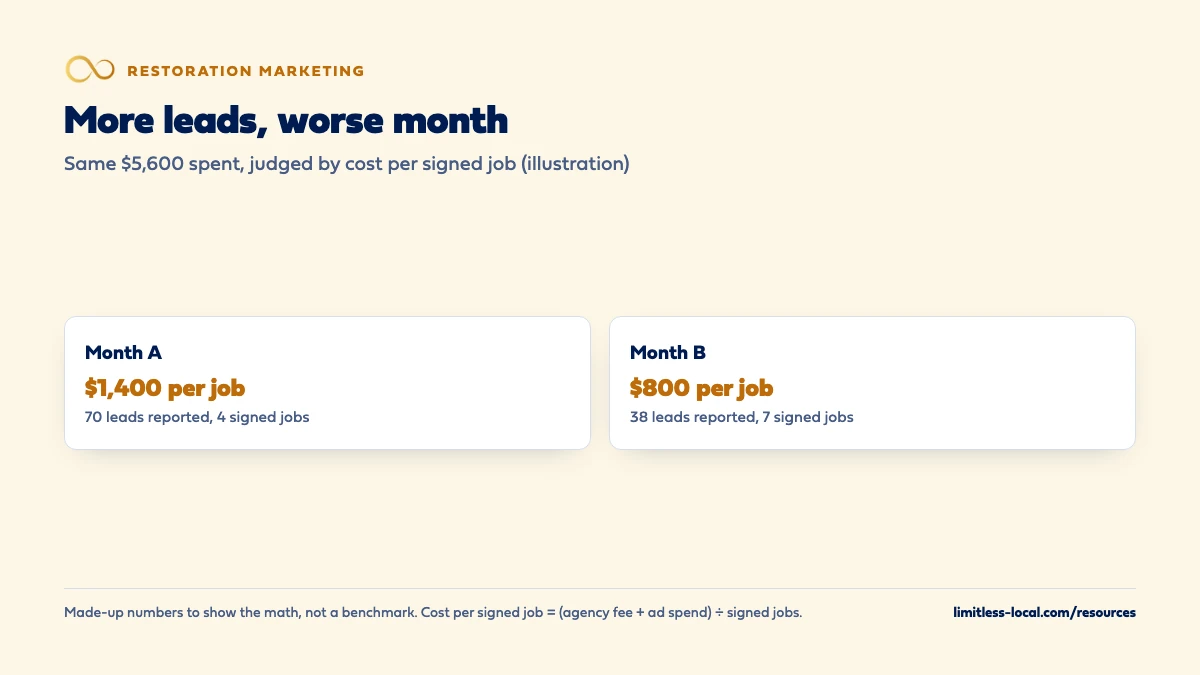
These numbers are made up to show the math, not a benchmark for your market. Say you spend $5,600 a month in total, the agency’s fee plus ad spend, and compare two months.
- Month A: the report shows 70 leads. When you check them, 18 were outside your service area and 14 were information seekers, sales calls or wrong-service calls. Another 9 were existing customers or referral partners. That leaves 29 real new leads, and 4 signed. Cost per signed job: $5,600 divided by 4, or $1,400.
- Month B: the report shows 38 leads, and 7 signed. Cost per signed job: $5,600 divided by 7, or $800.
Month A looks almost twice as good on the lead report and is worse for your business. Then wait for the money: once both months’ jobs have been paid, put the collected value next to the $5,600, and you’ll know which month actually paid for itself.
For reference, our Essentials package is $3,500 a month, and our Growth package, which adds Local Services Ads management, is $4,500 a month; ad spend is paid to Google separately in both. Whether either is worth it comes down to this same math, which is what a free visibility audit is for.
Frequently asked questions
Should my agency report cost per lead or cost per job?
Both, but decide on cost per signed job. Cost per lead helps spot problems early; it can’t tell you whether the spend turned into work.
Can my agency see which jobs insurance paid for?
Only if you share it. Payment data lives in your job records, so plan to add the invoiced and collected amounts yourself or give the agency a way to see them.
Is it a bad sign if my agency won't guarantee results?
No, it’s the honest answer. Google says no one can guarantee a #1 ranking, and job counts depend on things no agency controls, like weather and how fast your team answers.
How often should a restoration agency report to me?
A monthly report with a review call is a reasonable minimum, plus a dashboard you can check any time. More important than how often is whether each report reaches signed jobs.
Should Local Services Ads leads be judged differently?
Judge them the same way, on signed jobs and collected value, but report them separately from Google Ads. They’re priced differently, so mixing them hides which one is working.
Can I check my Google Ads account without risking changes?
Yes. Google Ads has a Read-only access level, which suits an owner or bookkeeper who wants to look at the numbers without editing anything.
Key takeaways
- Judge your agency on signed jobs from new customers and on cost per signed job, with its fee and your ad spend counted.
- Have out-of-area calls, information seekers and existing customers marked before anyone quotes a lead count.
- Separate referral, program and name-search jobs so paid channels only get credit for what they found.
- File insurance-paid jobs under the month the lead came in, and judge collected value once they pay.
- Own your Google Ads, Google Business Profile, website and tracking numbers.
Want a second set of eyes on your setup?
We'll look at how you show up locally and where calls are leaking, then send you a plain-English breakdown.
More in this section
- How do I track which marketing brings in booked restoration jobs?
- How should a restoration company market to commercial properties?
- How should a restoration company handle marketing during storm season?
- Should a restoration company run Google Ads, LSAs or both?
- Do Angi or HomeAdvisor listings help restoration companies rank?
Sources
- Do you need an SEO? — Google Search Central
- About access levels in your Google Ads account — Google Ads Help
- Manage your Business Profile owners & managers — Google Business Profile Help
- Transfer primary ownership of a Business Profile — Google Business Profile Help
- About phone call conversion tracking — Google Ads Help
- Offline conversion imports FAQs — Google Ads Help
- Inbound call recording — CallRail Help Center
- How to qualify leads in CallRail — CallRail Help Center