
What should a restoration website say about mold and fire damage?
- What content does a restoration company need on its mold and fire damage pages?
- Do mold and fire damage need their own pages on my restoration website?
- What should a mold remediation page cover?
- What can my website say about mold and health?
- Which mold claims should I take off my website?
- Should my mold page talk about mold testing?
- What should a fire and smoke damage page cover?
- What should these pages tell a property owner to do first?
- How should my mold and fire pages handle insurance?
- Should I write separate mold and fire pages for commercial buildings?
- What proof belongs on a mold or fire damage page?
- How do mold, water and fire pages work together?
- What's different about mold and fire pages for restoration companies
- A worked example: rewriting three risky lines on a mold page
- Frequently asked questions
- Key takeaways
- More in this section
- Sources
The short version
- One page per service: mold remediation and fire and smoke damage each get their own.
- Say what you do, where, how fast, and how the job runs from first call to done.
- Quote the EPA on mold and health, with a link; don't write your own health claims.
- Cut anything you can't prove: mold-free promises, EPA approval, insurance outcomes.
For restoration owners writing or fixing the mold remediation and fire damage pages on their own website.
Get a free visibility audit · Book a growth call
What content does a restoration company need on its mold and fire damage pages?
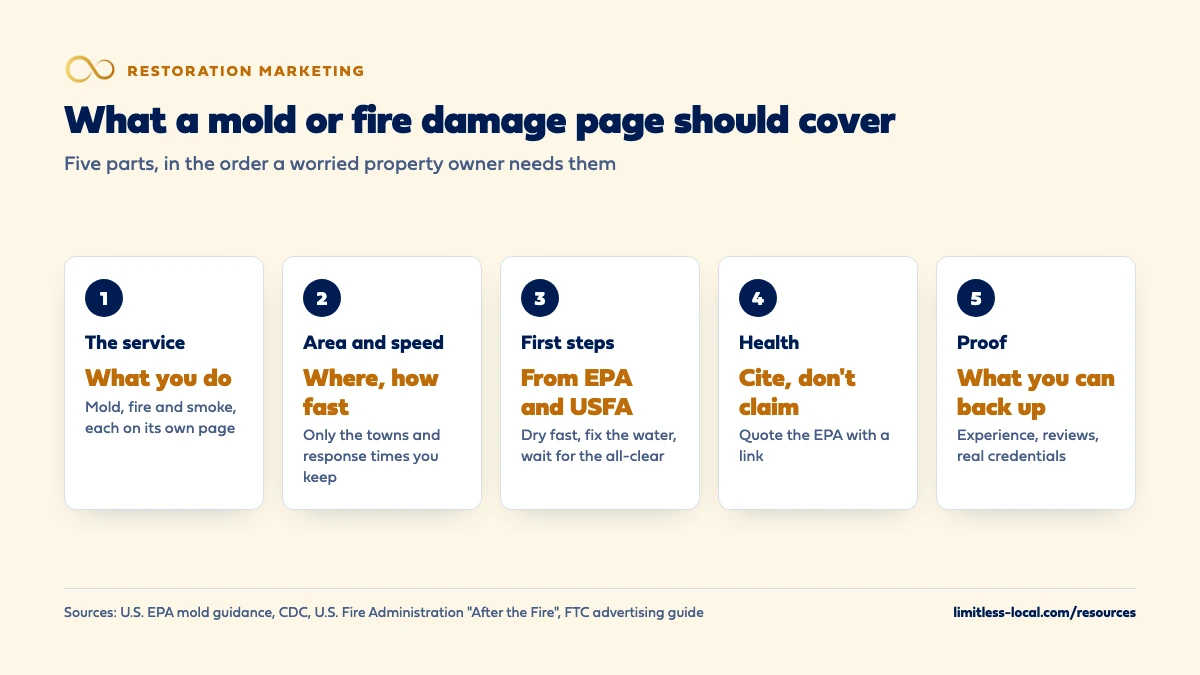
A restoration website should give mold remediation and fire damage their own pages that say exactly what you do, where you work, how fast you respond, how a job runs from first call to finished work, and what the property owner should do first. Any health statement about mold should repeat what a government source such as the EPA says, with a link, rather than your own claims. Leave out promises you can’t back up, like a mold-free home, guaranteed insurance coverage or a health outcome.
Mold and fire pages are a big part of what makes a restoration site worth calling from, and building pages like these is part of our website work for restoration companies: a themed site runs up to 25 pages, which leaves room for a page per service. If you want the bigger picture first, the restoration marketing guide covers every channel, and the rest of the restoration marketing questions library goes question by question.
Do mold and fire damage need their own pages on my restoration website?
Yes. A homeowner with a musty basement and a property manager with a kitchen fire want different answers, and one “Services” page with a line for each serves neither. Give water damage, mold remediation, and fire and smoke damage their own pages.
Google’s guidance on helpful, people-first content points the same way. It asks whether a page shows first-hand expertise, and says Google’s systems give even more weight to content with strong experience, expertise, authoritativeness and trust on topics that could significantly affect people’s health, financial stability or safety, and it calls trust the most important of those. Mold and fire pages touch both health and money, so in our view they’re held to a higher bar than a page about carpet cleaning.
What should a mold remediation page cover?
Write it for the owner of a wet, musty building who wants to know whether you’re the right company and what happens next. Cover these, in plain words:
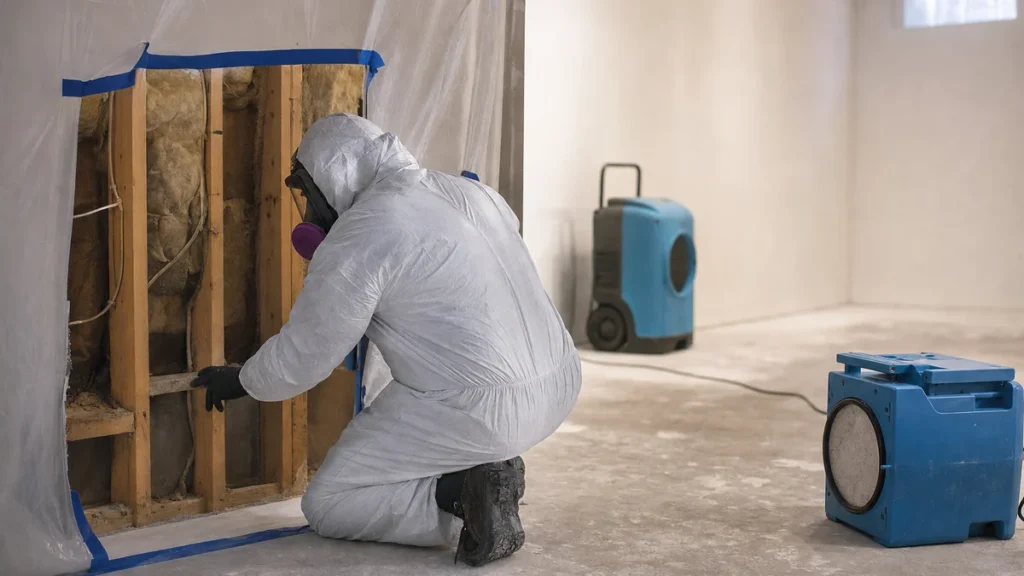
- What you do. Inspection, finding and fixing the moisture source or coordinating that repair, removing mold and damaged materials, drying, and putting the space back together, if you do the rebuild.
- Why the water source matters. The EPA’s guide to mold, moisture and your home says that if you clean up the mold but don’t fix the water problem, the mold problem will most likely come back. A page that explains this sounds like someone who does the work.
- Who you work for. Homeowners, landlords, property managers, commercial buildings.
- Where you work and how fast you respond. The towns you actually serve and what response time you can really keep.
- How the job runs. First call, inspection, written estimate, the work, the final walkthrough.
- Proof. Your own job photos, reviews that mention mold jobs, and certifications you actually hold.
What can my website say about mold and health?
Only what a government source says, in its words, with a link. The EPA’s Mold and Health page says molds have the potential to cause health problems, that inhaling or touching mold or mold spores may cause allergic reactions in sensitive individuals, and that molds can cause asthma attacks in people with asthma who are allergic to mold. It also says mold exposure can irritate the eyes, skin, nose, throat and lungs of both mold-allergic and non-allergic people, and that research on mold and health effects is ongoing. The CDC’s mold page adds that exposure to damp and moldy environments may cause a variety of health effects, or none at all.
Keep them careful on your site. Don’t turn “may cause allergic reactions in sensitive individuals” into “mold is making your family sick,” and don’t list symptoms as if you could diagnose them. The EPA points people with health concerns to a health professional; your page can do the same in one line.
There’s a legal reason too. The FTC’s advertising guide for small businesses says ads with health or safety claims usually must be backed by competent and reliable scientific evidence, that the proof must exist before the ad runs, and that implied claims count as well as express ones. Quoting the EPA with a link keeps the claim the EPA’s, not yours.
Which mold claims should I take off my website?
These come up on a lot of restoration sites, and each one runs into something a government source says:
- “Your home will be mold-free.” The EPA says it is impossible to get rid of all mold and mold spores indoors, and that in most cases it isn’t possible or desirable to sterilize an area. Promise to remove the mold growth and fix the moisture source instead.
- “EPA-approved” or “EPA-certified” remediation. The EPA says it doesn’t regulate mold or mold spores in indoor air, and its guide presents recommendations. If you follow the EPA’s remediation guide or other professional guidelines, say that, and only if it’s true.
- “We kill mold on contact.” The EPA says using a biocide such as chlorine bleach isn’t recommended as a routine practice during cleanup, and that dead mold may still cause allergic reactions in some people, so it isn’t enough to kill mold; it must be removed.
- Symptom checklists and scare headlines. They read as health claims, and they push a frightened homeowner instead of helping them decide.
Should my mold page talk about mold testing?
If you offer testing, describe it honestly. The EPA says that in most cases, if visible mold growth is present, sampling is unnecessary, and that because no EPA or other federal limits have been set for mold or mold spores, sampling can’t be used to check a building against federal mold standards. It also says surface sampling may be useful to determine whether an area has been adequately cleaned, and that sampling should be done by professionals with specific experience. Under home testing, the CDC’s mold page says outright that the CDC does not recommend mold testing.
So in our judgement, a mold page shouldn’t sell testing as the first step for every homeowner who can already see mold, or suggest a test result proves a home is “safe.” If you use sampling after remediation to check the work, say so plainly.
Curious what your marketing is actually booking?
Get a free visibility audit — no obligation, no sales pitch.
What should a fire and smoke damage page cover?
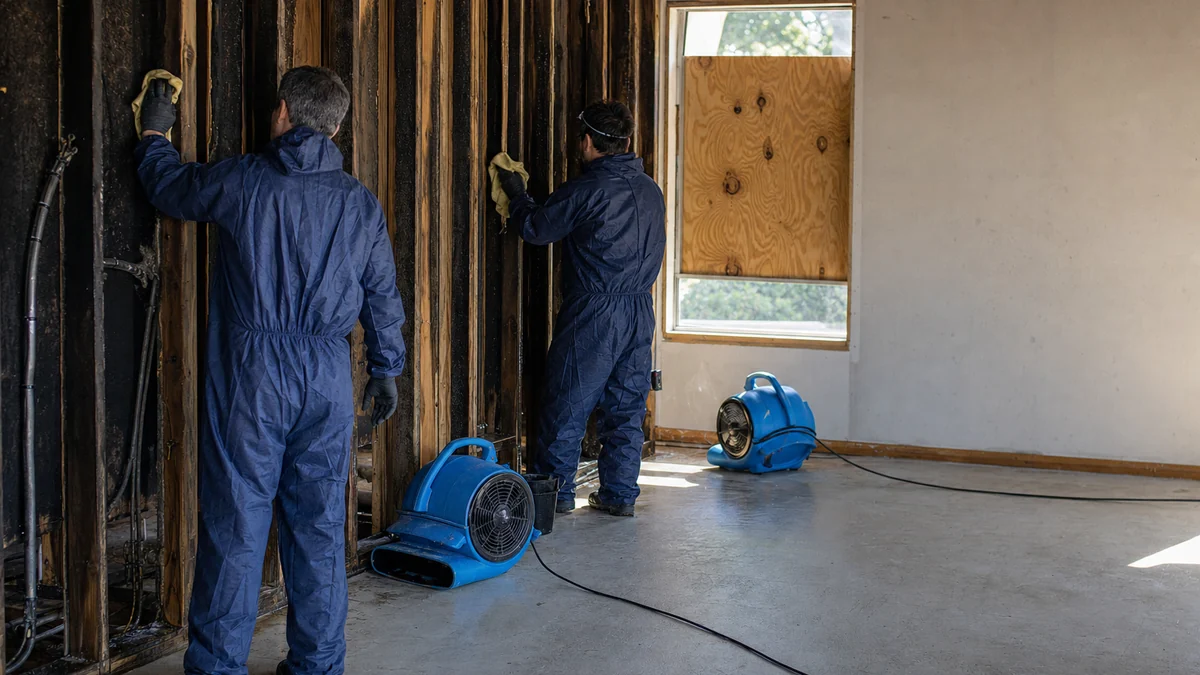
Start with what the owner is facing. The U.S. Fire Administration’s After the Fire guide tells fire victims their home may be damaged by flames, heat, smoke and water; that things the fire didn’t touch may still be ruined by smoke and soggy from the water used to put it out; and that anything they want to save will need to be carefully cleaned. It also notes firefighters may have broken windows and cut holes in the roof and walls, and that some owners may need to board up windows and doors.
That list is close to an outline for your page. Say which of these you handle:
- Board-up and securing the property
- Water removal and drying from firefighting
- Smoke and soot cleaning of the structure
- Odor removal
- Contents cleaning, pack-out and storage
- Rebuild, if you do it, or who you work with if you don’t
On health, the same rule as mold applies. USFA says the soot and dirty water left behind may contain things that could make people sick and tells them to be very careful going in. You can quote that with a link; don’t stretch it.
What should these pages tell a property owner to do first?
Give them the first steps the government sources give, so your advice never contradicts theirs:
- After a fire: don’t go back in until the fire department says it’s safe, and contact the insurance company right away to ask what to do first. Both come from USFA’s guide, which also tells people to save their receipts and, when they contact a company that cleans and restores their belongings, to ask for a cost estimate in writing.
- After water or mold: the EPA says to dry water-damaged areas and items within 24-48 hours to prevent mold growth, and that if mold is a problem, to clean it up promptly and fix the water problem.
Then tell them what happens when they call you: who answers, how fast someone comes out, and what the first visit includes. If you say you answer around the clock, make sure you do; how fast you answer emergency calls covers why that line has to be true.
How should my mold and fire pages handle insurance?
Generally and carefully. Your page can say whether you work with insurance companies, whether you bill them directly, and that you provide a written estimate. It shouldn’t promise that a policy covers mold, that a claim will be approved, or that the homeowner won’t pay anything; coverage depends on the policy and the insurer.
USFA’s guide is a useful line to stay inside: it tells fire victims to make sure they know whether they or their insurance company will pay for cleaning, and to ask for a cost estimate in writing. Whether to go further and explain the claims process step by step is its own decision, covered in whether your website should explain insurance claims.
Should I write separate mold and fire pages for commercial buildings?
If commercial work is a real part of your business, yes. The reader is a building manager, not a homeowner. The EPA’s remediation guide for schools and commercial buildings was written for exactly those people, and the EPA says it helps those in charge of maintenance evaluate a remediation plan submitted by an outside contractor. The EPA’s homeowner guide also points to it for larger jobs: if mold growth covers more than 10 square feet, or there has been a lot of water damage, it tells people to consult that commercial guide.
So a commercial mold page should read like the start of a remediation plan: how you assess the problem, protect occupants, contain the work and document the job, and which guidelines you actually follow. Marketing to commercial properties covers the rest of that audience.
What proof belongs on a mold or fire damage page?
Proof that a nervous owner can check. The EPA tells people who hire a mold contractor to make sure the contractor has experience cleaning up mold, check references, and ask the contractor to follow the EPA’s remediation guidance or other professional guidelines. Your page can answer those three checks before anyone asks:
- Experience: how long you’ve done mold and fire work, in the towns you serve.
- References: reviews from mold and fire customers, linked to your Google profile. Getting your Google Business Profile right helps the same reviews work in Maps.
- Guidelines and credentials: the ones you actually follow and hold, by name.
Use your own job photos, cropped so no customer’s home is identifiable. The FTC also says endorsements must reflect the honest experience of the person giving them, so don’t edit a review into something the customer didn’t say.
How do mold, water and fire pages work together?
The jobs overlap, so the pages should too. Fire jobs come with water from firefighting, which USFA describes, and water jobs left wet can turn into mold jobs, which is why the EPA’s 24-48 hours drying advice belongs on your water damage page. Link each page to the others where the overlap comes up naturally, so a reader on the fire page can see you handle the water and mold that follow.
Each page should still target its own service, because people searching about mold use different words than people searching after a fire. If you run ads, the same split helps; which Google Ads keywords to target covers matching ads to each service page.
Not sure which of these is costing you jobs?
A free visibility audit checks the Google profile, reviews, site and tracking, and shows what to fix first.
What's different about mold and fire pages for restoration companies
The reader is under stress. Someone reading a fire damage page may have just been displaced. In our judgement, calm, specific pages that say what happens next earn the call, and pages that add to the fear push people to the next result.
Health and money are both on the line. Google’s systems give even more weight to trustworthy content on these topics, and the FTC expects proof for health claims. Restoration sites carry both kinds of risk at once, which most trades don’t.
Photos need more care. A recognizable house after a fire is someone’s worst day. Crop to the work: dried framing, cleaned surfaces, your equipment and crew.
A worked example: rewriting three risky lines on a mold page
The “before” lines below are made up to show the kind of copy that causes trouble; they aren’t from any real company.
- Before: “Toxic black mold is making your family sick. Call now!”
After: “The EPA says inhaling or touching mold may cause allergic reactions in sensitive individuals, and that molds can cause asthma attacks in people with asthma who are allergic to mold. If you have health concerns, talk to a health professional. We can find and remove the mold and fix the moisture behind it.” - Before: “We’ll make your home 100% mold-free.”
After: “We remove mold growth and the damaged materials it’s in, and we find and fix, or help you fix, the moisture source, because the EPA says mold that’s cleaned up without fixing the water problem will most likely come back.” - Before: “EPA-certified mold removal.”
After: “We follow the EPA’s mold remediation guidelines for larger jobs.” (Only if you do; the EPA says it doesn’t regulate mold in indoor air.)
Each “after” line can be checked against a public source. Our website work includes service pages written this way; a themed site is $3,750, or $3,000 with any of our marketing packages, and a free visibility audit will show which pages your site is missing.
Frequently asked questions
Can I say mold is dangerous on my website?
Use the EPA’s own words instead: molds have the potential to cause health problems, and inhaling or touching mold may cause allergic reactions in sensitive individuals. Link the EPA’s Mold and Health page and stop there.
Should I use the phrase "black mold" on my site?
Use it only if it’s how your customers search, and don’t attach health claims to it. The CDC says you don’t need to know the type of mold to remove it, which is a fair line to put on the page.
Can my website say I'm certified for mold remediation?
Only for certifications you actually hold, named exactly. Don’t describe your work as EPA-certified; the EPA says it doesn’t regulate mold or mold spores in indoor air.
Should my fire page explain smoke odor removal?
Yes, if you do it. USFA tells fire victims that things the fire didn’t touch may still be ruined by smoke, so odor and smoke cleaning is a real question your page can answer.
Should I list prices for mold remediation on my website?
In our view, a range with what drives it (size, materials, access, the moisture source) helps more than a single number, because every job is different. Pair it with a written estimate after inspection, which is what USFA tells fire victims to ask for.
Key takeaways
- Give mold remediation and fire and smoke damage their own pages, each answering what you do, where, how fast and how the job runs.
- Quote the EPA, CDC or USFA on health, word for word and linked; don’t write your own health claims.
- Remove “mold-free,” “EPA-certified” and “kills mold” promises; each conflicts with what the EPA says.
- Match your first-step advice to the EPA and USFA: dry within 24-48 hours, fix the water, wait for the fire department’s all-clear.
- Handle insurance generally: who pays, written estimates, no coverage promises.
Want a second set of eyes on your setup?
We'll look at how you show up locally and where calls are leaking, then send you a plain-English breakdown.
More in this section
- Should my restoration website explain the insurance claims process?
- How should a restoration company market to commercial properties?
- How should a restoration company handle marketing during storm season?
- How do restoration companies get insurance-related water damage jobs?
- How fast does a restoration company need to answer emergency calls?
Sources
- A Brief Guide to Mold, Moisture and Your Home — U.S. Environmental Protection Agency
- Mold and Health — U.S. Environmental Protection Agency
- Mold Remediation in Schools and Commercial Buildings Guide: Chapter 1 — U.S. Environmental Protection Agency
- Mold — Centers for Disease Control and Prevention
- After the Fire — U.S. Fire Administration (FEMA)
- Advertising FAQ's: A Guide for Small Business — Federal Trade Commission
- Creating helpful, reliable, people-first content — Google Search Central