
How should a pool builder handle buyers who push on price?
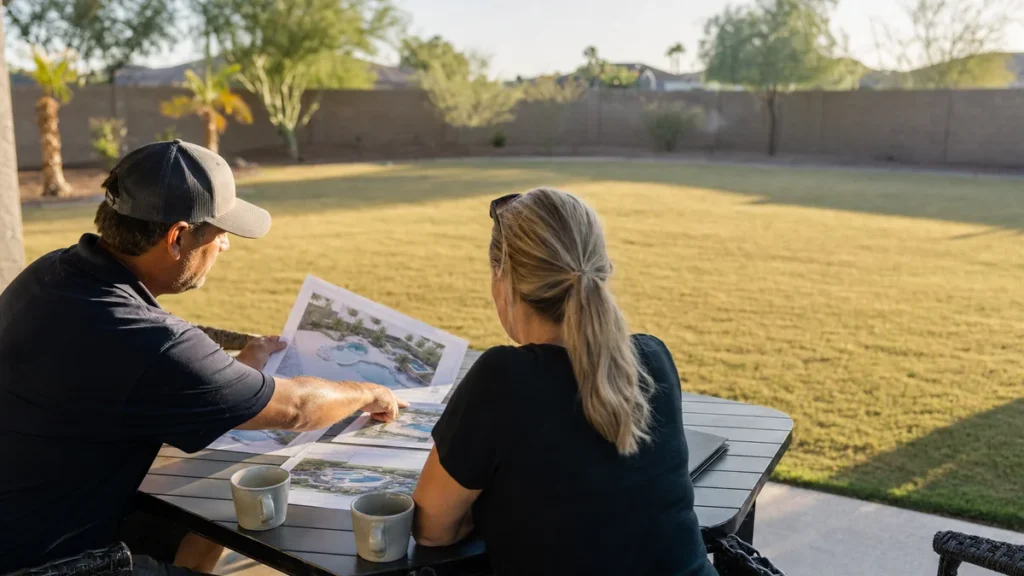
- How can a pool builder handle price negotiation on a proposal without discounting by reflex?
- Why do pool buyers push on price?
- Should a pool builder ever lower the price when a buyer pushes?
- How do I find out what's really behind the push?
- How do I compare my bid to a cheaper one without knocking the other builder?
- How can I change the scope instead of cutting the price?
- What can I offer instead of a discount?
- How do I talk about a deal without misleading the buyer?
- Should I offer a discount for signing today?
- What if a buyer asks me to match another builder's price?
- When should I walk away from a buyer who keeps pushing?
- How do I keep price from taking over the proposal meeting?
- What's different about price pushback for pool builders
- A worked example: what a small discount really costs
- Frequently asked questions
- Key takeaways
- More in this section
- Sources
The short version
- Ask what's behind the push: another bid, a budget, a monthly payment or a test.
- Change the scope, not the price: options, phases and finish swaps.
- Compare bids line by line without knocking the other builder.
- Skip padded prices and sign-today discounts; real deadlines are fine.
For pool builders who keep hearing “can you do better on the price?” after the proposal, and want to protect their margin without losing good buyers.
Get a free visibility audit · Book a growth call
How can a pool builder handle price negotiation on a proposal without discounting by reflex?
Find out what’s behind the push before you answer it, because it’s usually a cheaper bid with a different scope, a budget the buyer hasn’t said out loud or a worry about the monthly payment. Then move the price only when the scope moves: compare bids line by line, offer simpler options or phase add-ons to next year, and explain plainly what your number includes. Avoid cutting the same pool’s price by reflex, padding a number so you can discount it, or pressing for a signature today, since each one costs you trust or margin.
Price talks go easier when the buyer arrives already trusting you, and that’s what good marketing sets up: strong reviews, a gallery of your own pools and pages that answer buyers’ questions before the consultation. We price our own work in the open, too. On our packages page, Essentials is $3,500 a month and Growth is $4,500 a month, with ad spend paid directly to Google or Meta. The pool builder marketing page shows how we work with pool companies, and the pool builder marketing questions library takes the rest one question at a time.
Why do pool buyers push on price?
Mostly because a pool is one of the biggest checks they’ll ever write for their home, and they’re afraid of overpaying. A push on price is rarely a statement that your number is wrong. It’s usually one of these:
- A cheaper bid. Buyers are told to get several estimates, and pool bids almost never cover the same scope.
- A budget they haven’t said out loud. The design grew at the consultation and the total landed above what they had in mind.
- A monthly payment worry. If they’re financing, the real question may be what it costs per month.
- A test. Some buyers ask for a discount on every big purchase, just to see what happens.
- A doubt about value. They don’t yet see why your pool is worth more than the other one.
Each of those needs a different answer, and only one of them, at most, is solved by lowering the price. That’s why the first move is never the discount.
Should a pool builder ever lower the price when a buyer pushes?
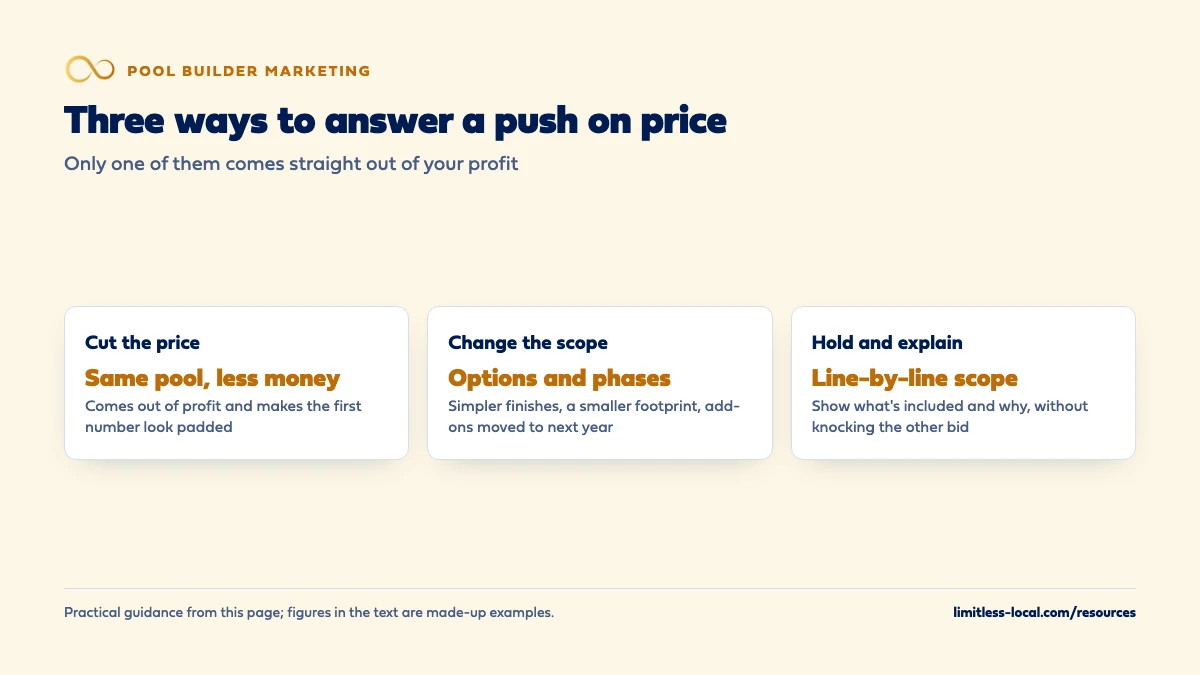
Rarely for the same scope. Cutting the number on an unchanged proposal tells the buyer your first price wasn’t real, and they’ll wonder what else in it is padded. It also comes straight out of the money that pays for warranty work, the surprises found during the dig and the crews you want to keep.
The better rule: the price can move when the scope moves. Smaller pool, simpler finish, an add-on moved to a later phase, a start date that fills a gap in your schedule. Each of those is a real change, so the lower number stays honest.
Decide your policy before you’re at the kitchen table. Know which items you can trade, which you can’t, and the lowest total you’d sign at for this pool. A builder who has already done that math can stay calm when the buyer pushes.
How do I find out what's really behind the push?
Ask before you answer. A few plain questions usually surface the real issue:
- “What are you comparing this to?”
- “Is it the total, or the monthly payment that worries you?”
- “Is there a number you had in mind when we started?”
- “Which part of the design matters most to you, and which could wait?”
Then stop talking and listen. If the answer is a cheaper bid, you compare scope. If it’s a budget, you design down. If it’s a monthly payment, you talk through financing options. If it’s a test, a calm explanation of what’s included is often enough, because the buyer just needed to hear that you stand behind the number.
How do I compare my bid to a cheaper one without knocking the other builder?
Go line by line, and talk about pools, not people. Offer to put both proposals side by side and check the things that move a pool’s price the most:
- Size, depth and shape.
- Steel, shell and structural details.
- Equipment: pump, filter, heater, lighting, automation.
- Interior finish, tile and coping.
- Decking, fencing, electrical runs and landscaping repair.
- Permits, engineering, cleanup and startup.
- The warranty and who stands behind it.
Most gaps between pool bids come from something on that list. When you find it, say what it is and why you include it, and stop there. Buyers trust a builder who explains a difference. They tune out one who runs down the other company.
A proposal that lists what’s in and what’s out from the start makes this conversation short. The questions pool buyers ask builders before hiring covers how to answer the scope question before it comes up.
How can I change the scope instead of cutting the price?
Give the buyer choices, so they can reach their number without you giving away margin:
- Options at three levels. The design they love, a version with simpler finishes and equipment, and a version with a smaller footprint.
- Phasing. Build the pool now, and add the spa, outdoor kitchen, lighting upgrades or extra decking next year.
- Swaps. A different finish, tile or coping that looks good and costs less.
Many quoting tools make this easy to show. Jobber’s optional line items, for example, let a client select or deselect items on a quote and see the total adjust automatically. Whatever you use, the effect is the same: the buyer builds their own yes, and the price that comes out is one you’re happy to sign.
For how to present those options at the consultation itself, see how pool builders turn design consultations into signed contracts.
Curious what your marketing is actually booking?
Get a free visibility audit — no obligation, no sales pitch.
What can I offer instead of a discount?
Things that are worth more to the buyer than they cost you:
- Schedule. A start date in your slow season, if the buyer can wait, can be worth a real concession, because it fills a gap you’d otherwise pay for.
- Payment timing. A draw schedule that matches their cash flow, within the limits your state allows.
- Financing information. If the worry is monthly, connect them with lenders you work with and let them compare.
- Service. An extra startup visit or equipment walkthrough you’d be glad to do anyway.
Before you put financing terms in your marketing or proposals, read how a pool builder can advertise financing options.
How do I talk about a deal without misleading the buyer?
Only call something a deal if it is one. The FTC’s Guides Against Deceptive Pricing say a reduction from your own former price is legitimate when that former price is the actual, bona fide price you offered to the public on a regular basis for a reasonably substantial period of time. When the former price is fictitious, such as an artificial, inflated price set so you can offer a large reduction, the bargain is a false one.
In pool terms: don’t write a padded number on the proposal so you can cross it out when the buyer pushes. A free item offered with a purchase can also deceive the buyer if the seller raises the regular price of what has to be bought, or attaches other strings. If you include an upgrade at no charge, make sure the rest of the price didn’t quietly go up to pay for it.
Real promotions are fine: a genuine off-season price you’d offer anyone, or a package you sell at the same price all year. Write the terms down, keep them consistent, and the buyer can trust every number you give them.
Should I offer a discount for signing today?
Avoid it. The FTC’s booklet Hiring a Contractor lists pressuring homeowners for an immediate decision as a sign of a home improvement scam, and careful buyers have read that list. A sign-today discount can make an honest builder look like one.
It may not hold anyway. Homeowners are also told their contract should include a written statement of their right to cancel within three business days if they signed it in their home. A contract signed under pressure at the kitchen table can come undone.
Real deadlines are different. If a build slot really opens up on a certain date and someone else is waiting for it, say so. That’s information, not pressure.
What if a buyer asks me to match another builder's price?
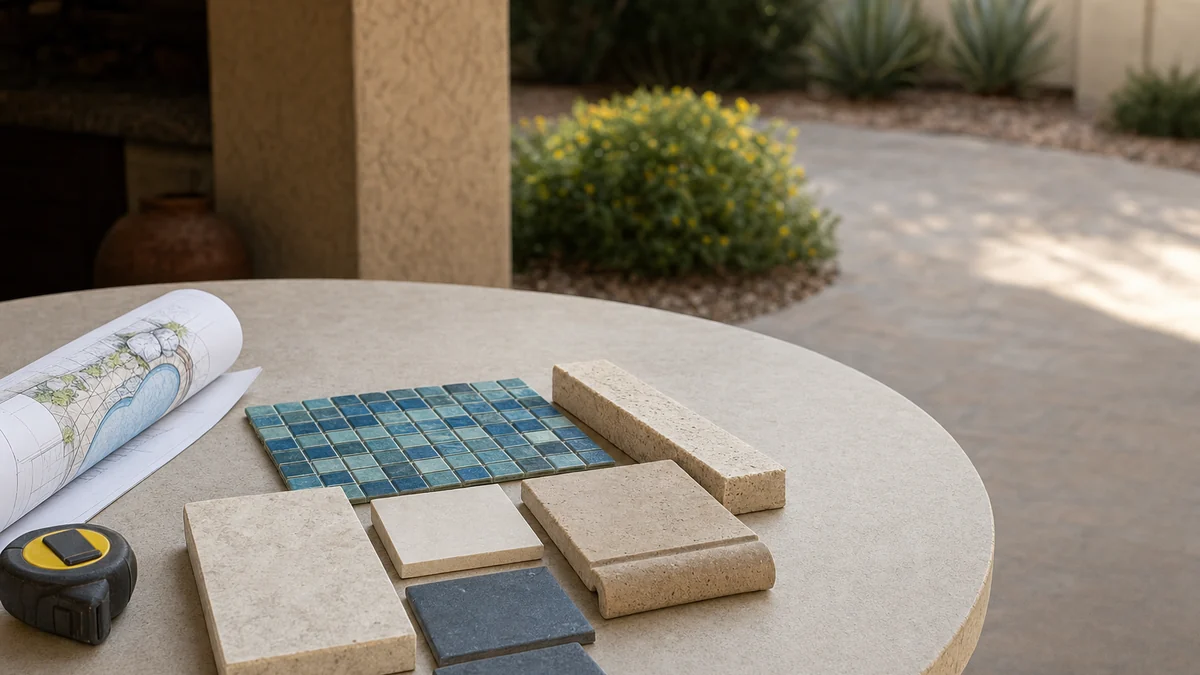
Compare scope first, every time. If the other bid covers less, show the buyer what’s missing and let them decide whether they want it. If the bids really do cover the same pool, decide in advance whether you match. Some builders never match. Others will move on price for a start date that fills a gap, or for a buyer in a neighborhood where a finished pool will bring more work.
Whatever you choose, make it a policy, not a mood. If you match one buyer and not the next, word gets around, and every proposal turns into a negotiation.
When should I walk away from a buyer who keeps pushing?
When the price talk never ends. Some signs: they push again after every concession, they question line items you’ve already explained, or they ask you to cut corners you won’t cut. A buyer who fights the price before the contract usually fights the change orders, the schedule and the final payment too.
Walk away politely. Thank them, leave the proposal on the table, and say you’d be glad to build it if they decide it’s the right fit. Keep them on your follow-up list. Some come back months later, once the cheaper option falls through.
If this happens often, the problem may start earlier, in who your marketing brings in. How pool builders stop attracting price shoppers covers that side.
How do I keep price from taking over the proposal meeting?
Set it up before the meeting starts:
- Talk budget at the consultation. Give a rough range for the design you’re discussing, so the proposal doesn’t come as a shock.
- Lead with the design. Walk through the pool, the process and the timeline before the total.
- Show what’s included. A clear list of what’s in and what’s out answers half the price questions before they’re asked.
- Bring the options. If you’ve prepared simpler versions, the buyer can choose instead of pushing.
Builders who sell on the strength of their work hear fewer price objections. How to position a pool company as a premium builder covers building that reputation.
Not sure which of these is costing you jobs?
A free visibility audit checks the Google profile, reviews, site and tracking, and shows what to fix first.
What's different about price pushback for pool builders
Bids rarely match. Two pool proposals for the same backyard can differ in size, equipment, finish, decking and what’s left out, so scope is almost always part of the answer.
The ground has a vote. Rock, groundwater and access can change the job after the dig starts. Margin you give away at the table is margin you don’t have when the excavator hits something.
Financing turns totals into payments. Many buyers think in monthly terms, so the push may really be about the payment, not the price.
Your calendar is a bargaining chip. An off-season start or a gap in the schedule is worth something real to you, which makes it an honest thing to trade.
A worked example: what a small discount really costs
These numbers are made up to show the math, not a benchmark for pool builders. Say a pool contract is $80,000 and your gross margin on it is 30%, or $24,000.
A buyer pushes, and you take 5% off the same scope: $4,000. The contract drops to $76,000, but the whole $4,000 comes out of your profit, which falls from $24,000 to $20,000. That’s about 17% of your profit gone from a 5% price cut. To earn back that $4,000 at a 30% margin, you’d need about $13,333 in extra sales.
Now the other path. The buyer moves a $4,000 lighting and automation upgrade to a second phase next spring. The contract is the same $76,000, your margin on the work you’re doing stays at 30%, and you have a reason to come back. Same number for the buyer, very different result for you. A free visibility audit shows whether your marketing is bringing in buyers who value that kind of work.
Frequently asked questions
Should I put my price on the table at the first consultation?
Give a rough range for the design you’re discussing. Buyers who hear a ballpark early push less when the full proposal arrives, and the ones far outside your range can say so before you spend hours on a design.
Is it okay to have a seasonal price for off-season builds?
Yes, if it’s real: the same price for anyone who books that season, written down and kept consistent. It’s an honest way to fill slow months.
What if the buyer says the other builder will throw in extras for free?
Ask whether the other bid’s base price covers the same pool. An extra included at no charge is only a deal if the rest of the price didn’t rise to pay for it.
How do I handle a buyer who goes quiet after the proposal?
Follow up with a short note asking whether anything in the proposal needs explaining, and offer a simpler version if budget is the worry. Following up on leads through a long sales cycle covers the timing.
Should my salesperson be allowed to give discounts?
Only within limits you set in writing: which items can be traded, which can’t and the lowest total for each kind of pool. Limits keep every buyer’s price consistent.
Key takeaways
- A push on price usually means a cheaper bid, an unspoken budget, a monthly payment worry, a test or a doubt about value. Ask before you answer.
- Move the price only when the scope moves: options at different levels, phasing and finish swaps.
- Compare bids line by line and explain differences without knocking the other builder.
- Never pad a price to discount it later, and skip sign-today discounts; real schedule deadlines are fine.
- Small discounts cost a large share of profit, so decide your trade-offs before you reach the kitchen table.
Want a second set of eyes on your setup?
We'll look at how you show up locally and where calls are leaking, then send you a plain-English breakdown.
More in this section
- How do pool builders stop attracting price shoppers?
- What questions do pool buyers ask builders before hiring?
- Should a pool builder wait for more reviews before raising prices?
- How do pool builders qualify leads before the design consultation?
- How does a pool builder work out what a lead is worth?
Sources
- 16 CFR Part 233, Guides Against Deceptive Pricing — eCFR (Federal Trade Commission guides)
- Hiring a Contractor — Federal Trade Commission (via govinfo.gov)
- Optional Line Items on Quotes — Jobber Help Center