
Which local SEO tactics work best for a pool builder?
- What local SEO tactics bring a pool construction company the most leads?
- What does local SEO actually cover for a pool builder?
- Which local SEO tactics matter most, in order?
- How do I get my Google Business Profile right?
- How should I set my service area?
- How much do reviews matter for a pool builder's local SEO?
- What should my website have for local SEO?
- Do photos of my pool builds help?
- Do directory listings and citations still matter?
- Which local SEO tactics are a waste of time for pool builders?
- Which tactics should I start with if I'm new or short on time?
- How long until local SEO tactics show results?
- What's different about local SEO for pool builders
- A worked example: putting the tactics in order for one builder
- Frequently asked questions
- Key takeaways
- More in this section
- Sources
The short version
- First: a verified, complete Google Business Profile with the most specific category and an honest service area.
- Second: a review ask at every handover, so new reviews keep arriving through the season.
- Third: a page for each type of pool work, area pages only where you build, and a real project gallery.
- Then: build photos on the profile and matching name, address and phone everywhere you're listed.
For pool builders who want to know which local SEO work earns its keep, and what order to do it in.
Get a free visibility audit · Book a growth call
What local SEO tactics bring a pool construction company the most leads?
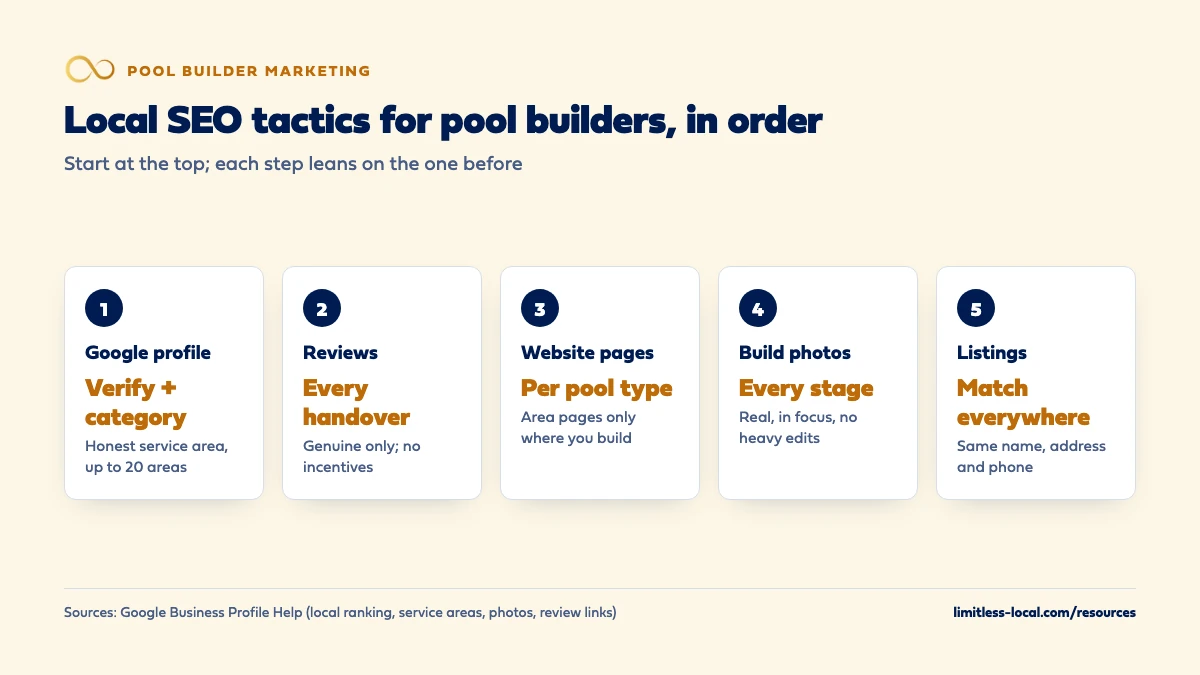
The local SEO tactics that do the most for a pool builder are, in order: a verified, complete Google Business Profile with the right category and an honest service area; a steady flow of genuine reviews from every finished pool; a website with a page for each type of pool work and a gallery of real builds; and business details that match everywhere you’re listed. Those cover the relevance and popularity that Google says local results are mainly based on, along with distance, which you can’t change. Most other tactics only help once these are in place, and all of them build over months, not weeks.
Every tactic on this list is part of our local SEO work: listing cleanup, Google Business Profile management, review generation, location pages and content. We know the pool side from the inside, too: the agency was an equity partner in a pool construction company, where it streamlined back-office operations, built the lead-generation engine and ran sales and marketing, and that business did $2M+ revenue in year one. Our pool builder marketing page shows how local SEO fits with ads and follow-up, and the pool builder marketing questions library goes deeper on each tactic.
What does local SEO actually cover for a pool builder?
Local SEO is everything that decides whether a homeowner searching for a pool builder near them finds you, and whether they like what they see when they do. For a pool company that means three places: the regular Google results, the Maps 3-pack (the short list of businesses with a map above the regular results), and the answers AI tools like ChatGPT and Google’s AI Overviews give when someone asks who builds pools in their town.
If you’re still deciding whether local SEO is worth paying for at all, whether local SEO brings a pool builder enough leads covers the money side. This page is about what to do, and in what order.
Which local SEO tactics matter most, in order?
Google’s help page on improving your local ranking says local results are mainly based on relevance, distance and popularity, and that there’s no way to request or pay for a better local ranking. Every tactic worth your time pushes on relevance or popularity. Distance is mostly out of your hands. Ranked by what they do for a pool builder:
- A verified, complete Google Business Profile with the right category and an honest service area. This is the foundation; the rest leans on it.
- Genuine reviews from every finished pool, arriving through the season. Reviews feed popularity and they’re what homeowners read before they call.
- Website pages for each type of pool work and the areas you build in, so Google and homeowners can match you to the search.
- Real photos of your builds, on the profile and the website.
- Matching business details everywhere you’re listed, so nothing contradicts your profile.
Work top to bottom. A builder with a half-finished profile who spends money on directory listings is fixing the fifth thing first.
How do I get my Google Business Profile right?
Start with verification. A verified profile tells Google you’re authorized to represent the business, which makes it more likely to show up, and businesses with complete and accurate information are more likely to appear in local results. Then fill in every field.
The category matters more than most owners think. Google says the categories you select affect your local ranking, and that you should choose the most specific one that fits rather than a general one. Pick the pool construction category that best describes the bulk of your work as your primary category, and add only a few additional categories for real lines of business, like renovation or pool service if you offer it. Changing a category can also trigger a fresh round of verification, so make the change once and deliberately. Choosing Google Business Profile categories as a pool builder goes through the options.
How should I set my service area?
Honestly, and tighter than you’d like. Most pool builders don’t have a showroom customers visit, which makes them a service-area business in Google’s terms. If you don’t serve customers at your address, Google’s page on service areas says to remove the address from your profile. A builder with a staffed design center that receives customers can show the address and set a service area too.
A few rules from that page that shape your plan:
- You can list up to 20 service areas, by city, postal code or other area, not as a radius around your shop.
- The whole area shouldn’t stretch more than about 2 hours of driving time from where you’re based.
- Service-area businesses can only have one profile for the whole area they serve.
Listing towns you’d rarely drive to doesn’t make you rank there; you still rank best near your base. Put your strongest towns first in your thinking, and use ads for the edges. Setting up a pool builder service area on Google walks through the settings.
How much do reviews matter for a pool builder's local SEO?
A lot, and twice over. More reviews and positive ratings can help your local ranking, and homeowners comparing three builders read reviews closely before they book a design consultation. A pool is a big, months-long purchase, so detailed reviews that mention communication, timelines and how problems were handled carry real weight.
The tactic is simple: ask every customer, every time, at the same moment. Handover day, when the pool is filled and the family is excited, is the natural point. Google lets you create a review link or QR code to share in a thank-you email or a text. It’s strict about one thing: offering anything in exchange for a review, like a discount or a free service, counts as fake engagement and is prohibited. Reply to every review too; replies show homeowners you value their feedback. Getting more Google reviews for a pool company covers scripts and timing.
Curious what your marketing is actually booking?
Get a free visibility audit — no obligation, no sales pitch.
What should my website have for local SEO?
Pages that match how homeowners search, and proof that you build where they live. For most pool builders that means:
- A page for each type of work you want more of: custom gunite or concrete pools, fiberglass, renovations and resurfacing, outdoor living. A homeowner searching for a fiberglass pool installer should land on a page about fiberglass, not your home page.
- Area pages only where you really build, each with something specific to that area: projects you’ve finished there, soil or permitting realities, the neighborhoods you work in. A page that swaps the town name and repeats everything else adds nothing.
- A project gallery with real builds, captioned by town and pool type.
- Your name, phone and service area on every page, matching your profile.
Google’s own SEO Starter Guide is blunt that there are no secrets that’ll automatically rank a site first, and it warns that keyword stuffing is against its spam policies. Write for the homeowner and the rankings follow from that. How many city pages a pool builder needs helps you decide how far to go with area pages.
Do photos of my pool builds help?
Yes, and pool builders have an edge here most trades don’t: the work is beautiful and it changes every week. Google’s photo tips for Business Profiles suggest adding at least three photos of your work and at least three of your team, and say photos should be in focus, well lit and represent reality, without heavy filters or AI edits. Photos only show on a verified profile.
Shoot every build at every stage: layout, excavation, steel, gunite or shell set, tile and coping, startup, and the finished yard at dusk. Post a few to your profile each month and put the best in your gallery with the town named.
Do directory listings and citations still matter?
They matter as a cleanup job, not a ranking trick. Google says it builds business profiles from several sources, including crawled web content like your own website, licensed data from third parties and information users contribute. If an old directory lists your previous phone number or a shop address you left years ago, that’s conflicting information about you floating around.
Make your name, address and phone identical on your website, your profile and the directories and trade sites that matter. Once that’s clean, a hundred more low-quality listings won’t move much.
Which local SEO tactics are a waste of time for pool builders?
A few come up again and again:
- Stuffing keywords into your business name. Google’s guidelines for representing your business say your name should match the real-world name you use on your signage, website and paperwork, and that adding unnecessary information can get your profile suspended. “Smith Pools” is fine; “Smith Pools Best Pool Builder Phoenix” is a risk.
- Virtual offices to rank in another city. The same guidelines say a rented mailing address you don’t operate from isn’t eligible for a profile.
- Buying or swapping reviews. It breaks Google’s rules, and homeowners can often spot a burst of thin five-star reviews.
- Dozens of near-identical city pages. They cost money to write and rarely bring a design consultation.
- Chasing extras before the basics. Daily profile posts and link packages come after a complete profile, steady reviews and a site that shows your builds.
Which tactics should I start with if I'm new or short on time?
Your situation changes the order a little:
- New pool company, no reviews yet: verify the profile, set a tight service area, and ask every customer you’ve built for, even if it’s only a handful. Get a simple site live with a page for each pool type and photos of whatever you’ve finished.
- Established builder, weak online presence: your biggest asset is years of past customers. A one-time review ask to them can close a gap fast, and your back catalogue of project photos can fill a gallery in a weekend.
- Owner on the job site all day: pick two things you’ll do every week, like the handover review ask and three new photos, and hand the rest of the profile and website work to someone else.
- Builder who lost a Maps spot: check the profile first, then the website, then reviews. What the map pack is and how a pool builder gets into it explains what you’re trying to get back into.
How long until local SEO tactics show results?
Some changes register quickly and some take a season. A fixed category or corrected hours can show within days. Reviews and website pages build slowly, and the long pool sales cycle adds another delay between a homeowner finding you and signing. SEO typically takes 3-6 months to show meaningful organic growth, and Google’s guide notes that some changes take effect in a few hours while others could take several months, and suggests waiting a few weeks to judge any one change.
Judge the work by what it produces, not by a ranking screenshot: the calls and website clicks your profile reports, what every new lead says when you ask how they found you, and how many of those leads sign.
Want to see where your company stands?
A free visibility audit shows where you show up on Google, Maps and AI answers, and what it's costing you in calls.
What's different about local SEO for pool builders
Fewer jobs, slower reviews. A builder finishing a couple of dozen pools a year collects reviews far more slowly than a service company with weekly route stops, so every handover ask counts.
A seasonal calendar. Pool shopping peaks before the swimming season in most markets. Profile, review and page work done in the off-season is what’s in place when homeowners start searching.
Homeowners look farther. They’ll shortlist a pool builder from the next county if the work looks right. Your website and gallery can reach farther than your Maps ranking.
A worked example: putting the tactics in order for one builder
This builder is made up to show the method. It finishes about 20 pools a year, works out of a yard with no showroom, and has 9 Google reviews. Its profile shows the yard address and a general contractor category, its website has one “Services” page, and its old phone number is still on two directories.
- Week one: remove the yard address and set service areas by town; switch the primary category to the most specific pool construction category; add photos of the team and recent builds.
- Weeks two to four: fix the two directories that show the old number; send a review link to every customer from the last three seasons.
- Months two and three: split the Services page into custom pools, fiberglass and renovations; build a gallery captioned by town; add area pages for the three towns where it has built the most.
- Every week from then on: a review ask at each handover and a few new stage photos.
If half of the roughly 60 customers from the last three seasons leave a review, that’s about 30 new ones on top of the 9, and half of each season’s 20 handovers adds 10 a year after that. The order is the point: profile, reviews, pages, then everything else.
Frequently asked questions
Should I have separate Google profiles for new pools and renovations?
No. Google’s guidelines call for one profile per business, and service-area businesses can only have one profile for the whole area they serve. Use additional categories and your services list to show both lines of work.
Do Google Business Profile posts help a pool builder rank?
Google’s local ranking help doesn’t list posts as a ranking factor. They can still help a homeowner who’s already looking at your profile, so post real projects when you have them, but don’t put them ahead of reviews and photos.
Does schema markup matter for a pool builder's website?
It’s a small technical step worth doing once. Google’s documentation on local business structured data says it lets you tell Google about things like your business hours. It won’t make up for a thin profile or no reviews.
Can I list my home address if I run the company from home?
If customers don’t visit you there, Google says to remove the address and show only your service area. Your home address stays hidden and you still appear in local results.
Is blogging a local SEO tactic for pool builders?
It can be, if the posts answer questions your homeowners really ask, like how permitting works in your county. Generic posts written for search engines rarely bring consultations.
Key takeaways
- Google says local results are mainly based on relevance, distance and popularity; work on the first and last.
- Start with a verified, complete profile, the most specific category and an honest service area of up to 20 areas.
- Ask for a review at every handover, never offer anything in exchange, and reply to every one.
- Build a page for each type of pool work, area pages only where you build, and a captioned project gallery.
- Keyword-stuffed names, virtual offices and bought reviews put the profile at risk instead of helping it.
Not sure what's working right now?
Start with a free visibility audit: rankings, Google profile, reviews and tracking, checked against your service area.
More in this section
- How competitive is local SEO for a pool builder in my city?
- Is local SEO alone enough to keep a pool builder's crew busy?
- Does local SEO bring a pool builder enough leads to be worth it?
- How should a pool builder write website content for local keywords?
- What keywords should a pool builder target?
Sources
- Tips to improve your local ranking on Google — Google Business Profile Help
- Manage your business category — Google Business Profile Help
- Manage your service areas for service-area & hybrid businesses — Google Business Profile Help
- Guidelines for representing your business on Google — Google Business Profile Help
- Create a Google link or QR code to request reviews — Google Business Profile Help
- Tips for business-specific photos on your Business Profile — Google Business Profile Help
- SEO Starter Guide: The Basics — Google Search Central
- Understand how Google sources & uses info in Business Profiles & local search results — Google Business Profile Help