
What share of revenue should a pool builder put into marketing?

- What percentage of my annual revenue should my pool company spend on marketing?
- Why do so many owners budget marketing as a percentage of revenue?
- Why doesn't a fixed percentage fit a pool company well?
- Which revenue should the percentage be based on?
- What is the percentage really measuring?
- How do my growth goals change the share?
- How does my margin change what share I can afford?
- How does close rate change the share?
- What if my crews or my sales time can't handle more?
- What should count as marketing in the percentage?
- How do I turn a yearly share into monthly spending?
- When is a rising share good news, and when is it a warning?
- How often should I revisit the number?
- What's different about a marketing share for pool builders
- A worked example: one budget, three different percentages
- Frequently asked questions
- Key takeaways
- More in this section
- Sources
The short version
- A percentage is a check on the budget, not the way to set it.
- Your share is really cost per signed pool divided by your average contract.
- Growth goals, margin, close rate and crew capacity are what move it.
- Base it on the revenue you need marketing to bring in, and revisit it every quarter.
For pool builders who budget as a percentage of revenue and want to know what number belongs there, and what should move it.
Get a free visibility audit · Book a growth call
What percentage of my annual revenue should my pool company spend on marketing?
There’s no single right percentage, so let the share come out of your numbers instead of going into them. Work out how many signed pools you need from marketing, what each one can afford to cost at your margin and close rate, and how many your crews can actually build; that total divided by your revenue is your share. Expect it to run higher in a growth year or a new area, and lower once referrals carry more of the load.
We think about budgets from the contract backward because we’ve run one from the inside: we were an equity partner in a pool construction company, where we built the lead-generation engine and ran sales and marketing, and that business did $2M+ in revenue in year one. Our packages are public, so you can drop the fee straight into your own math: Essentials is $3,500 a month, Growth is $4,500 a month, and ad spend is paid directly to Google or Meta on top. Our pool builder marketing page shows how we approach the trade, and the rest of the pool builder marketing questions go one decision at a time.
Why do so many owners budget marketing as a percentage of revenue?
Because it’s simple, it grows with the business, and it’s the way your accountant and your banker already talk.
That’s how a lot of small businesses do it. A 2019 Small Business Administration blog post on marketing budgets says there’s no hard and fast answer to how much to spend, that many businesses use a percentage of revenue as a guide, and that a startup should use its projected revenue.
The trouble for a pool builder isn’t the idea of a percentage. It’s picking the percentage first and hoping the contracts follow. The number only means something once you know what it has to buy.
Why doesn't a fixed percentage fit a pool company well?
Four things about the trade make a borrowed percentage misleading:
- Few, large contracts. A handful of extra pools can swing a year’s revenue, so the same percentage can mean a generous budget one year and a starved one the next.
- Lag. The marketing that signs a spring pool is often paid for in the fall and winter before. A percentage of last year’s revenue funds this year’s pipeline with old numbers.
- A mix of work. New builds, remodels and resurfacing carry different contract sizes and margins. One blended percentage hides which one marketing is really paying for.
- Capacity. Once your build calendar is full, spending more doesn’t add revenue this season. It adds a waiting list.
None of that means a percentage is useless. It means it works as a check on a budget you built from contracts, not as the budget itself. The full backward method is in how much a pool builder should spend on marketing.
Which revenue should the percentage be based on?
The revenue you need marketing to bring in, not every dollar that crosses the books. Most pool builders have three kinds of revenue:
- New contracts from new customers, the work marketing is actually buying.
- Referral and repeat work, which shows up whether you run ads or not (though reviews and a good website help it along).
- Other lines, such as a service route, repairs or retail, which may have their own marketing or none.
Base the share on the first one, and use this year’s target, not last year’s result. If you divide the budget by total revenue instead, the number looks smaller and tells you less. The worked example below shows the same budget coming out as three different percentages depending on which revenue you divide by.
If you don’t know how much new-customer revenue you need, start from the contracts: how many leads a pool builder needs for a revenue goal walks from the target back to leads.
What is the percentage really measuring?
If you base the share on new-contract revenue, your marketing share is just two numbers divided:
Marketing share = what you spend to sign one pool ÷ what one pool sells for.
So the percentage isn’t a setting you pick. It’s the result of your cost per signed contract and your average contract price. That’s useful, because it tells you what will move it:
- A higher average contract lowers the share, even if every pool costs the same to win.
- A better close rate lowers what each pool costs to win, which lowers the share.
- Cheaper leads that don’t sign raise the cost per pool, which raises the share.
If you want a lower percentage, you’re really asking for a lower cost per signed pool or a bigger average job. What a good cost per signed pool contract looks like covers how to set that ceiling from your margin.
How do my growth goals change the share?
A lot. Keeping a steady calendar and growing are two different budgets.
- Holding steady: you need marketing to replace the pools referrals don’t cover. The share can sit lower and stay there.
- Adding a crew or a new town: you’re buying contracts you’ve never had, from homeowners who’ve never heard of you. Expect the share to run higher for a season or two while reviews, photos and search visibility catch up in the new area.
- Moving upmarket: bigger contracts lower the share in the long run, but the first season often costs more, because you’re reaching a buyer who doesn’t know your work yet.
The same holds for any business: one just starting out needs to budget more while it builds awareness, and an established one can spend less once it has a steady customer base, though not nothing.
Curious what your marketing is actually booking?
Get a free visibility audit — no obligation, no sales pitch.
How does my margin change what share I can afford?
Margin decides the ceiling. Two builders selling the same size of pool can afford very different marketing shares if one keeps a lot more of each contract after materials, labor, subs and permits.
Set the ceiling from gross profit per pool, not from the contract price: decide what slice of each pool’s profit you’re willing to spend winning it. The higher your margin, the more room you have.
The reverse matters too. If your margins are thin, a share that looks modest on paper can still eat most of the profit on each pool. In that case the fix usually isn’t a smaller budget. It’s pricing, a better mix of jobs or a better close rate, because cutting marketing on thin margins tends to shrink the business without fixing the margin.
How does close rate change the share?
Directly. Close rate is the number of signed contracts out of the design consultations you run, and every point of it changes what each pool costs to win.
Take a builder who signs one in four consultations. If that improves to one in three with the same marketing spend, each signed pool costs a quarter less, and the marketing share drops with it, without spending a dollar less on marketing.
So before raising your share, look at what happens after the lead comes in. Slow callbacks, consultations with homeowners who were never a fit and proposals that go quiet all push the share up. What a good close rate looks like for pool construction leads covers how to measure yours.
What if my crews or my sales time can't handle more?
Then the share should stop where your capacity stops. Marketing can’t sign more pools than you can build in the season you’re selling into, and it can’t sign pools nobody has time to sell.
Check both limits before setting the number:
- Build capacity: how many pools your crews, subs and permits can realistically handle next season.
- Sales capacity: how many design consultations and proposals you, or whoever sells, can run a week in peak season without callbacks slipping.
If you’re the one selling and building, sales capacity is often the tighter limit. In that case, part of a bigger budget may belong to someone who answers and books consultations, not to more ads. When a pool builder should raise the monthly budget covers the signs that you have room.

What should count as marketing in the percentage?
Everything you spend to win new contracts, or the percentage flatters you. Count:
- Ad spend paid to Google or Meta.
- Agency or freelancer fees, or the pay of whoever runs it in-house.
- The website, its hosting and upkeep.
- Photos, video and drone footage of your builds.
- Tracking and follow-up software.
- Home shows, print, signs and anything else aimed at new homeowners.
Be consistent year to year, because a share that quietly adds or drops a line isn’t comparable. The full list of what sits beyond the ads is in what a pool builder budgets beyond ad spend.
How do I turn a yearly share into monthly spending?
Set the share for the year, then spread it unevenly. Pool demand runs with the seasons, and the marketing that fills a spring calendar has to run before and during the months homeowners are researching, not once you’re already booked.
- Multiply your target new-contract revenue by the share to get the year’s marketing total.
- Take out the fixed monthly costs, such as fees and software.
- Weight what’s left, mostly ad spend, toward the research and booking months, with a lighter amount through the rest of the year so the pipeline never goes cold.
Google Ads works on an average daily budget rather than a monthly one. Google’s help page on average daily budgets says to divide a monthly amount by 30.4, the average number of days in a month, and that the month’s spending limit for most campaigns is 30.4 times the daily average. You can change it at any time, which makes the seasonal shape easy to follow.
When is a rising share good news, and when is it a warning?
A share that goes up isn’t automatically a problem. Read it next to cost per signed contract and the calendar:
- Good news: the share rose because you chose to grow, cost per signed pool stayed under your ceiling, and the extra contracts are on the calendar.
- A warning: the share rose because revenue fell while spend held, or because cost per signed pool climbed while the contract count stayed flat.
A falling share needs the same check. If it fell because referrals and reviews are now doing more of the work, that’s the long game paying off. If it fell because you cut spend and the consultation calendar is thinning out for next season, it’s a problem that hasn’t shown up in revenue yet.
How often should I revisit the number?
Look at it every quarter, and reset it once a year. BDC, Canada’s business development bank, suggests setting measurable, specific goals before setting a budget, then assessing the budget quarterly and annually to see whether your projections line up with what you actually spent.
For a pool builder, a sensible rhythm is:
- Monthly: watch leads, consultations booked and cost per consultation, the early signs.
- Quarterly: compare spend against plan and check cost per signed pool for contracts that have had time to sign.
- Yearly: recalculate the share from next season’s contract target, margin, close rate and capacity.
Don’t reset the share off one slow month; contracts sign months after the marketing that found them.
Talk it through with someone who runs this every day
A 15-minute growth call: your market, your numbers, and what a realistic budget looks like. No pressure.
What's different about a marketing share for pool builders
Revenue lands long after the spend. A deposit at signing and draws through the build mean the revenue from this year’s marketing can show up across two calendar years. Measure the share on contracts signed, not cash collected, or the timing will mislead you.
New builds and renovations behave differently. A remodel or resurfacing contract is smaller and often decided faster. If you sell both, work out a share for each, because a blended number can hide that one line is profitable to market and the other isn’t.
Referrals are a big part of the business. Many pool builders get a meaningful share of work from past customers and neighbors who saw a build. Keep that revenue out of the base, so marketing isn’t credited, or blamed, for it.
A worked example: one budget, three different percentages
These numbers are made up to show the math, not a benchmark for your market.
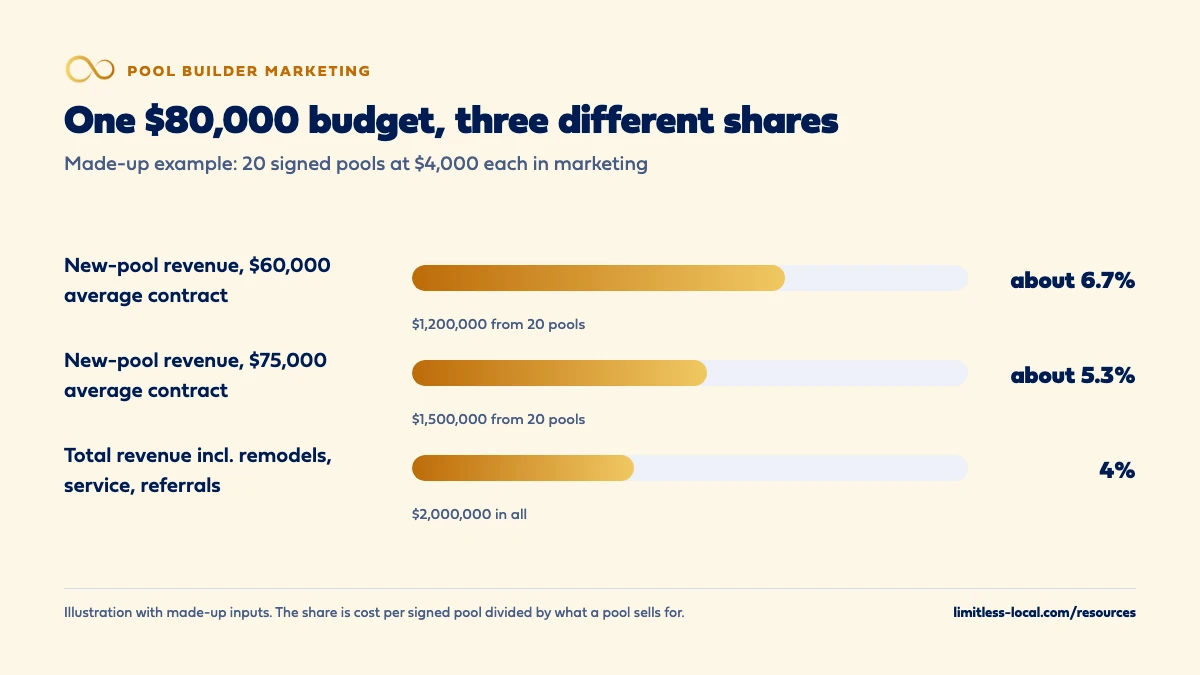
A builder wants 20 new pools from marketing next season. Each pool leaves about $22,000 in gross profit, and the owner decides marketing can take up to $4,000 of that per signed pool. So the year’s marketing can cost up to 20 × $4,000 = $80,000.
Now the percentages, all for the same $80,000:
- Against new-pool revenue at a $75,000 average contract: 20 pools is $1,500,000, so marketing is about 5.3%.
- Against new-pool revenue at a $60,000 average contract: 20 pools is $1,200,000, so marketing is about 6.7%.
- Against total revenue, adding $500,000 of remodels, service and referral work to the $1,500,000: marketing is 4% of $2,000,000.
Same budget, same cost per pool, three different shares. That’s why the contract math sets the budget and the percentage only checks it.
To see how a fee fits inside it: our Essentials package at $3,500 a month plus $2,500 a month in Google Ads spend paid to Google is $6,000 a month, or $72,000 a year. That leaves $8,000 of the $80,000 for photos, a home show or software. Whether those 20 pools actually sign comes down to close rate and follow-up, not the percentage.
Frequently asked questions
Should I use last year's revenue or this year's target?
This year’s target for new contracts. Last year’s revenue tells you what the business could afford before; the target tells you what the marketing has to buy now.
Is it a problem if my share is higher than another builder's?
Not by itself. Their contracts, margins, close rate and referral mix are different from yours. Compare your cost per signed pool against your own ceiling instead.
Does agency pricing as a percentage of ad spend change the math?
No. However a fee is priced, add it to the year’s marketing total. Our fees are flat and public, which makes them easy to put into the share.
Should I lower the share when the calendar is full?
Lower the ad spend for the months you can’t build in, but keep the profile, reviews, website and a light pipeline running. Next season’s contracts start this season.
Can a pool builder spend too little as a share of revenue?
Yes, when the consultation calendar has gaps in peak season or you sign fewer pools than your crews can build. A low share that leaves crews idle is expensive.
How do I count a contract that signs next year from this year's marketing?
Count it against the season it was signed for, using the lead source recorded when the homeowner first called. That’s why the source gets recorded on the very first call.
Key takeaways
- Set the budget from signed pools, then use the percentage as a check.
- Your share equals cost per signed pool divided by your average contract price.
- Base it on the new-contract revenue you need marketing to bring in, using this year’s target.
- Growth years, new towns and thin margins push the share up; better close rates pull it down.
- Stop where crew and sales capacity stop, and revisit the share quarterly.
Ready to compare options?
Book a short growth call and we'll walk through the math for your service area, including when we're not the right fit.
More in this section
- How should a pool builder split its marketing budget?
- How much should a pool builder spend on marketing?
- When should a pool builder raise its monthly marketing budget?
- Which marketing tasks should a pool builder do in-house?
- What should a pool builder expect in the first 90 days of marketing?
Sources
- How to Get the Most From Your Marketing Budget — U.S. Small Business Administration
- What is the average marketing budget for a small business? — BDC (Business Development Bank of Canada)
- About average daily budgets — Google Ads Help