
What share of plumbing marketing budget goes to fast leads?

- How much of a plumbing budget should go to ads and LSAs versus SEO?
- Which plumbing marketing channels count as fast leads?
- Why does the fast-lead share usually start high?
- What decides my starting split?
- When should the fast-lead share go up?
- When should the fast-lead share come down?
- How should the split change once SEO starts booking jobs?
- How do Local Services Ads budgets fit into the split?
- What should never get cut to feed the fast side?
- Where does an agency or management fee fit in the split?
- How do I know if my split is right?
- What if I can only afford one fast channel right now?
- What's different about the split for plumbing companies
- A worked example: how one plumbing shop's split might shift
- Frequently asked questions
- Key takeaways
- More in this section
- Sources
The short version
- Fast-lead channels (Google Ads, LSAs) usually take the bigger share at first.
- Slow channels (SEO, Google profile, reviews) start early, mostly with time.
- Shift money as each channel proves its cost per booked job.
- Never cut the review ask, the profile or tracking to feed the ads.
For plumbing owners splitting one monthly budget between the channels that ring the phone this week and the ones that build calls for next year.
Get a free visibility audit · Book a growth call
How much of a plumbing budget should go to ads and LSAs versus SEO?
There’s no fixed share, but early on most of a plumbing company’s cash usually goes to fast-lead channels like Google Ads and Local Services Ads, because they’re the only ones that can book jobs this month, while SEO, your Google profile and reviews start with more time than money. As the slower channels start booking jobs, the fast-lead share should shrink, or hold flat while the total grows. What moves the split is how full your schedule is, how strong your reviews and profile are, the season, and what each booked job costs you by channel.
That’s how our packages are built, too: both sides of the split in one plan. Essentials is $3,500 a month and covers local SEO, Google Business Profile management, review generation and Google Ads management up to $2,500 a month in ad spend; Growth is $4,500 a month and adds Local Services Ads management and up to $5,000 in Google Ads spend. Ad spend is paid directly to Google and isn’t in either price. See what each package includes, how it works for plumbing companies, or browse the plumbing marketing questions library.
Which plumbing marketing channels count as fast leads?
A fast-lead channel is one you can switch on and get calls from within days. For most plumbers that means two things:
- Google search ads. You pick the searches and towns, and you usually pay per click.
- Local Services Ads. The listings at the top of Google with the Google Verified badge, where you pay per lead instead of per click.
Paid lead sites belong in this group too. They’re fast, but you share the lead and don’t own the customer relationship, so they’re worth judging on their own numbers.
The slow side is everything that builds up over time: SEO and your service pages, your Google Business Profile, and a steady flow of reviews. Referrals and repeat customers sit off to one side. They cost mostly time, not ad dollars, so they barely show up in the split at all.
Why does the fast-lead share usually start high?
Because it’s the only money that can pay you back this month. Ads can generate leads within days of launch. SEO typically takes 3-6 months to show meaningful organic growth. If your phone is quiet, a budget that’s mostly SEO means waiting a season to find out whether it worked, with trucks sitting idle in the meantime.
That doesn’t make the slow side optional. It’s the part that keeps getting cheaper per job the longer it runs, and it’s what lets you cut back on ads later without the phone going quiet. Start it on day one, even if it’s mostly your own time on the Google profile and a review ask at the end of every job.
Combining paid ads, SEO and referrals covers the order to add channels in. This page is about the money: how much goes on each side, and when it moves.
What decides my starting split?
Five things, roughly in this order:
- How empty the schedule is. If techs are waiting on calls, the fast side gets more. If you’re booked out two weeks, it gets less.
- How strong your Google profile and reviews already are. A shop with a full profile and a few years of steady reviews already gets free calls from Maps, so it needs less paid help than a new shop with a handful of reviews.
- The state of your website. If your service pages are thin or missing, more of the slow-side money goes into fixing them, because ads send people there too.
- Cash on hand. SEO money is spent now and paid back later. If cash is tight, the slow side leans on your time instead of your wallet.
- The season. More on that below.
Local results on Google are mainly based on relevance, distance and popularity, according to Google’s tips to improve your local ranking. Reviews and a complete profile feed that directly, which is why owners with strong ones can lean less on paid calls.
When should the fast-lead share go up?
Raise the paid side when there’s room on the schedule and the ads are booking jobs at a cost per job you’re happy with. Common moments:
- A hard freeze is on the way. Burst-pipe calls spike, and paid ads are the fastest way to be in front of them.
- You’ve added a truck or a tech. New capacity needs calls in weeks, not months.
- You lost a map pack spot. Paid can cover the gap while you work out why.
- A slow channel stalled. A website rebuild or a profile problem can drop free calls for a while.
One sign that isn’t enough on its own: Google Ads marking a campaign Limited by budget. Google’s own page says applying the recommended budget will help you increase clicks and impressions. Clicks aren’t jobs. Check cost per booked job first, and only then decide whether more spend makes sense.
When should the fast-lead share come down?
Pull the paid side back when one of these is true:
- The schedule is full. Paying for calls you can’t run in the next few days wastes money and annoys customers.
- Cost per booked job is climbing and stays high for more than a month or two, even after the obvious fixes.
- The slow side is carrying more of the load. If organic calls and Maps calls are up, you may need less paid volume to fill the same schedule.
- Nobody’s answering. If calls ring out or forms sit for hours, cut back on paid calls until the office catches up. Every paid lead nobody calls back is money gone.
Bring it down in steps, not all at once. A paid channel switched off cold takes time to warm back up, and what happens when you stop paying for Google Ads explains why.
Curious what your marketing is actually booking?
Get a free visibility audit — no obligation, no sales pitch.
How should the split change once SEO starts booking jobs?
Slowly, and only when the numbers show it. A workable pattern:
- Hold paid spend flat instead of raising it automatically each month.
- Keep paying for the slow side. The pages and reviews that started working are the reason it’s working; stopping them now gives the gains back.
- Let total booked jobs grow on the same paid budget, which pulls your blended cost per job down.
- Trim paid in small steps once the slow side reliably covers part of the schedule, and watch whether booked jobs hold.
In practice the fast-lead share falls because the slow side grows, not because you slash the ads. That’s the safer direction: you never bet the schedule on a channel that hasn’t proven itself yet.
How do Local Services Ads budgets fit into the split?
LSAs behave a little differently from search ads, which changes how you count them. According to Google’s page on how leads work, you pay for valid leads such as calls and messages, and lead prices may vary depending on your location, the job type, the type of lead and your bidding. You’re paying per contact, not per visitor.
Budgets are changing shape as LSAs move into Google Ads. Google’s transition page says weekly budgets become daily ones, with monthly spend capped at your daily average budget times 30.4, and plumbing is one of the trades in the first phase. If you set your split monthly, as most owners do, divide your monthly LSA amount by 30.4 to get the daily figure.
For the split, count LSA spend on the fast side with your search ads. If you run both, compare their cost per booked job side by side before deciding which one gets the next dollar. How Google Ads and LSA leads compare on quality helps with that call.
What should never get cut to feed the fast side?
Three things that cost little and keep every other dollar working:
- The review ask. A text after every finished job costs almost nothing, and popularity, which reviews feed, is one of the things Google weighs in local results.
- Your Google Business Profile. Accurate hours, real job photos and the right categories. It’s free, and it’s often a big source of calls on its own.
- Call tracking and lead sources. Without them you can’t tell which side of the split booked the work, so every future budget decision is a guess.
When money gets tight, owners tend to protect the ads and drop these. It should be the other way around.

Where does an agency or management fee fit in the split?
Count it separately from the split, or you’ll fool yourself. A management fee usually covers work on both sides: building and watching the ads, and doing the SEO, profile and review work. If you lump the whole fee onto one side, that side looks more expensive than it is.
A simple way to keep it straight is three lines on your monthly sheet: ad spend paid to Google (fast), any paid SEO or website work done outside the fee (slow), and the management fee itself. Judge the split on the first two, and judge the fee on whether total booked jobs and cost per booked job are moving the right way. How much a plumbing company should spend on marketing covers setting the total in the first place.
How do I know if my split is right?
Look at cost per booked job for each channel every month, next to how full the schedule was. If the paid side books jobs cheaply and you still have open slots, it’s probably too small. If it’s booking expensive jobs while organic calls grow, it’s probably too big.
You need to know where each job came from to do this. The SBA’s guide to getting the most from your marketing budget notes that tracking can be as simple as reminding employees to ask new customers where they learned about your business. Call tracking numbers and the lead source field in ServiceTitan, Housecall Pro or Jobber do the same job with less guesswork.
Realistic cost per booked plumbing job by channel walks through the math for each one.
What if I can only afford one fast channel right now?
Fund one paid channel properly rather than two thinly. A small budget split across Google Ads and LSAs often means neither gets enough calls to show you what a booked job costs.
Pick the one that fits your shop: LSAs if your reviews are strong and someone reliably answers the phone, search ads if you want tighter control over which jobs and towns you pay for. Then put the slow side on your own time for now: the review ask, the Google profile and one good page for each of your biggest jobs. Whether to start with LSAs, Google Ads or SEO goes deeper on that choice.
Not sure which of these is costing you jobs?
A free visibility audit checks the Google profile, reviews, site and tracking, and shows what to fix first.
What's different about the split for plumbing companies
Emergencies favor the fast side. A homeowner with water on the floor searches, taps the first plumber who looks trustworthy and calls right away. Paid placements and a strong map listing catch those calls. That’s a big reason plumbing shops tend to keep a steady paid budget even after SEO is working.
Big planned jobs favor the slow side. Water heater replacements, repipes and sewer lines get researched before anyone calls. Good service pages and plenty of reviews win those, often at a lower cost per job than paid clicks, which is why they deserve a protected slice of the budget.
Freezes move the split overnight. A cold snap can flood the phones. Raise paid spend ahead of a forecast freeze, not after the calls have already gone to someone else, and pull it back once the rush passes.
A worked example: how one plumbing shop's split might shift
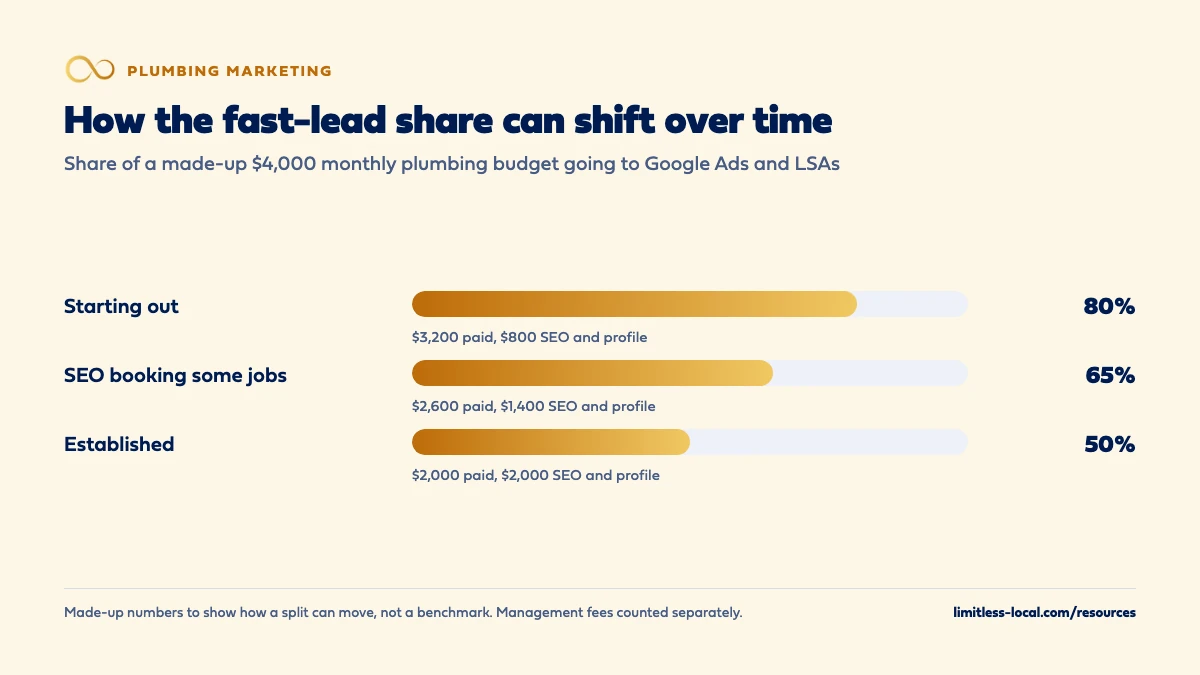
These numbers are made up to show how a split can move, not a target for your shop. Say a plumbing company sets a $4,000 monthly marketing budget, not counting any management fee.
- Starting out (a handful of reviews, thin website): 80% fast, so $3,200 on Google Ads and LSAs and $800 on service pages and the Google profile.
- Once SEO books some jobs: 65% fast, so $2,600 on paid and $1,400 on the slow side. Paid spend went down a little because organic and Maps calls picked up some of the schedule.
- Established (steady reviews, pages that rank): 50% fast, so $2,000 on each side.
The total stayed at $4,000 the whole time. What changed is that more of the booked jobs came from channels that cost less per job, so the same budget filled more of the schedule. If a freeze hits in the established stage, the fast side can jump back up for a few weeks without touching the slow-side work.
Frequently asked questions
Is there an industry-standard split between ads and SEO for plumbers?
No standard that would fit your market and your schedule. Set a starting split from your reviews, website, cash and season, then move it each month based on cost per booked job by channel.
Should I stop SEO in a busy month to put everything into ads?
No. SEO pays back months later, so a pause now shows up as fewer free calls next season. Keep the slow side going and raise the paid side on top if you need more calls.
Do paid lead sites count as fast leads?
Yes, they’re fast, but you’re sharing each lead and building someone else’s platform. Track their cost per booked job alongside Google Ads and LSAs before giving them a bigger slice.
How often should I change my split?
Look monthly and change it in small steps. Moving big chunks every week makes it hard to tell which change did what, and paid campaigns need a steady stretch to settle.
Does a bigger fast-lead share mean more jobs?
Only while there’s room on the schedule and someone answers every call. Past that point, more paid leads just raise your cost per booked job.
Where does my website fit, fast or slow?
Both sides use it. Ads send people to it and SEO depends on it, so fixing a weak website helps the whole budget. Count a rebuild as a one-off cost rather than part of the monthly split.
Key takeaways
- There’s no fixed share; most plumbing shops start with the bigger slice on Google Ads and LSAs.
- Start the slow side on day one, even if it’s mostly your time on reviews and the Google profile.
- Raise the fast side for freezes, new trucks and open schedules; lower it when the schedule is full or cost per job climbs.
- Let the fast-lead share shrink because SEO grows, not because you slash the ads.
- Judge the split on cost per booked job by channel, with management fees counted separately.
Want a second set of eyes on your setup?
We'll look at how you show up locally and where calls are leaking, then send you a plain-English breakdown.
More in this section
- How many plumbing leads before marketing shows booked jobs?
- What percentage of revenue should a plumber spend on marketing?
- How do I turn plumbing marketing spend into more revenue?
- How much budget and time does each plumbing marketing channel need?
- How do I get more plumbing leads?
Sources
- Tips to improve your local ranking on Google — Google Business Profile Help
- Fix “Limited by budget” status — Google Ads Help
- How leads work — Google Local Services Help
- Local Services Ads transition to Performance Max campaigns with pay-per-lead goals — Google Ads Help
- How to Get the Most From Your Marketing Budget — U.S. Small Business Administration